
by NICOLAS ROSENTHAL
 IMAGE/The London School of Economic and Political Science
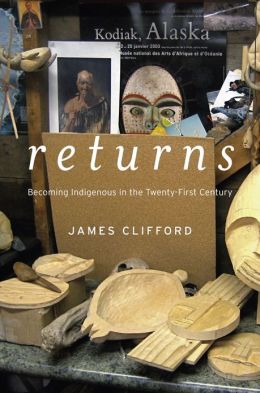
Returns: Becoming Indigenous in the Twenty-First Century by James Clifford (Cambridge: Harvard University Press, 2013. 366 pp. $39.95)
This third volume in a series of works by the prominent theorist, historian, and cultural anthropologist James Clifford holds tremendous potential for both directing scholarship and more widely reshaping the conversation on indigenous peoples throughout the world today. Following the influential The Predicament of Culture: Twentieth-Century Ethnography, Literature, and Art (1988) and Routes: Travel and Translation in the Late Twentieth-Century (1997), Returns addresses the more recent past and the resurgence of “global indigeneity.” It begins with the breakdown of old colonial narratives of progress that presented indigenous people the choice between physical and cultural genocide, but always guaranteed their disappearance. By the early twenty-first century, the supremacy of the West has come into question and the “signs of systemic crisis and transition are everywhere” (p. 5). Against this backdrop, indigenous people have emerged through generations of survival, struggle, and renewal, adapted to modernity and increasingly visible as they move through local, regional, and global networks. To understand these recent changes, Clifford calls for an “ethnographic and historical realism” that eschews both Western triumphalism and savage romanticism in favor of close readings of indigenous experience embedded within shifting global conditions (p. 7). Specifically, Clifford tracks processes of “decolonization, globalization, and indigenous becoming” as they “construct, reinforce, and trouble each other,” focusing on the past few decades (p. 8). At the center of Returns is a willingness to understand history as contingent and open-ended, not only as a refutation of past meta-narratives but also as a way to take seriously an “indigenous longue durée,” or the idea that disruptions of colonization, settler-colonialism, and modernity can be seen as brief moments in much longer histories that are passing on the way to more hopeful futures (p. 42).
Returns is composed of a series of essays that can be read separately or together as a single volume. Part 1 is general and theoretical in scope, introducing the author’s concerns and establishing the book’s analytical framework. Its first essay argues that “indigenous people have emerged from history’s blind spot” and need to be taken seriously as “visible actors in local, national, and global arenas” (p. 13). Indeed, throughout the world, indigenous people have come to challenge the hegemony of both the nation-state and transnational capitalist networks by asserting their presence in global culture and politics, through a diverse set of forums that range from local arts and cultural festivals to the United Nations. The old narratives make no sense when viewing the Zapatista movement in Mexico, Native Hawaiian struggles for sovereignty, or the success of Indian gaming in the United States. Calling for a “historically and politically attuned ethnographic realism” as a model of scholarship, Clifford primarily uses three analytical tools (p. 36). “Articulation” refers to how indigenous peoples assemble an identity made up of a broad range of elements grounded in their influences, encounters, and experiences over time, such as Native Alaskan communities incorporating the trappings and worldview of Russian Orthodoxy. Closely related is “translation,” where indigenous peoples remake their social, cultural, and political influences into something new, like the Zapatistas adapting Marxism to their claims for autonomy. Indigenous identities are put on display through “performance,” or staged heritage displays, cultural tourism, and other forums where indigenous peoples make themselves understandable to their audiences, often with political, economic, or cultural goals in mind. Clifford illustrates these concepts to various degrees in two essays adapted from talks on Native studies in the Pacific World and the limits and possibilities of diaspora studies for indigenous people
H Net for more