
by SALLY BROWN
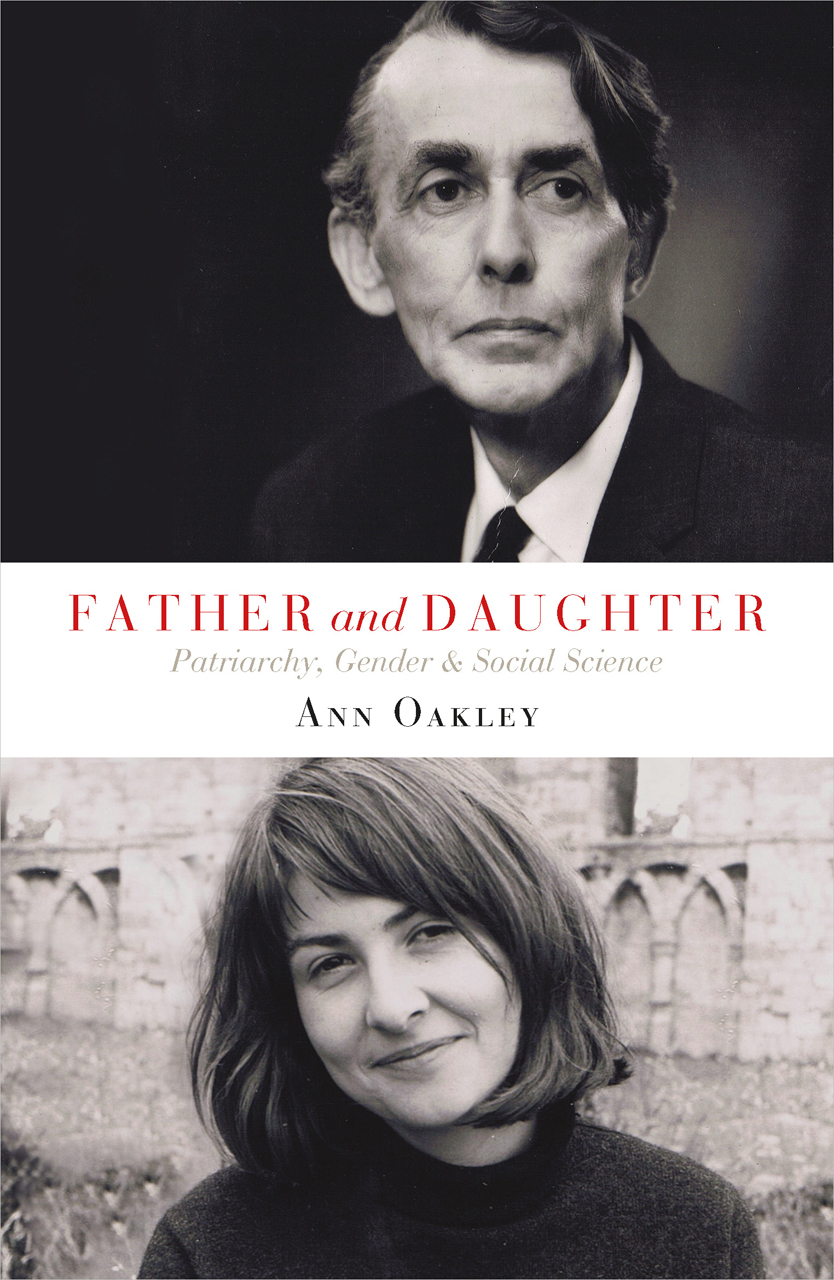
Father and Daughter: Patriarchy, gender and social science. Ann Oakley. Policy Press. 2014.
Find this book:
Father and Daughter, is, according to its author, “this awkward book” (p3); as a combination of biography, autobiography, social history, and social science, it may be awkward but it is certainly compelling. Ann Oakley has written a fascinating and at times alarmingly honest book about her father, Richard Titmuss, but this book is much, much more than a conventional biography. Showing how he became the man he was – “the Professor”, revered by his circle of admirers at LSE – she also explores her own life and how she also became a world famous sociologist, although a very different one to her father. She also illuminates what is sometimes out of sight or hidden in the biographies of “great men”: the toll it takes on those not in the spotlight.
The book begins with a visit to the author’s childhood home, which is being given a blue plaque to honour her father. The Blue Plaque House, as Oakley refers to it throughout, was where her parents lived for the majority of their married life, and where she grew up. It sounds like a cold, austere house, where rather austere meals were served in a somewhat strained atmosphere much of the time. It comes as something of a surprise, then, to read of Brian Abel-Smith telling Ann Oakley that her father “appeared to be madly in love” (p.97) with her whenever he visited the Blue Plaque House. Oakley’s mother Kay, meanwhile, was very much a 1950s housewife, taking on the role of running the home having given up voluntary social work when she married. The frustration and at times despair that she seemed to feel is inescapable as the book proceeds, indeed her depression seems to worsen as she becomes isolated after her husband’s death. Despite all this, Oakley describes how her mother worked hard to construct and maintain the myth of who Richard Titmuss was and where he had come from. A significant amount of the book is constructed from letters and diaries that Kay Titmuss chose not to give to LSE, thus safeguarding “the legend of her husband as a saintly man” (p247). Instead, the papers came to Oakley; she describes at one point how Nigel Nicolson must have agonised over the writing of certain sections of his biography of his parents, Harold Nicolson and Vita Sackville-West, and she too must have had moments when she wondered whether to reveal that in fact the saintly man had skeletons in his cupboard.
One of the most shocking sections of the book is where Oakley describes in candid detail her father’s battles in his early days at LSE with the “difficult womee” – the women who had been running social work courses, led by Eileen Younghusband. Taking on a Chair of Social Administration, created by Titmuss’ predecessor in the department, T H Marshall, so he could concentrate on sociology, Titmuss appears to have set out to take over her projects and thus eject Younghusband from her post. Caught up in the “LSE Affair” and coming off worst were the women who worked with Younghusband; what is shocking about this part of the story is how completely an avowed socialist like Titmuss could disregard women and ensure he was surrounded by men, who were, naturally, paid more and were on more secure contracts. The gender blindness, and the maleness, of sociology, seems astonishing now, but it is largely due to the work of Oakley and others, pioneers in making sociology take notice of gender, that looking back at a relatively recent time when it simply wasn’t mentioned can seem so strange. What is heartwarming, and fascinating, about these central sections of the book, are the stories about the connections that many of the women in the story had, both in terms of academic networks and deep and enduring friendships.
The London School of Economics and Political Science for more