
by VIVEK BALD
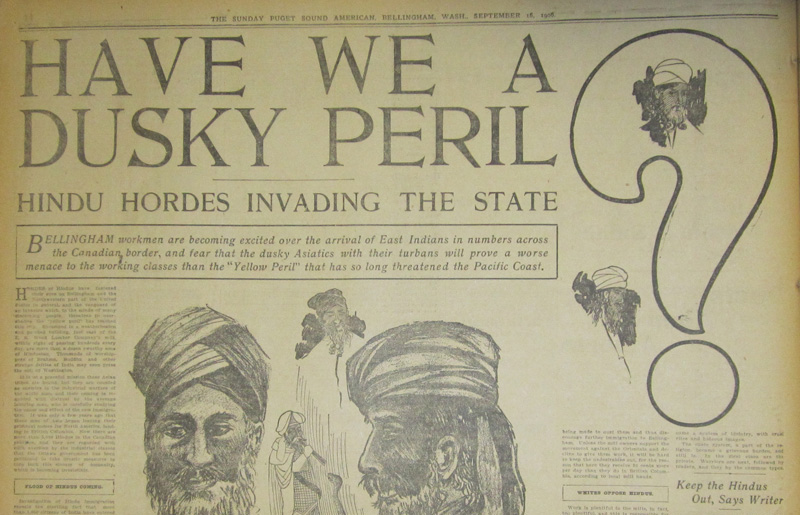 An article from the September 16, 1906 Puget Sound American describing recent “Hindu” immigration to Bellingham, Washington. PHOTO/South Asian American Digital Archive
The contrast was stark. One group of South Asians had become objects of fear and derision and targets of immigration enforcement and extra-legal violence. Another group of South Asians was being heralded for their social, economic, and cultural contributions to the United States. The aftermath of 9/11 had brought into relief a deep set of divisions within the South Asian American community. In some ways, these years called into question the very utility of “South Asian” as an identity marking the common experiences of Americans with roots in Pakistan, India, Bangladesh, Nepal, and Sri Lanka. These were nations that shared colonial histories as different parts of British India and Ceylon, but they were now divided by military, religious, and ethnic conflicts on the subcontinent, and their diasporic communities had significantly different levels of power, income, and influence in the United States.
…
Fear and Exclusion
On an early September night in 1907, fifteen hundred white lumber mill workers set off on a rampage against Indian immigrants in the coastal town of Bellingham, Washington. The Indians, also mill workers, were predominantly from Punjab; most were turbaned Sikh men. The rioters saw the Indians as aliens, outsiders, and racial inferiors who were taking away American jobs, jobs that should go to white men. As they made their way across Bellingham, the mob, according to historian Joan Jensen,
swept down to the waterfront . . . where many of the Indians lived. Battering down the doors, the mob . . . pocketed money and jewelry, and dragged Indians from their beds . . . Those who did not move fast enough were beaten . . . Fifty men stormed the surrounding mills, pulled Indians from their bunks and began to burn the bunkhouses.
By the end of the night, two hundred Indian men, beaten and bruised, had been rounded up like cattle into Bellingham’s City Hall. Over the next days, most of the Indians chose to leave Bellingham, and the United States, in search of work in British Columbia. Local white residents cheered as their train rolled out of the station.
Dissent for more
via 3 Quarks Daily