
Tahira Mazhar Ali – Torchbearer for a progressive politics
by BEENA SARWAR
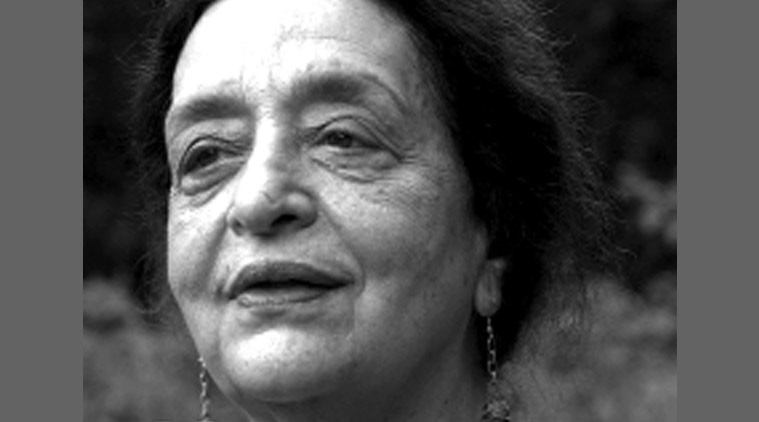
One of my enduring memories of the formidable Tahira Mazhar Ali, or Tahira apa as I called her, is from December 1992. As a young journalist in Lahore, I watched her on a raised platform in Mozang Chungi, holding forth in Punjabi before a sea of rapt faces, the crowd estimated at over 3,000. Jet-black hair pulled back in her habitual bun, a tall, confident figure, she spoke boldly against the government’s plans to insert a religion column in the Pakistan national identity card, required for all citizens above 18 years of age.
In 1984, General Zia-ul-Haq’s illegitimate military regime had inserted a religion column in Pakistani passports, a Saudi-inspired move aimed at preventing the country’s beleaguered Ahmadi community (officially termed as non-Muslims after a constitutional amendment in 1974) from going on pilgrimage to Mecca. In 1992, an elected government was trying to further this apartheid. Tahira apa and her husband, the respected journalist Mazhar Ali Khan, were part of the movement against this move. The people prevailed. The discriminatory proposal was shelved.
…
She talked about that meeting in a 2007 interview for a book I was working on. Speaking in her no-nonsense, rapid-fire way, she recalled bicycling over to Mamdot Villa on Habibullah Road where Jinnah was staying. “I told him, Mr Jinnah this is a resolution passed by the Communist Party and I was asked to give it to you because they have agreed that if the Muslims want a separate homeland they should have it.”
“‘Have they come to their senses?’ he asked. Then: ‘You’re not with us. I hear you’re with the Congress.’
“I said, ‘Yes, very much so Mr Jinnah, because the Congress talks to the whole of India but you only talk to the Muslims, so I am with the Congress.’
“I was very young and talking back. But he said to me, ‘But why are you worried? All your friends will come and meet you here from Amritsar and Jalandhar and Bombay and India and you can go there when you want to, as I will be going to Bombay every year.’
“So I think Mr Jinnah had a different vision of how Pakistan would be made. I don’t think he could cope with his ill health and he was also in a hurry, like Mountbatten. He was going to die (of tuberculosis). His physician was a Hindu who promised him he would never let this secret come out, so this secret never came out. If it had, things might have been different.”
The Indian Express for more
Tahira Mazhar Ali Khan, 1925-2015
by JUGNU MOHSIN
When her husband, the journalist and lifelong activist Mazhar Ali Khan, died in January 1993, there was a deluge of glowing obits, both here and abroad. In life as in death, Tahira Mazhar Ali Khan is no less cherished, and for me as for many others, she was a beacon of inspiration, a pillar of strength and a bastion of hope.
She, along with my aunt, the late and much-missed Kishwar Abid Hussain, stirred me to political activism, encouraged me to decide my own fate, and supported me through an early and amply rewarded struggle. They were my partisans in my battle to marry a man of my own choice in the face of family disapproval. I was 23, the man was Najam Sethi and this was more than 30 years ago.
Born in 1925 to Sir Sikander Hyat Khan, later premier of Punjab and leading Unionist politician, Tahira grew up to be a stunning young woman, schooled at Queen Mary’s College in Lahore and drawn to revolt while still in her teens. She eloped with her charismatic, student leader cousin Mazhar when she was 17. Their marriage went on to become a fabled partnership.
Tahira spoke to me of this legendary union, when Mazhar Ali Khan died. This is her story once again:
“Mazhar was born with the Revolution in 1917. His father, Nawab Muzaffar Khan, was my father’s cousin. Our family lived in Wah, the elders thought the tribe came to India from Ghazni with Sultan Mahmud. They also believed that Jehangir stopped by the springs on their land en route to Kashmir and exclaimed, ‘Wah!’ We were brought up in Lahore, we were a large brood, ten children off three mothers. Abaji (Sir Sikander) was very keen that we be constructively employed in after-school hours. He encouraged an interest in the arts and culture. I went to Queen Mary’s College with my sisters and had a passion for sport. We spent the weekends at our family home in Lahore where the other cousins also gathered. Mazhar was 8 years older than me. I must have been 14 or 15 when I first noticed him. He was tall and quiet. He was already a well-known debater and student leader. I remember I tried several antics to attract his attention. He ignored me. I think he began to notice me a year or so later.
Friday Times for more
(Thanks to Harsh Kapoor, Robin Khundkar, & Asad Zaidi)