
by JOHN GRAY
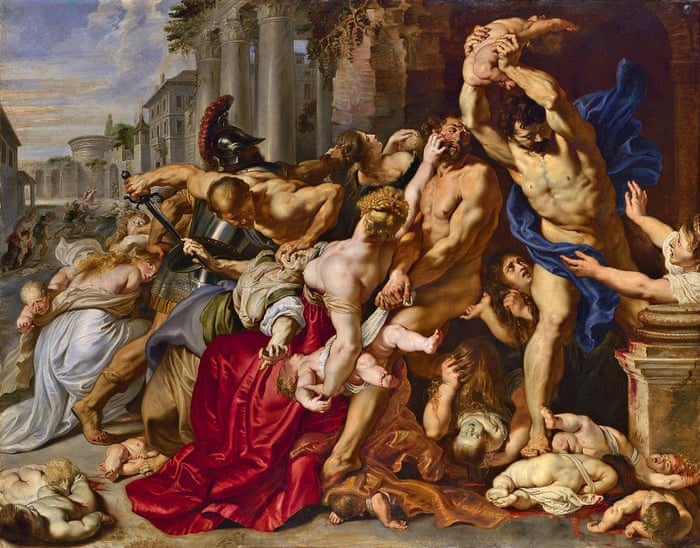 Peter Paul Rubens depicting the episode of the biblical Massacre of the Innocents of Bethlehem, as related in the Gospel of Matthew, Ch.2, vs.13-18, created in 1611-1612. PHOTO/National Gallery, London
A new orthodoxy, led by Pinker, holds that war and violence in the developed world are declining. The stats are misleading, argues Gray – and the idea of moral progress is wishful thinking and plain wrong
For an influential group of advanced thinkers, violence is a type of backwardness. In the most modern parts of the world, these thinkers tell us, war has practically disappeared. The world’s great powers are neither internally divided nor inclined to go to war with one another, and with the spread of democracy, the increase of wealth and the diffusion of enlightened values these states preside over an era of improvement the like of which has never been known. For those who lived through it, the last century may have seemed peculiarly violent, but that, it is argued, is mere subjective experience and not much more than anecdote. Scientifically assessed, the number of those killed in violent conflicts was steadily dropping. The numbers are still falling, and there is reason to think they will fall further. A shift is under way, not strictly inevitable but enormously powerful. After millennia of slaughter, humankind is entering the Long Peace.
…
Pinker was not the first to promote this new orthodoxy. Co-authoring an article with Pinker in the New York Times (“War Really Is Going Out of Style”), the scholar of international relations Joshua L Goldstein presented a similar view in Winning the War on War: the Decline of Armed Conflict Worldwide (2011). Earlier, the political scientist John E Mueller (whose work Pinker and Goldstein reference) argued in Retreat from Doomsday: The Obsolescence of Major War (1989) that the institution of war was disappearing, with the civil wars of recent times being more like conflicts among criminal gangs. Pronounced in the summer of 1989 when liberal democracy seemed to be triumphant, Francis Fukuyama’s declaration of “the end of history” – the disappearance of large-scale violent conflict between rival political systems – was a version of the same message.
…
Like many others today, Pinker’s response when confronted with such evidence is to define the dark side of the Enlightenment out of existence. How could a philosophy of reason and toleration be implicated in mass murder? The cause can only be the sinister influence of counter-Enlightenment ideas. Discussing the “Hemoclysm” – the tide of 20th-century mass murder in which he includes the Holocaust – Pinker writes: “There was a common denominator of counter-Enlightenment utopianism behind the ideologies of nazism and communism.” You would never know, from reading Pinker, that Nazi “scientific racism” was based in theories whose intellectual pedigree goes back to Enlightenment thinkers such as the prominent Victorian psychologist and eugenicist Francis Galton. Such links between Enlightenment thinking and 20th-century barbarism are, for Pinker, merely aberrations, distortions of a pristine teaching that is innocent of any crime: the atrocities that have been carried out in its name come from misinterpreting the true gospel, or its corruption by alien influences. The childish simplicity of this way of thinking is reminiscent of Christians who ask how a religion of love could possibly be involved in the Inquisition. In each case it is pointless to argue the point, since what is at stake is an article of faith.
The Guardian for more