
The Myth of he Hindu Holy Cow
by Yoginder Sikand
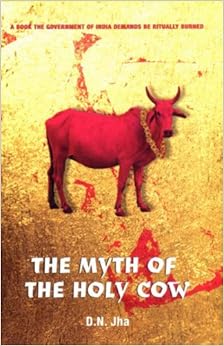 IMAGE/Amazon
‘The central fact of Hinduism,’ wrote MK Gandhi, ‘is cow protection’. Gandhi was not alone in making such a claim. Like him, most Hindu ideologues insist on the centrality of the cow to Hinduism. For them, the cow is not just a four-legged beast but, rather, the goddess Gau Mata, or even, for some, the repository of all the millions of Hindu deities. Worship of the cow, so it is argued, is a cardinal principal of Hinduism, along with vegetarianism. The supposed holiness of the cow and the Hindu ban on beef-eating, Hindu ideologues claim, go back all the way to the period of the Vedic Aryans. The belief in the sanctity of the cow is routinely marshaled by right-wing Hindus as a symbol to distinguish Hindus from others, particularly Muslims, who are treated with disdain on account of their supposed penchant for beef and their alleged constant readiness to slaughter ‘the mother cow’. In this way, the myth of the holy cow serves as a powerful tool to create and consolidate a powerful sense of Hindu communal identity transcending caste-class divides, which is premised on relentless hostility to the beef-eating Muslim ‘other’.
Not surprisingly, then, Indian history is littered with the memory of scores of deadly communal riots between Muslims and Hindus in the name protecting the cow and its alleged sanctity, in which thousands of people have lost their precious lives. Numerous ‘upper’ caste Hindu revivalists, from the medieval period onwards, sought to stir up Hindu sentiment against Muslims in the name of ‘protecting Brahmins and cows’. Reflecting Hindu pro-cow sentiment, the Indian Constitution made it incumbent on the Indian state to ‘take steps for…prohibiting the slaughter of cows and calves’, a demand which right-wing Hindu parties keep raising from time to time, especially when elections are just round the corner, this being a potent vote-catching gimmick.
…
Jha provides ample evidence to back his claim. The Rig Veda frequently refers to cooking of ox meat to offer the gods, especially the supposedly greatest of them all, Indra, who is invoked as the destroyer of the forts of the enemies of the invading Aryans—the autochthonous Indian people. The Rig Veda has Indra as announcing, ‘They cook for me 15 plus 20 oxen’, while elsewhere in the same book he is said to have eaten the flesh of a bull flesh or a hundred buffaloes. Similarly, the Rig Veda depicts Agni, second in importance to Indra among the Aryan gods, as roasting a thousand buffaloes, and he is described as ‘one whose food is the ox and the barren cow’. A third key Rig Vedic god, Soma, is also recorded as also requiring bloody sacrifice of animals, including cattle.
The later Vedic texts, Jha adds, provide further details of these gory animal sacrifices that formed the core of the Aryan tribal religion, convincingly proving that non-vegetarianism, venerating the cow and proscribing the eating of beef were wholly alien to the formative period of what is today called ‘Hinduism’. These animal sacrifices, geared to providing Brahmins with an enormous and free supply of meat, were devised by the priests in such a way as to convince those who performed them that this was a means to please the blood-thirsty Aryan gods. Thus, the texts speak of different types of cows to be sacrificed to different gods, each god supposedly having his own favourite sort: a bull is to be sacrificed to Indra, a dappled cow to the Maruts, a copper-colored cow to the Asvins, and so on. In most public sacrifices (such as the asvamedha, gomedha, rajasuya and vajapeya), the flesh of animals, especially the cow, ox and bull, was required, so the scriptures laid down. The agnyadheya sacrifice required a cow to be killed and the priest to put four dishfuls of rice on the hide of a bull. In the asvamedha, the most important Vedic sacrifice, more than 600 animals and birds were killed, and this display of gore ended with sacrifice of 21 sterile cows. The gavamayana sacrifice involved the sacrifice of three barren cows offered to Mitravaruna and other deities, while in the grhamedha, a lavish feast, an unspecified number of cows were killed. The gosava or sacrifice of a cow was also an important component of the rajasuya and vajapeya sacrifices and the agnistoma ritual. An element in the pancasaradiyasava ritual was the immolation of seventeen dwarf heifers aged under three years. In the sulagava sacrifice, an ox was killed to please Rudra, its tail and skin thrown into the fire and its blood poured on the grass for the snakes.
Yahoo for more
One man’s beef…
by PANKAJ MISHRA
Shortly before he died, at the age of 101, the Anglo-Bengali scholar and polemicist Nirad Chaudhuri received the leader of the Hindu nationalist BJP party, LK Advani, at his home in Oxford. The Hindu nationalists, who recently presided in Gujarat over India’s worst-ever anti-Muslim pogrom, had been pleased by some of Chaudhuri’s offhand denunciations of the medieval Muslim invaders of India.
They probably hoped that India’s most distinguished intellectual exile would do more for their fascistic cause, but they hadn’t fully reckoned with Chaudhuri, who interrogated Advani about his knowledge of India. He was still full of scorn when I saw him weeks later. “These wretched BJP types,” he told me, “they call themselves cultural nationalists, speak of an ancient Hindu ethos, yet do not know Sanskrit, know nothing of their own history. Such barbarous people!”
The sayings and beliefs of religious fundamentalists are often taken at face value. As fervent believers, they seem not to have any truck with rational politics. But it is important to realise how pathetically little they know about the religious and spiritual traditions that supposedly inform their political beliefs; and how the superior morality they noisily lay claim to is important to them only so far as it can give legitimacy to resolutely unspiritual ambitions to capture state power in their native countries. This marks most of the fundamentalists as inescapably modern: people quite like us.
The middle-class Hindu nationalists of India are no different. Their agenda – a militaristic nation-state with a culturally homogeneous population of Hindus – resembles not so much anything in the Bhagavad-Gita as it does the nation- and empire-building projects of 19th-century Europe.
They redefine many of their preferred aspects of Indian tradition and culture, and present them as eternal and immutable, interrupted only by alien Muslims and other unclean foreigners. They fear the kind of scholarship that reveals that Indian tradition, like all other traditions, is a man-made thing, vulnerable to endless change, revision, and appropriation.
The Guardian for more