
by PAM ALLEN
In a recent Tempo article, Goenawan Mohamad described 1965 as ‘a kind of code … for a catastrophic occurrence – and because of this, always simplified.’ He went on to observe that 2012 seemed to be a year of remembering, or imagining, 1965.
One of the most significant manifestations of that remembering was the special September 2012 edition of Tempo that featured interviews with people who had taken part in murdering communists or suspected communists in 1965-1966. In response to this and to the government-appointed Human Rights Commission report on the conduct of the killings, young people in particular have expressed their shock at discovering an aspect of Indonesia’s past of which they had no previous knowledge.
A similar broadening of the discourse on 1965 can be seen in works of fiction reimagining the events of 1965–1966. Such fiction was formerly the domain of authors who had personally lived through the events, such as Umar Kayam and Ahmad Tohari. Now, however, stories on this theme are fictional recollections of an imagined past.
The phenomenon of imagining 1965, alluded to by Goenawan Mohamad, has resulted in a flurry of creative output – fiction, theatre, film – over the last 18 months. Examples include the novels Cerita Cinta Enrico by Ayu Utami (2012), Amba by Laksmi Pamuntjak (2012), Candik Ala 1965 by Tinuk Yampolsky (2011) and Ayu Manda by I Made Darmawan (2010).
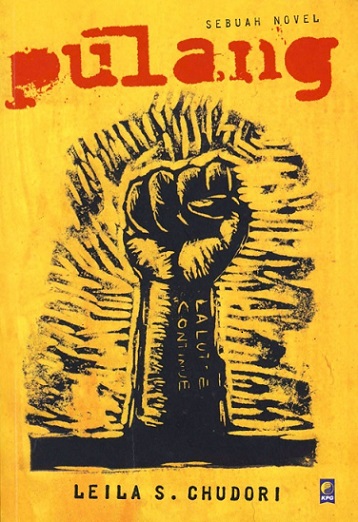
Chudori’s Pulang
A very important contribution to this literary phenomenon was the publication in December 2012 of Leila Chudori’s novel Pulang (Going Home). Greeted with much acclaim by literary critics in Indonesia, this is Chudori’s antidote to the ‘official history of 1965’, which was her diet as a school student growing up under the Suharto regime.
Like many Indonesians too young to remember the events of 1965, but kept in the dark about them, Chudori sought answers about what she calls the ‘black hole’ of Indonesian history. Because history books did not provide the answers, and because her parents’ generation would not speak of the events, she sought to explore and imagine the answers through creative writing – in her case, a novel drawing on years of meticulous research based on real-life characters.
Inside Indonesia for more