
by EMMA BROCKES
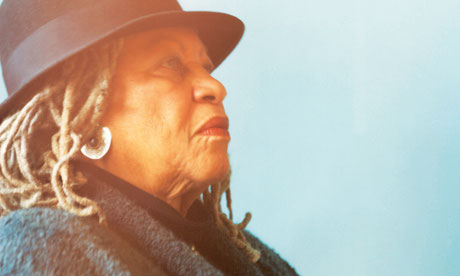 Author Toni Morrison: “At 81, I don’t feel guilty about anything.” PHOTO/Caroll Taveras/The Guardian
I first met Toni Morrison about 15 years ago, to talk about her seventh novel, Paradise, an encounter I remember largely for its number of terrifying pauses. Morrison, in her late 60s then, was at the height of her powers, a Nobel laureate with a famously low tolerance for journalists and critics, and a personal style as distinctive as her prose: silver dreadlocks, sharp, unwavering eye contact and a manner of speech – when she did speak – that, to her annoyance, people were wont to call poetry.
…

Her latest novel, Home, is set in the aftermath of the Korean war and coincides with that sentimentalised period of American history that Morrison remembers rather differently. “I was trying to take the scab off the 50s, the general idea of it as very comfortable, happy, nostalgic. Mad Men. Oh, please. There was a horrible war you didn’t call a war where 58,000 people died. There was McCarthy.”
…
She felt this very strongly when she sat down to write The Bluest Eye. She would not, she decided, try to “explain” black life to a white audience. She would not write from the position of outsider to her own experience. She took issue with, for example, the title of Ralph Ellison’s famous novel, Invisible Man; as she told the New Yorker in 2003, “Invisible to whom? Not to me.”
She wanted to write from within. It was the era of “black is beautiful”; everywhere she looked in New York, the black power movement was promoting that slogan. It struck her both as true – “of course” – and at the same time, ahistorical and reactive. “All the books that were being published by African-American guys were saying ‘screw whitey’, or some variation of that. Not the scholars but the pop books. And the other thing they said was, ‘You have to confront the oppressor.’ I understand that. But you don’t have to look at the world through his eyes. I’m not a stereotype; I’m not somebody else’s version of who I am. And so when people said at that time black is beautiful – yeah? Of course. Who said it wasn’t? So I was trying to say, in The Bluest Eye, wait a minute. Guys. There was a time when black wasn’t beautiful. And you hurt.”
The Guardian for more
(Thanks to reader)