
by ASHLEY SMITH
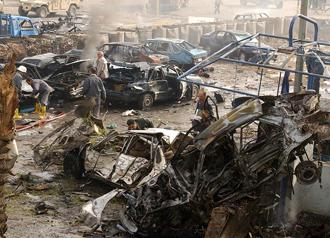 Wreckage left behind after a car bombing in Baghdad PHOTO/James Gordon
Prime Minster Nuri al-Maliki arrived in Washington, D.C., for a summit meeting with Barack Obama on November 1, his country teetered on the precipice of a new sectarian civil war. Iraq Body Count reports that an average of 70 bombings and shootings each month have killed more than 7,000 civilians and wounded thousands more in 2013.
The wave of violence has forced even more Iraqis to flee their homes, adding to the 4 million displaced during the Sunni-Shia civil war that reached its height between 2006 and 2008.
As the New York Times reports, Baghdad is again being torn apart by sectarian attacks:
“The drastic surge in violence–mainly car bombs planted by al-Qaeda’s Iraq affiliate against the Shiite majority, and the security sweeps in majority Sunni neighborhoods that follow–has lent a new sense of Balkanization to this city. Security forces have increasingly restricted the movements of Iraqis in and out of Sunni areas, relying on the neighborhoods listed on residence cards as an indicator of sect. Sunnis also fear reprisals from reconstituted Shiite militias, groups once responsible for some of the worst of the sectarian carnage that gripped Iraq just a few years ago.”
The sectarian polarization throughout the Middle East, including in Syria, has spilled over into Iraq and exacerbated the country’s slide back toward another civil war. Thus, Martin Kobler, the UN’s special representative for Iraq until earlier this year, states that the “battlefields of Iraq and Syria are merging.”
The same powers backing sectarian forces in Syria are doing the same in Iraq. According to the Economist, “Shia Iran and Sunni Saudi Arabia fund some of the most militant groups. Iraqi officials say that Turkey and other Gulf countries, including Qatar, are involved, too.”
As a result, says the International Crisis Group’s Joost Hiltermann, Iraq is “a house of cards” on the verge of collapse. He continued, “It is a contraption held together solely by the reluctance of many of its components to let things again come to blows, and which survives on constant infusions of cash thanks to high international oil prices.”
The Myth of Eternal Sectarianism
In the run-up to Maliki’s visit to Washington this month, the corporate media provided their usual explanation for the sectarian violence in Iraq–the supposedly “ancient” conflict between Sunni and Shia in the Muslim world. New York Times columnist David Brooks quoted policy analyst Anthony Cordesman claiming that, “[T]he upheavals in the Islamic and Arab world have become a clash within a civilization, rather than a clash between civilizations.”
In reality, this is a self-serving myth. The U.S. is the principal culprit behind the explosion of sectarianism in Iraq and the region. As Nir Rosen, the author of Aftermath: Following the Bloodshed of America’s Wars in the Muslim World, writes:
While there was never perfect harmony, there was also no history of civil war between Sunnis and Shiites until the American invasion of Iraq, nor anything reassembling the international mobilization of sectarianism through media and statements of politicians and clerics. But since the American occupation of Iraq created a bloody civil war, relations between Sunnis and Shiites in the region have deteriorated to the point where if you meet a stranger, the first thing you want to find out if he is Sunni or Shiite.
The Bush administration went to war in Iraq 10 years ago to seize control of the country and impose a client regime. The Bush team wanted to replace Saddam Hussein’s state capitalist regime and its nationalized oil industry with a neoliberal one that would open up the economy to multinational oil companies.
According to the “Bush Doctrine,” the invasion of Iraq was to be the first of a series of regime changes that would reach Syria and Iran, too. With the region and its energy reserves under its hegemony, the U.S. could blackmail the rest of the world’s powers, especially its rising rival China, which depends on the area for its oil and natural gas imports.
While Iraqis were happy to have Saddam Hussein toppled, the Shia and Sunni communities did not welcome the U.S. as a liberator. Only the Kurds in the North were pleased to greet the Americans. Bush alienated the Sunni ruling class and masses by criminalizing membership in Hussein’s Baath Party–which to many people was merely a requirement for employment, not a statement of political sympathy. This project drive parts of the Sunni population toward the armed resistance.
Bush similarly drove the Shia establishment and masses into opposition when he delayed elections and declared that the U.S. would rule Iraq through the Coalition Provisional Authority. He feared that Shia parties would win any early contest and align the country with Iran.
Socialist Worker for more