
by CLAIRE MESSUD
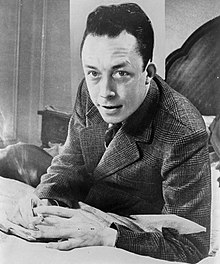 French author/philosopher Albert Camus (1913-1960) PHOTO/New York World-Telegram and the Sun Newspaper Photograph Collection, 1957/Wikipedia
Algerian Chronicles by Albert Camus, edited and with an introduction by Alice Kaplan, and translated from the French by Arthur Goldhammer (Belknap Press/Harvard University Press, 224 pp., $21.95)
“What a misfortune is the one of a man without a city.” “Oh make it so that I will not be without a city,” the choir said [in Medea]. I am without a city. Albert Camus, Notebooks, 1951–1959
…
Last year, on July 5, 2012, Algeria celebrated fifty years of independence from France. When Albert Camus perished in a car accident near Sens on January 4, 1960, at the age of forty-six, two and a half years before the Évian Accords that ended the war, he had become a figure of contempt and scorn for both the left and the right, seen as simultaneously naive and dogmatic in his persistent hope for a moderate Algerian solution. As late as 1958, Camus wrote that his aim was to “achieve the only acceptable future: a future in which France, wholeheartedly embracing its tradition of liberty, does justice to all the communities of Algeria without discrimination in favor of one or another.”
November 7 of this year marks Camus’s centenary. The artist and essayist—the author of L’Étranger (1942) and L’Homme révolté (1951)—has consistently held the reading public’s admiration and imagination. But his attitudes on the Algerian question—excoriated by his contemporaries on all sides, and subsequently by critics as diverse as Conor Cruise O’Brien and Edward Said—remain controversial.
…
The recent publication, for the first time in English, of Camus’s Algerian Chronicles, edited and introduced by Alice Kaplan and beautifully translated by Arthur Goldhammer, affords Camus the belated opportunity to make his own case to the Anglophone public. This book, in slightly different form, proved his final public word on the Algerian question when it was originally published in June 1958. Ending two and a half years of public silence that followed his failed call for a civilian truce in Algiers in January 1956—a silence that became, according to Kaplan, “a metonymy for cowardice” but that my relatives would have recognized as agony—Algerian Chronicles was published in France in 1958 to “widespread critical silence.”
The lack of interest that greeted the book can be attributed in part to its publication fast upon the heels of Henri Alleg’s The Question, the vivid and disturbing autobiographical account of the author’s torture in the Barberousse prison in Algiers, an immediate best seller subsequently suppressed by the French authorities. This book, and the debates that arose from it, greatly affected French public opinion on the war; and it was, thereafter, impossible to ignore the facts about the French military’s use of torture.
The Question was followed, a year later, by The Gangrene, the accounts of seven young Algerian intellectuals and students tortured by French authorities in Paris. This book, like Alleg’s, was rapidly suppressed in France, and was translated into English by Robert Silvers, the editor of this journal. As the American publisher Lyle Stuart wrote in his introduction to the US edition:
The tortures described in this book didn’t take place on a lonely country road three miles from a primitive village…. They happened in the heart of Paris, France. They happened eight months after General Charles de Gaulle assumed power…less than three hundred yards from the Elysée Palace.
The New York Review of Books for more