
by WANGUI KIMARI
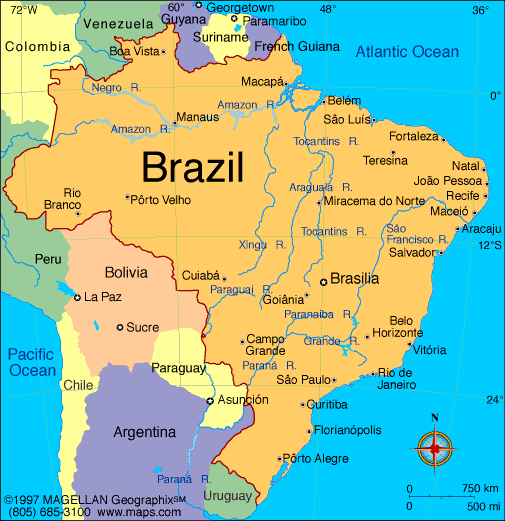 Map of Brazil, a country in South America. SOURCE/Info Please
“React or be Dead” is a campaign initiated by many Black communities and movements in Salvador, Bahia, and that has been taken up nationally, with the objective of organizing to fight against the police brutality, prison industrial complex and genocidal state of affairs in their communities. Essentially, these communities are asserting their right to survive and live free of state violence and its machineries such as the police, paid death squads, militias and extermination groups that seek to defend the status quo.
This campaign began in 2005 in an environment of unrelenting domination by the same political groupings that for decades control finances, means of production and also inevitably the systems of (in) justice and communication that predictably have racism as a key ingredient of this power — an important instrument of which is the penal system. The deaths of thousands of Black youth nationally, whether by violent action or inaction, confirm this politics of genocide by those in political control.
These murders were more than enough to provoke the campaign “React or be Dead” which began as an articulation of Afro-Brazilian community and social movements in the struggle to politicize these deaths; an organizing that builds upon resistance by Afrikans in Brazil. Nonetheless, these homicides have not ceased in the 8 years since the inception of the campaign in 2005, and in fact have increased even in spite of the activism of the Black movement in both national and international spheres; an activism that has seen them deliver reports and demands to both the United Nations and the Organization of America States. In contrast, homicides in Brazil are more than those in Iraq, a country that is at/in a “war” provoked by violent imperialist occupation. In light of this situation, it is not a stretch to declare that many Black communities in Brazil are living in a state of siege.
…
While the life expectancy of Afro-Brazilians is lower than other groups, and homicides are the principal cause of death for Black males between the ages of 15 and 29 years and who, often, live in poor urban settlements, it is important that the discontent with this state of affairs is shown in the streets. Furthermore, even the Ministry of Health documented in 2010 that over 53.3% of the roughly fifty thousand homicide deaths in Brazil are youths and from these 76.6% are Black Brazilians and 91.3% are young men. This is coupled with poverty and lack of access to services such as health care and education — all wide spread manifestations of the white supremacy that is pervasive in the lives Black Brazil and which mark Afro Brazilians as “enemies to be combatted” by the Police and injustice systems.
This is indeed a genocide.
Counterpunch for more