
by JENNY CHAN, NGAI PUN, and MARK SELDEN
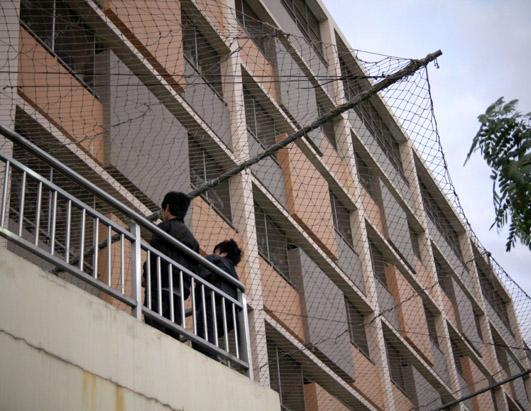 “Suicide Prevention Nets” lined the dormitories on Foxconn’s Shenzhen Longhua campus. These nets were erected on every building during the spring of 2010 in response to a spate of employee suicides. PHOTO/Karson Yiu/ABC News
Abstract
Apple’s commercial triumph rests in part on the outsourcing of its consumer electronics production to Asia. Drawing on extensive fieldwork at China’s leading exporter—the Taiwanese-owned Foxconn—the power dynamics of the buyer-driven supply chain are analysed in the context of the national terrains that mediate or even accentuate global pressures. Power asymmetries assure the dominance of Apple in price setting and the timing of product delivery, resulting in intense pressures and illegal overtime for workers. Responding to the high-pressure production regime, the young generation of Chinese rural migrant workers engages in a crescendo of individual and collective struggles to define their rights and defend their dignity in the face of combined corporate and state power.
Introduction
The magnitude of Apple’s commercial success is paralleled by, and based upon, the scale of production in its supply chain factories, the most important of them located in Asia (Apple, 2012a: 7). As the principal manufacturer of products and components for Apple, Taiwanese company Foxconni currently employs 1.4 million workers in China alone. Arguably, then, just as Apple has achieved a globally dominant position, described as ‘the world’s most valuable brand’ (Brand Finance Global 500, 2013), so too have the fortunes of Foxconn been entwined with Apple’s success, facilitating Foxconn’s rise to become the world’s largest electronics contractor (Dinges, 2010). This article explores the contradictions between capital and labour in the context of the global production chains of the consumer electronics industry. Drawing on concepts from the Global Commodity Chains and Global Value Chains framework (Gereffi and Korzeniewicz, 1994; Bair, 2005; Gereffi et?al., 2005), the article analyses the power dynamics of the buyer-driven supply chain and the national terrains that mediate or even accentuate global pressures.
The principal focus is on labour in the electronics supply chain, including working conditions and labour as agency, consistent with recent studies of labour as the key element in global production chains or networks (McKay, 2006; Smith et?al., 2006; Taylor and Bain, 2008; Webster et?al., 2008; Taylor et?al., 2013). In particular, the concentration of capital in China and the important roles played by Asian contractors open new terrains of labour struggle (Silver, 2003; Appelbaum, 2008; Silver and Zhang, 2009). This inquiry evaluates the incentives for Apple to outsource and to concentrate production in a small number of final-assembly facilities in China. It also examines the potential risks or disincentives that might compel Apple to respond more directly, or responsibly, to negative publicity surrounding labour conditions and the collective actions of workers in its supply chain. While the specific detail is concerned with the interaction between Apple and Foxconn, the article briefly considers the relationship between other buyers (e.g. Dell) and contractors (e.g. Pegatron). Consequently, it locates emergent labour struggles more broadly in the electronics sector as a whole.
The Asia-Pacific Journal for more