
By Hayashi Kiminori, Oshima Ken’ichi and Yokemoto Masafumi
Translated by Christopher Nelson
I. Military Activity and Environmental Problems
War is said to be the ultimate cause of environmental destruction. The absolute devastation of the environment in combat has been proven by examples such as World War II, the Vietnam War, the Gulf War, and the Iraq War. However, even in peacetime, military activity causes environmental destruction through the construction of facilities, everyday activities on base, and the preparation for war such as military training and maneuvers. Particularly in the case of the United States, the enormous military power that accounts for half of the world’s military expenditures, the destruction of the environment is appalling. For example, in Japan, the damage to nature that would accompany the construction of an alternative facility to Futenma Marine Corps Air Station in Okinawa will be accelerated and aircraft noise will damage the areas surrounding the bases. In the Korean community of Mehyang-ri, aerial bombing practice has caused severe environmental pollution. This essay will focus on the pollution of US bases in Asia in order to come to grips with the environmental problems caused by military activity. After investigating the pollution of US bases in Yokota (Japan), Okinawa and the Philippines, we will examine the principal conclusions that can be draw from those examples. Our purpose is to locate ways to resolve these military environmental problems.
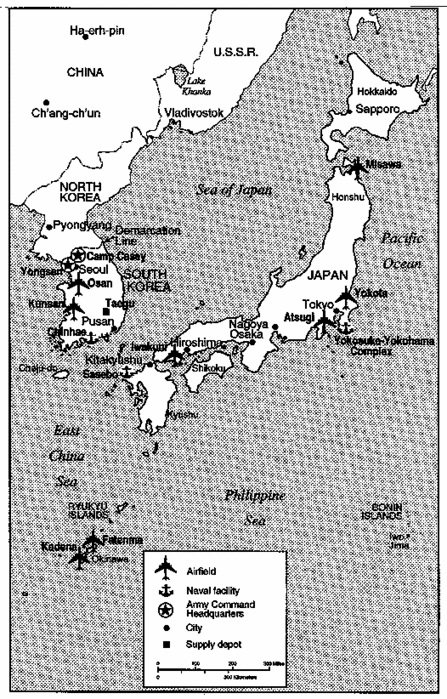
US military bases in Japan, Okinawa and Korea
Why did we choose the problem of pollution associated with American bases in Asia? One reason is the particular importance to the US of Asian bases, especially those in Japan. In 2002, 44.3% of all American soldiers stationed overseas and 26.7% of US bases were concentrated in Asia. Since US bases in the Philippines were closed in 1992, most are now in Japan and Korea. The majority of US Marines stationed abroad are also located in Japan. What’s more, Japan provides 62% of the budget for basing American soldiers in Japan. In 2001, it was about 4.6 billion dollars. In addition to the so-called “Sympathy Budget” that Japan offers in order to support US bases, Japan provides additional funds such as indemnities for noise and various kinds of financial support for base activities. From the prospective of the American military, this has made it easy to pay for their overseas presence. Only in Japan (Yokota) has such an extensive complex of foreign military air force and navy bases, including port facilities for an aircraft carrier, been placed in such close proximity to the capital of an independent state. From a global perspective, this is an exceptional situation.

A US plane approaches Yokota
A second reason is that, even among US overseas bases, Asian base pollution is unusually severe. In accordance with 1993 Bonn supplemental agreements, base pollution became the first military environmental problem to be attended to by the American military. However, as can be seen from the example of damage in the Philippines, while we have entered a new century, pollution has been left as it is without being adequately addressed. It is a matter of great urgency to decide how to rectify these conditions.
II. The Problem of Pollution in US Bases in Asia
The Philippines
…
JF for more