
by A. J. PHILIP
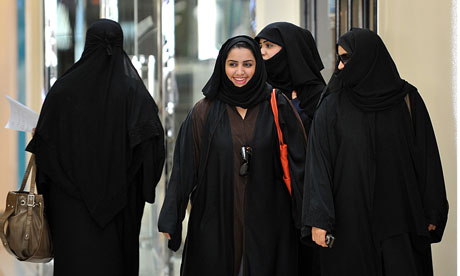 Proposals for four similar women-only cities in Saudia Arabia have been submitted. Segregration of the sexes is applied throughout the kingdom. PHOTO/AFP/Getty/Guardian
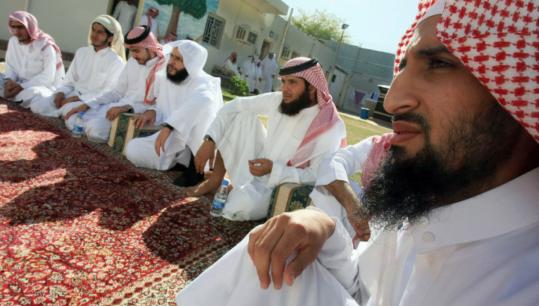 A group of Saudi men at a rehab center north of the Saudi capital, Riyadh. PHOTO/HASSAN AMMAR/AFP/Getty Images/Boston
Every time my journalist son goes abroad, I tell him to bring as many pictures as possible. Only once did I make a special request. That was when he went to Myanmar. I wanted a photograph of the grave of Bahadur Shah Zafar, the last Mughal ruler who was exiled by the British following the Revolt of 1857. My son brought back several photographs and I was very happy.
Last month when he accompanied Foreign Minister Salman Khurshid to Saudi Arabia, I expected him to bring a lot of pictures, which would have helped me know the country better. Alas, he did not bring a single photograph, although he carried a new Canon SLR.
“There are so many restrictions on photography in Riyadh. You do not know which building can be photographed and which cannot. It is dangerous to take photographs of even streets and parks because if a woman complains to the religious police, you are in for trouble. I did not even take out the camera”.
I am sure the external affairs ministry, which organizes such trips, would have issued an advisory to the journalists accompanying the minister, to avoid taking pictures. He spent four days in the country, which is the only one named after a family, the house of Saud or al Saud, and he found it the most boring trip he had ever had.
“It is a truly black and white nation, with men wearing white and women black. During my entire trip, I would not have seen more than 40 women, and those only in malls. I did not find a single woman on any road. Even in the malls, there were shops exclusively for women. In any case, a woman can move around only if she is accompanied by her husband or a close relative like her father or brother.
“If even a married couple indulges in a bit of romance in a public place, they are sure to be questioned and, possibly punished, by the religious police. Everybody dreads the ubiquitous police”. I am glad that my son did not take any photograph and came back without any questioning by the Mutawas, as the dreaded religious police are known.
One of my acquaintances had the shock of his life when he landed in Dhamam with a well-paid job visa. At the customs counter at the airport, they detected a Malayalam Bible he carried in his briefcase. The official dug it out, stared at my acquaintance’s face and threw it into the trash can. “My blood boiled, but I was helpless”.
My sister-in-law, who spent more than three decades in a remote area in the Kingdom, was not foolish enough to carry a Bible and risk her life. Instead, she bought a Malayalam Quran and started reading it as a substitute. Today, she knows more about the Quran than the Bible, although it has not diminished her original faith. My brother-in-law, who spent over three decades in Saudi Arabia and is now settled in Canada, had told me how a policeman at a Saudi airport had objected to the little cross he wore.
The Herald of India for more