
by KABITA CHAKMA
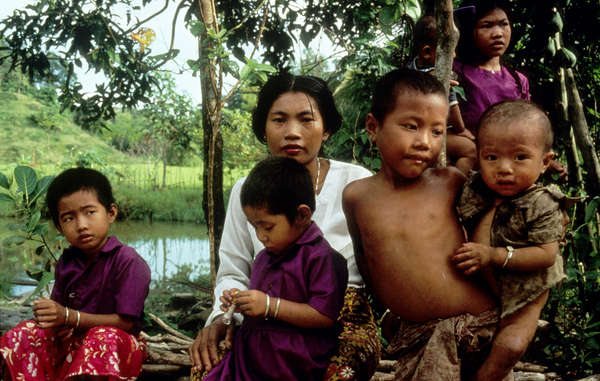 A family from the Chittagong Hill Tracts in Bangladesh, where killings, torture and rape against tribal people are common. PHOTO/© Mark McEvoy/Survival
SEXUAL violence against non-Bengali hill women by Bengalis was not an issue in the 18th, 19th and more than half of the 20th century, even though Bengalis have been regular visitors to the region at least from the later decades of the 18th century. One of the earliest accounts of the region recorded in 1798 by Francis Buchanan, a British surveyor and traveller, testifies that Bengalis were working in the hills as seasonal labourers. Small numbers of Bengalis have been living in the hills at least from the second decade of the 19th century when Raja Dharam Bux Khan brought Bengali labourers to introduce plough cultivation.
There has been a high rate of violence against women all over Bangladesh in recent years. The Bangladesh Mahila Parishad records show an increase in women’s death resulting from violence relating to dowry demands, rape and assault. There were 1,373 deaths in 2009, 1,377 in 2010 and 1,450 in 2011.
An examination of police records of 2012 reveal that rape cases in the first three quarters of 2012 almost reached the total number of reported rape cases in 2004. A complete picture of violence against women in the country is difficult to obtain because many VAW cases remain unreported across the country. Many VAW complaints are not followed up by authorities. ‘Marital rape’ is not even recognised as violence against women in public discourse in the country.
Kapaeeng Foundation figures for January 2007 to December 2012 reveal that Jumma women and girls endured 3 times higher violence rates than their indigenous sisters living in the plains of Bangladesh. It is difficult to obtain any comparative analysis of violence against indigenous women vs. Bengali women in the country. But it is clear that while most cases of sexual assault against indigenous women are by Bengalis, there are hardly any reports of assaults of Bengali women by indigenous men. There is often a mistaken assumption that sexual assault of CHT’s Jumma women by indigenous men does not occur. However, the Maleya Foundation reported that in the last half of 2012 there were four cases of indigenous men committing sexual violence against indigenous women, including two shocking gang-rapes of Jumma school girls aged 15 and 12.
New Age for more
(Thanks to Harsh Kapoor of SACW)