
by EMILY ACHTENBERG
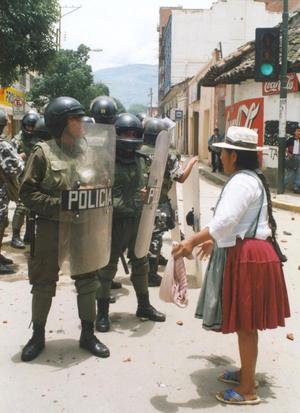 Cochabamaba 2000. SOURCE/thehealthculture.com
When Bolivian President Evo Morales arrived at the new Uyuni airport last August and found no water running from the tap, he publicly reprimanded and promptly dismissed his Minister of Water. As it happened, the pipes were merely frozen. The incident underscores the critical—and highly symbolic—role of water in the politics of this landlocked Andean nation.
Water war
In April 2000, a popular struggle against water privatization in Cochabamba, Bolivia’s third largest city, ignited a chain of events that profoundly altered the nation’s political landscape. The Water War was precipitated when SEMAPA, Cochabamba’s municipal water company, was sold to a transnational consortium controlled by U.S.-based Bechtel in exchange for debt relief for the Bolivian government and new World Bank loans to expand the water system.
A new law allowed Bechtel to administer water resources that SEMAPA did not even control, including the communal water systems prevalent in the ever-expanding southern periphery and in the countryside, which had never been hooked into the grid. Local farmer-irrigators feared that “even the rain” collected and distributed for centuries by their associations would fall within Bechtel’s grasp.
These concerns, along with a 50% average increase in water rates for SEMAPA customers, prompted the formation of a broad alliance of farmers, factory workers, rural and urban water committees, neighborhood organizations, students, and middleclass professionals in opposition to water privatization. They were joined by the militant federation of coca growers from the Chapare, led by then labor leader Evo Morales, who lent his considerable expertise in organizing civic strikes, road blockades, and massive popular assemblies. Eventually, Bechtel was forced to abrogate its contract, return SEMAPA to public control, and withdraw its legal claim against the Bolivian government for $50 million in compensation.