
by KEREM OKTEM
 A woman holds up a banner that reads “Don’t interfere with my life style ” as thousands of people gather in support of demonstrators staging a sit-in to prevent the uprooting of trees at an Istanbul park, in Ankara, Turkey, Friday, May 31, 2013. PHOTO/AP Photo/Burhan Ozbilici/Huffington Post
Hundreds of thousands of protesters in the streets of Istanbul. Tens of thousands of policemen attacking with teargas bombs and rubber-bullets. The Bosphorus bridge heaving with demonstrators. Solidarity meetings all over Turkey and beyond. A government that seems to have lost touch with events on the ground. An establishment media whose patrons have been bullied not to report what is in front of its eyes. A nation in turmoil. A prime minister, who in 2011 was lecturing Hosni Mubarak about democracy and divine justice – and who was re-elected then with a massive popular vote – who now looks awkwardly like the former Egyptian dictator. All this has thrown Turkey into its deepest crisis for more than a generation.
Turkey seems among the unlikeliest candidates for a popular uprising. It has one of Europe’s few thriving economies, with record growth, falling unemployment and decreasing urban poverty. The country’s technical infrastructure was never as advanced, its people never as educated, its society never as broadly middle class as it is now. A peace process in Kurdistan promises a new deal with the country’s largest and most brutally oppressed minority after decades of war. The socio-economic factors which drove people in Egypt, Tunisia, Greece and Bulgaria to the streets are largely absent. Despite all this, a small protest in the Gezi Park of Istanbul’s Taksim Square quickly turned into an enormous eruption of protest.
So why Turkey, and why now?
The background
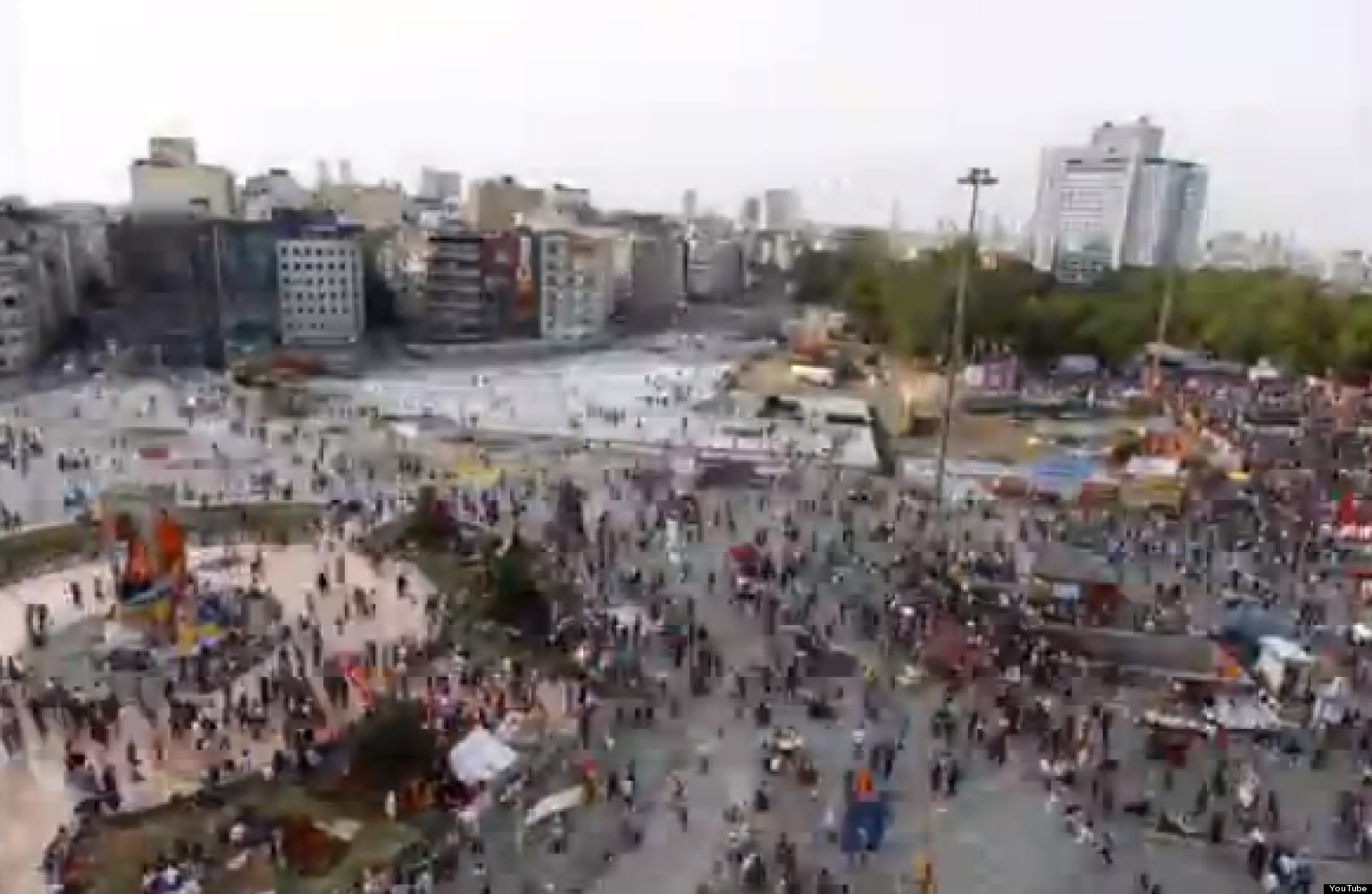
On Wednesday 29 May 2013, a small group of students and ecologists tore down the barriers to occupy the Gezi Park adjoining Taksim, the most symbolic of Istanbul’s central squares. Their declared aim was to stop developers from building a shopping-centre that was to be housed in a replica of a military barracks building demolished sixty years ago – resulting in the destruction of much of the park. The group attracted support from intellectuals and politicians, notably the pro-Kurdish socialist MP S?rr? Süreyya Önder.
The event was completely peaceful, but the police response to activists was, by any measure, disproportionate. Their repression initially forced the protesters out of the park, but caused wide public outrage. Soon, mobilised by social media, they were back – and in hugely greater numbers. By Friday 31 May, tens of thousands were clashing with police units in different Istanbul neighbourhoods, while clouds of teargas darkened the skies. Police units threw gas-bombs and teargas into metro-stations, hotel-lobbies and residential buildings. By midnight, protesters had retaken the park, even as street-fights continued and spread to many, mostly middle-class, suburbs. Hundreds of protestors were wounded and hundreds more taken into police custody. Clashes intensified on Saturday and spread increasingly around the country.
On Sunday afternoon, all police units suddenly withdrew from Taksim Square and Gezi Park. Since then, the only evidence of their presence is a few burned-out police-vans. By Monday, the police also withdrew from the Dolmabahçe area and from Be?ikta?, home to prime minister Recep Tayyip Erdogan’s Istanbul office as well as to its most politicised and dar?ng football-supporters’ group (called Çars?). As of Monday night, 3 June, and after two confirmed deaths, the police had either completely evacuated or settled for less brutal policing strategies.
The context
What, beyond their immediate spark, has motivated the protests? At least three interrelated factors have incubated them:
* an increasingly uninhibited neoliberal development process
* the government’s growing conservative zeal
* a troubled foreign policy
These three factors come together in a further overarching source of discontent: with the prime minister’s authoritarian style of government.
…
The neoliberal boom has been felt particularly in Istanbul, where a process of massive urban regeneration and dispossession is in evidence. Entire neighbourhoods housing the urban poor have been cleared of their former residents in opaque planning processes by the municipality and large construction companies (again, close to the government).
…
Even as Istanbul’s built environment is being reshaped, the government has imposed socially conservative and religiously inspired policies that have shattered any pretence of secular politics. A school reform has increased the number of required religion classes and forced many pupils to attend religious schools, often against the will of their parents. The right to abortion has been curtailed, while social policy has increasingly focused on increasing birthrates and recasting women as dependent mothers rather than as equal individuals.
…
A review of Erdogan’s speeches and statements since his last election victory in 2011 suggests a near-delusional worldview. “Women should have at least three children”….”Abortion is murder”…”The Sunnis of Syria are our brothers” (implying that the Alawis are not)…”We want a pious youth”…”Alcohol is destructive”….”Zionism is a crime against humanity”. Millions of Turks – at least the 50% who did not vote for the AKP – feel that this is not the man to become the country’s first elected president, the top position Erdogan has announced as his personal-political goal. But even within the electorate of the AKP, dismay is rising.
Open Democracy for more
(Thanks to Robin Khundkar)