
by YVES NIYIRAGIRA
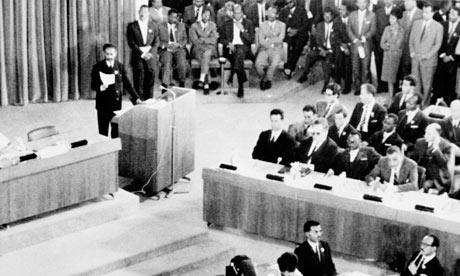 Delegations from African countries listen to Haile Selassie in Addis Ababa in 1963 at the conference that set up the African Union. PHOTO/AFP/Guardian
On 25 May 2013 Africa will remember 50 years of the establishment of the Organisation of African Unity (OAU), which was replaced by the African Union (AU) in 2002. While there are various opinions as to whether the OAU/AU realised the vision of unity among Africans that founders of the continental organisation sought to achieve, there is no doubt that Africa does not need more five decades to learn from past mistakes.
At the 25 May 1963 founding summit of the OAU in Addis Ababa, Ethiopia, it was clear that the driving force behind the then African leaders was to ‘liberate all African people’ and form effective solidarity among them. Leaders such as Ghana’s Kwame Nkrumah and Algeria’s Ahmed Ben Bella and their supporters, the so-called Casablanca group, wanted immediate unification of all African people and the elimination of all tariffs and boarders (The Africa Report, May 2013). The golden opportunity to start the unification process was lost when opponents of the Casablanca group, under the so-called Monrovia camp, took the day with their proposal of a much looser organisation that would not prevent them from maintaining stronger ties with their former colonial masters.
Even though Africa failed to take the route of a stronger federation at the OAU founding summit, there have still been numerous opportunities over the last fifty years to come back to the right path. Unfortunately, Africa is not yet unified; it is a continent of fifty-five artificial entities, not nations, some of which ought not to have been called countries in the first place according to some commentators.
This article argues that leaders of post-independent Africa as well as their successors failed to realise the aspirations and hopes of self-determination and unity that African people had at decolonisation. Those dreams died in May 1963. While recognising that the end of colonisation and South Africa’s apartheid were strong steps towards African unity, the lack of political will has since prevented Africans from being united. This article proposes five basic but important steps that AU member states need to take now without waiting another 50 years for Africans to be on the path to full integration.
Pambazuka News for more