
by A. G. NOORANI
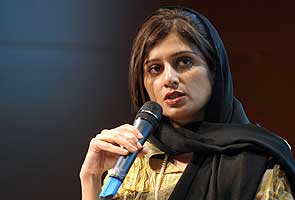 Pakistan’s former Foreign Minister Hina Rabbani Khar. PHOTO/NDTV
Hina Rabbani Khar, as Foreign Minister of Pakistan, speaks about her country’s commitment to normalise relations with India on every front in order to be able to build mutual trust and solve outstanding problems.
Hina Rabbani Khar’s record in office as Foreign Minister of Pakistan revealed her passionate commitment to Pakistan’s interests, for which she fought with conspicuous ability. She has a rational, enlightened concept of those interests which she assesses in the light of the situation at home as well as the entire region of South Asia. This was evident enough in the debate in the National Assembly on January 21, when the Leader of the Opposition Chaudhury Nisar Ali Khan, like his counterparts in India, accused the government of appeasement of India after the shrill cries in India following the flare-up on the Line of Control (LoC). “Don’t sell away Pakistan’s honour like this,” he said. Her response was to reiterate “our commitment not to escalate the situation”.
The maturity as well as proud nationalism were very evident in the remarks she made on February 26 in an interview to this writer at her office in the Foreign Office in Islamabad.
The one constant theme was “the learnt lessons” from the past. Here was a modernist with a fresh outlook speaking while emphasising the correctness of her government’s policy. She reckons with the realities of domestic politics in India as well as in Pakistan but is determined to break from a sorry past. “In the last 60 years both India and Pakistan have done a fantastic job in creating hostility and animosity in the minds and hearts of our people against each other and in the world against each other.” Very many in both countries are still at work on this shameful exercise. It requires courage on the part of one in high office to condemn it.
Governments must lead and mould public opinion. That is the test of true leadership.
…
Foreign Minister, it is very kind of you to grant this interview amidst your busy schedule. You are held in high regard in India and are noted for your moderation. Let me begin with the question that is uppermost on our minds today. Given the impasse in the Indo-Pak situation, where do we go from here and what steps can be taken by both sides to lower the temperature?
Thank you, first of all, for giving me this opportunity of expressing my views, Noorani saheb. I think really if I look back at the tenure of this government in the last five years—as you know in just about a few weeks we will be handing over to a caretaker government—I can tell you that I am highly satisfied with the Government of Pakistan’s approach towards India. I can talk about the last two years when I have been Foreign Minister of Pakistan. I believe that it came from a deep, abiding understanding, and learnt lessons, to be quite honest, that Pakistan needs for its own peaceful growth and development a stable atmosphere on its borders, both in the east and the west, and on the other side of course. I think we really went out of the way to reach out to India to start a normal dialogue process, to continue with the normal dialogue process, to get out of the trust deficit mode and to get into the trust-building mode. I can say that until about three months back, up to the last visit of Foreign Minister [S.M.] Krishna, we were fairly satisfied with the way things were moving because trust was building, we were able to have a deeper, saner conversation and we all agreed that we need it to get the core issue of Jammu and Kashmir resolved, and other territorial disputes resolved, for Pakistan and India to be able to coexist peacefully. We have to start on that road of trust-building so that we can trust each other enough to be able to solve the problem on the dialogue table.
What I am trying to say is in the last five years the Government of Pakistan has been very clear, every time we have been presented with the choice of taking a course of action or of chalking out a new course of action which leads to the future which we want in Pakistan-India relations. I am very satisfied with the fact that we have not fallen into the trap of domestic rhetoric or domestic requirements of politics. We have always created the pathway for good diplomacy and then the domestic rhetoric has changed. We have been able to do that. I give a lot of credit for that to President [Asif Ali] Zardari because, instead of falling into domestic compulsions, domestic politics, domestic requirements, he has led it [public opinion] by clarifying that Pakistani interests are important and we will continue to forge ahead on it. I give you two or three examples because talk is cheap but walk is not cheap, and walk is more important than talk. When this government changed the 40 years’ policy on trade normalisation with India, we got a lot of backlash. What did we do? We persevered through the backlash and made sure that the negative entity turned into a positive entity. Today there are many people in Pakistan who do understand the intentions behind it because what we are trying is to build stakeholders in others’ future. We are trying to normalise our relations on every front, enough to be able to build the trust in order then to be able to solve more important problems.
Frontline for more