
by B. R. GOWANI
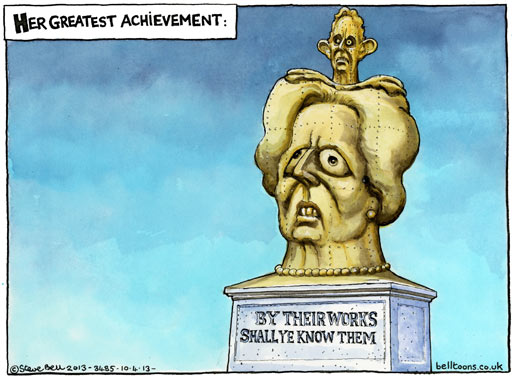 Guardian/Copyright © Steve Bell 2013
Former British Prime Minister Margaret Thatcher (1925-2013) passed away this week after a stroke. She was named the “Iron Lady” by the Soviet military journalist Captain Yuri Gavrilov for her strong opposition to socialism.
If the purpose of opposing socialism was to criticize the socialist policies which were not benefiting the people in countries pursuing that ideology, then one should appreciate the thought. However, when the motive behind the opposition to socialism was to cut down benefits the people in England were receiving, then it was a totally devious idea.
When she came to power in 1979, there were 14% children living in poverty. During her time, the number rose to 33%. During her period, the United Kingdom became the IMF’s (International Monetary Fund) best “neoliberal poster child”, as Michael Hudson and Jeffery Sommers points out in their wonderful article, “The Queen Mother of Global Austerity and Financialization”. She became the British version of the Russian Boris Yelstin who sponsored “the carve-up of centuries of public investment.”
The families with three children belonging to the bottom ten percent of the population became poorer by pound 625, whereas the top ten percent of the families with three children were richer by pound 21,000. Unemployment rose. The statistics for the poor were (and still are) gloomy.
Being a grocer’s daughter, Thatcher summed up the entire free-market economics in this one sentence:
“There is no better course for understanding free-market economics than life in a corner shop.”
But she was no more a grocer’s daughter. She had become a millionaire’s wife, but still she kept on projecting her image as the grocer’s daughter. Peter Clarke explains the reason:
“There is an obvious ideological significance in Thatcher’s failure to acknowledge her good fortune as a millionaire’s wife. To do so would be to vitiate her faithfully re-created identity as the grocer’s daughter.”
Whereas the small town life, Tom Mills notes, is now controlled by big super markets and corporations.
A year and a half later, after she came to power, on the other side of the Atlantic Ocean, Ronald Reagan came to office with a similar agenda. By the end of the 1990s, both had left but the political landscape had changed. The Labour Party in Britain and the Democratic Party in the United States, had lost whatever little instinct they had for the welfare of the average people.
The above cartoon has the Labor Prime Minister Tony Blair (1997-2007) popping out of the Thatcher’s head. Thatcher belonged to the Conservative Party. It shows how much the difference between the Labour and Conservative parties have disappeared.
Instead of Thatcher and Blair, if the above cartoon had Bill Clinton or Barack Obama coming out of Reagan’s head, it would have the same surreal effect.
Margaret Thatcher has finally melted away, but the attack she and Reagan started on social and welfare programs have not melted away.
B. R. Gowani can be reached at brgowani@hotmail.com