
by Dan Glazebrook
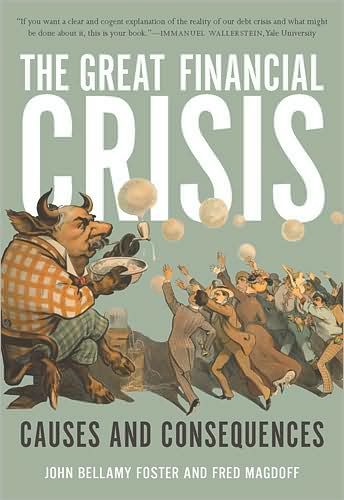
John Bellamy Foster and Fred Magdoff, The Great Financial Crisis (Monthly Review Press, 2009).
One of the few boom industries in times of slump, it seems — aside from private security firms, debt collection agencies and porn — is the publication of books about slumps.
Everyone from Vince Cable to Newsnight economics editor Paul Mason is touring the country, touting their own take on recent economic events. Copies of Das Kapital are reportedly flying off the shelves faster than they can be printed.
The Great Financial CrisisWhat makes this short book by the editors of the long-standing US left journal Monthly Review stand out is that it looks beyond the shenanigans of high finance to the deeper, structural causes of capitalism’s current malaise.
Fifty years ago, Paul Baran and Paul Sweezy published their classic work Monopoly Capital.
In it, they argued that mainstream economic thinking on recession was topsy-turvy from the outset.
Instead of asking why the Great Depression occurred — and thus accepting that it was some kind of freak occurrence — they argued it was capitalism’s growth periods that needed explaining.
Capitalism in its monopoly phase — the age of the giant corporation — is characterised by stagnation and only experiences anything different due to historically specific — and temporary — “fixes.”
At the root of this stagnation lies the classic contradiction of capitalism — that productive capacity tends to outstrip effective demand.
In other words, we are not paid enough to buy all the crap we produce. Goods pile up unsold, productive activity freezes up and capital is unable to find avenues for profitable reinvestment.
Mr Zine for more