
by MARY KENNY
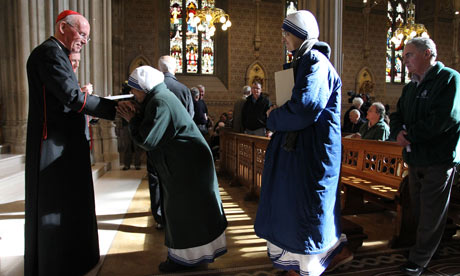 Cardinal Sean Brady, the primate of All Ireland, hands out a letter from the Pope to worshippers about the clerical sex abuse scandal. PHOTO/Peter Morrison/AP
Many Irish people have ditched the religion of their ancestors, but the generous impulses of faith live on
In the historic sense, Ireland’s long love affair with the Catholic church was, as Ella Fitzgerald once sang, “too hot not to cool down”. Catholicism was once so all-pervading in Irish life that it seemed a definition of Irishness: but now, according to a survey by the pollsters Red C, the Irish are losing their faith quicker than most: seven years ago, 69% of Irish people described themselves as “religious”: this has now fallen more than 20 points to 47%.
Something had to give, and even before the clerical scandals broke into the public realm – in the 1990s – this intermingling of faith and fatherland was in decline. There was the effect of the 1960s. There was the effect of the pill, which, contrary to legend, was legal in Ireland. There was television. There was modernisation, which the Vatican advanced as aggiornamento. Around the time of Vatican II – 1962-65 – it could be said that in the hills of Connemara they spoke of little else.
But there were a lot of concerned parents, too, writing to the devotional magazines saying that they were in despair because they just couldn’t get their offspring to pray: the family rosary was gone: their son (it was usually their son) wouldn’t go to mass, no matter how much they beseeched. Gradually, you could see traditional Irish Catholicism unravelling. The votive lights placed under the picture of the Sacred Heart were disappearing in country B&Bs. My aunt, who had once felt miserably guilty for absent-mindedly taking a cup of Bovril on a meatless Friday, could relax.
Then there were heated national arguments about divorce – arguments as often about land as matrimony – and it took three referendums to introduce a divorce law. There were even more heated debates about abortion, and though faith is still a strong part of Irish values in this, there is a cultural element too: agricultural societies regarded infertility as failure, and “abortion” traditionally meant a cow had failed to calf.
And then in the 1990s and the 2000s the clerical scandals erupted, in which ghastly episodes of priests molesting and sometimes raping children and young people were brought to light. Richard Dawkins visited Dublin – and Listowel, in Co Kerry, for Writers’ Week – and scolded the Irish for having God in their constitution; they took it on the chin, and bought his book The God Delusion at the double.
Among Dublin’s smart set it seemed the kiss of social death to admit to being a practising Catholic: it’s even vaguely unfashionable to be married, especially only once. Nonetheless, in the 2011 census, it emerged that 84% of the people of the Irish Republic described themselves as “Roman Catholic”. The number of atheists and agnostics and diverse other faiths was up too, but Roman Catholics remained the majority.
The Guardian for more