
by DAVID THORSTAD
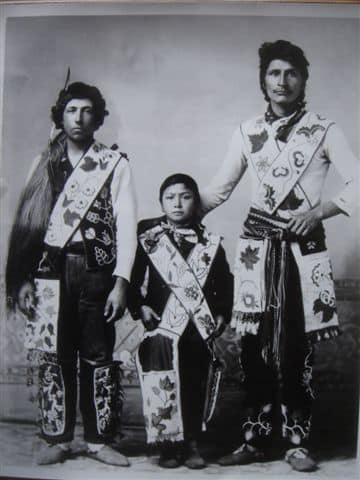 Rudolph Berg (left) with John Strong (a son of Red Robe) and grandson (photo by Smith). Berg was the interpreter when the Ojibwe cemetery at Squaw Point was moved to the Red Lake reservation in 1904.
In 1904, the Ojibwe village at Thief River Falls, in northwest Minnesota, was removed to the Red Lake Indian Reservation to the east, much diminished after the tribe’s cession of 256,152 acres between the reservation and Thief River Falls (known as the eleven western townships). The Indian cemetery at the village, on a piece of land known as “Squaw Point,” where the Red Lake and Thief rivers meet, was dug up and around 115 remains were taken by barge up the Red Lake River where they were to be “buried at a suitable point on the banks of the Red Lake river just across the reservation line.”1 Red Laker Wub-e-ke-niew, in his book We Have the Right to Exist, says “the Métis told us that our dead were dumped near where the old Frogs’ Bridge was, but I went and looked, and found no evidence of this.” Two issues were involved in the removal, he says: “one of them was the plundering of the graves of my people for ‘artifacts,’ the second was the removal of all physical evidence that the Ahnishinahbæótjibway had ever lived in the area.”2
This site is known at Red Lake as Silent City. It is hard to imagine that anything could have been reburied in this marshy terrain, even as it is today. It is possible that the barge could not proceed any farther than Frogs’ Bridge, so had to leave the dead there. Another version from Red Lake has tribal elders stopping the barge out of disagreement with the village band, whose chief, Red Robe, had accepted allotment, whereas Red Lake had rejected allotment in favor of keeping all land to be owned in common by the tribe as a whole. This scenario seems unlikely because the village Indians “said they were willing to remove at any time, but would not sign any paper until their head men up at the lake approved of the matter.”3 The story of Silent City remains sensitive for Red Lake, and may be fraught with superstition as well. When I mentioned my research to one tribal official, he replied: “Some things should not be written about.”4
Monthly Review Zine for more