
by B. R. GOWANI
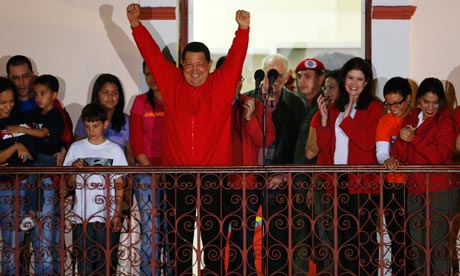 Venezuelan President Hugo Chávez of the United Socialist Party of Venezuela, after winning the presidential election for a fourth term. PHOTO/Jorge Silva/Reuters/Guardian
Venezuela – noiseless democracy
The presidential election campaign in Venezuela began on July 1 and the election was over in the first week of October. 80.94% of the 19,119,809 registered voters turned out to vote-the highest in Venezuela’s history. And the 55% of the people who voted for and supported Chavez was because he had done a great deal and is trying to do more for the common people. Between 2003 and 2008, the poverty was reduced by 50%. The social policies are assigned 43% of the budget. While addressing the people, Chavez pledged: “Venezuela will never return to neoliberalism, it will continue transition to the democratic socialism of the 21st century!”
The result and announcement must have definitely drove the neoliberal gods of capitalism, including the former managing director of Goldman Sachs and US Deputy Secretary of State Robert Zoellick, mad. Back in June, the then World Bank President Zoellick had predicted:
“Chavez’s days are numbered. If his subsidies to Cuba and Nicaragua are cut, those regimes will be in trouble. The democrats of Latin America – left, center, and right – should be preparing. The calls for democracy – for an end to intimidating thugs, human rights, fair elections, and rule of law – should come from all its capitals.”
Andres Izarra, Venezuela’s information minister, had countered Zoellick very correctly: “The predatory capitalism that the World Bank promotes has numbered the days for all of humanity.”
Zoellick, one of the thugs of the US ruling class, should be reminded that the election was fair. Jimmy Carter, the former US president, said this about the result: ““As a matter of fact, of the 92 elections that we’ve monitored, I would say the election process in Venezuela is the best in the world.”
One should, however, refrain from romanticizing things, and same applies to Venezuela. Chavez will have to work on reforming the bureaucracy and tackling the inefficiency and corruption, which as Gabriel Hetland points out, Chavez inherited when he came to power.
United States – noisy democracy
In contrast to Venezuela, in the US, President Barack Obama formally announced his election campaign on April 4, 2011. On the other hand, one of the Republican Party candidates Mitt Romney announced his campaign on June 2, 2011. (Other Republicans announced their campaigns at various times; some earlier than Romney and others latter.
The presidential election is a huge business in the US. Up until now, both candidates have spent over $800 million on ads. The major beneficiaries are the TV stations, followed by the radio stations, and the print media. Then there are the pundits, who once the campaign began, started the guesswork as to who the Republican nominee would be. That continued for few months and when some of the candidates dropped out due to funds shortage or for other reason, the guess-game then shifted to the remaining candidates. Finally, when it became clear that Romney had enough delegates on his side, the media then moved to comparing Romney and Obama.
Then it was the pre-debate conjecture as to who would win the debate. After the first debate, the constant discussion was focused on postures, body language, aggressiveness, polls, public perceptions, and so on. The people indulging in this nonsense are the highly paid media pundits-one of the most useless segments of the society.
If instead these pundits were to devote their energy to issues that could really bring some change in common people’s lives, it would have been much better. In Venezuela, Chavez cut poverty by half in five years. Whereas in the US, in the late 1950s, 22.5% of the people were living in poverty, that number had dropped to just 15.1% in 2010. The drop in poverty occurred between 1959 and early 1070s due to government interventions and President Lyndon B. Johnson’s Great Society initiative. But as the corporate hold over government increased, its ability to end poverty declined.
At present, over 46 million live in poverty, but the Pentagon (in the name of “national security” and “defense”) gets over $600 billion, which goes to private defense companies. The US defense spending equals the combined defense spending of the rest of the world.
In the name of “democracy,” the US makes so much noise and is constantly lecturing the world about it, but when it comes to delivering the benefits of democracy, such as more equality and social benefits, it doesn’t match the quiet democracy of Venezuela.
B. R. Gowani can be reached at brgowani@hotmail.com