
by DR. SAROJINI SAHOO
“This is not a revolt against religion, or a plea for any religion. This is only a wailing. This is only a cry.”
These are the last few lines from one of Kamala Das’ short stories “An Incomplete Love Story.” It is a sad love story about a love between a Muslim and Hindu, which was first published in Malayalam and then translated into English by the author herself.
Being short-listed for Nobel Prize in 1984, Das possessed a significant position in the Indian literary scenario. Writing in English and Malayalam, Das authored many autobiographical works and novels, several well-received collections of poetry in English, numerous volumes of short stories, and essays on a broad spectrum of subjects. Since the publication of her first collection of poetry, Summer in Calcutta in 1965, Das has been considered an important voice of her generation who exemplified a break from the past by writing in a distinctly Indian persona rather than adopting the techniques of the English modernists.
In her life, Kamala Das was also put into controversy for her inclination for Islam and for the man behind this inclination, Sadiq Ali, who was an Islamic scholar and a Muslim politician who became an MP from Malabar. Needless to say, there was a strong love relationship between them despite a significant difference in age and a bar of religion in between them. Eventually, they decided to marry and for that, Kamala Das changed her religion and then became known as Kamala Suraiya. The wedding hall had been booked and plans had been made for a ceremony but strangely enough, Ali absconded before their wedding day.
Kamala Das had written “An Incomplete Love Story” before the failure of the scheduled marriage but ironically, her last love actually did become an incomplete one.
Here, we will discuss the pathos fate of female sexuality with respect to Kamala Das alias Kamala Suraiya’s life. The poetess herself describes the myths and facts regarding female sexuality through this autobiographical observation in one of her poems:
“I was child, and later they
Told me I grew, for I became tall, my limbs
Swelled and one or two places sprouted hair.
When I asked for love, not knowing what else to ask
For, he drew a youth of sixteen into the
Bedroom and closed the door, He did not beat me
But my sad woman-body felt so beaten.
The weight of my breasts and womb crushed me.
I shrank Pitifully.
Then … I wore a shirt and my
Brother’s trousers, cut my hair short and ignored
My womanliness. Dress in sarees, be girl
Be wife, they said. Be embroiderer, be cook,
Be a quarreller with servants. Fit in. Oh,
Belong, cried the categorizers. Don’t sit
On walls or peep in through our lace-draped windows.
Aches which are not yours. I too call myself I.”
An introduction to Kamala Das
Poet K. Satchidanandan elaborated on Das’ views explaining that “the woman cannot change her body; so the poet changes her dress and tries to imitate men. But the voices of the tradition would force her back into sarees, the saree becoming here a sign of convention. She is pushed back into her expected gender roles: wife, cook, embroiderer, quarreler with servants: the gender role also becomes a class role.” (Satchidanandan, K., “Transcending the Body” Only the Soul Knows How to Sing by Kamala Das. Kottayam [DC Books, 1996])
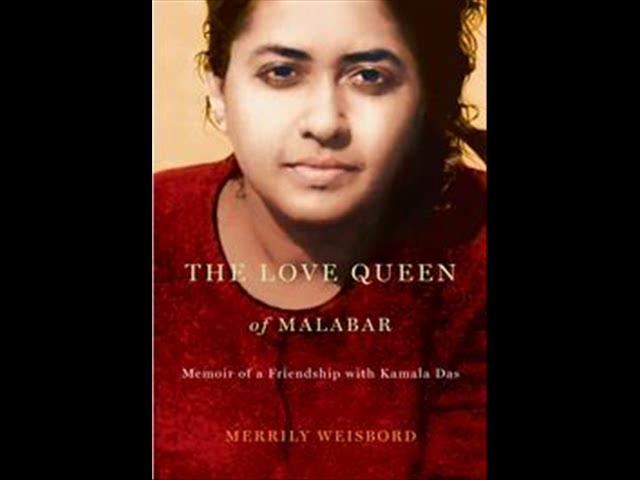
Merrily Weisbord, a Canadian non-fiction writer wrote a book in 2010, The Love Queen of Malabar: Memoir of a Friendship with Kamala Das (ISBN: 0773581413, 9780773581418, published by McGill-Queen’s Press) based on her decade-long friendship with Das and in a chronological narration which travels through pain, desire, hope and despair, has documented a riveting decade in the life of the great Indian poetess. Weisbord first met Das through her poems and found the verses resonating with a kindred spirit. In a brave moment, she decided to pursue a further connection and visited Das in Kochi in1995. In return, Das visited Canada twice. Weisbord visited Kochi six times between 1995 and 2005 with the idea of writing a book on her friend poetess. In the process, she got closer to the writer and the woman in Das like no one else.
Nominated for the 2010 Writers’ Trust Non-Fiction Prize, this book is not only an intimate portrait of Kamala Das but also a truly original example of cross-cultural adventuring, typically with an Asian focus. In these memoirs, Weisbord pries open a hermetic Asian culture and exposes it to broad view with real understanding and style.
Who Was Kamala Das?
Daughter of the renowned Malaylam poet Balamani Amma, Kamala Das had writing in her genes and was further deeply influenced by her uncle Nalapat Narayan Menon, a prominent writer. Her formal education was limited to a short span of schooling – a European School in Calcutta. Married to a quite matured man (more than double her age) shortly before her 16th birthday, Das never enjoyed sex with her husband, though became mother of three children from that marriage.
According to Weisbord, her husband consummated the marriage with a penis longer than most and consequently, Das bled profusely and needed surgery. What Das experienced in her sexual life is not new for many women. At this juncture, we are reminded of Sylvia Plath, another woman writer who also underwent the same trauma as Das did. In one of my stories in Odia “Doora Pahadara Chhabi” (the story is yet to translated into English), I describe how the protagonist gets raped by her lover husband during their first night mating, causing bleeding of her vagina.
Feminine Fragrance for more