
by KEANE BHATT
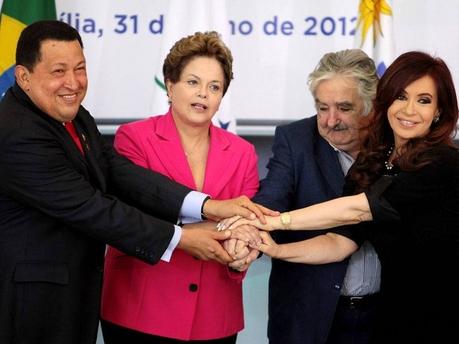 Mercosur’s leaders in Brazil’s capital Brasilia. From left to right, Venezuelan President Hugo Chavez, Brazilian President Dilma Rousseff, Uruguayan President Jose Mujica, and Argentinian President Cristina Kirchner. PHOTO/AP
On Tuesday, July 31, the presidents of Argentina, Brazil, and Uruguay met in Brasília and formally admitted Venezuela into Mercosur, the world’s third-largest trading bloc. Venezuela’s full membership, the BBC reported, had been previously approved by all of Mercosur’s member countries except Paraguay, whose rightwing congress had obstructed the initiative for years. With Mercosur’s recent suspension of Paraguay over a parliamentary coup carried out in June, which saw Paraguay’s President Fernando Lugo overthrown, the $3 trillion trade grouping easily voted Venezuela in.
Cristina Kirchner of Argentina called July 31 “a historic day” that would herald the rise of Mercosur as a “new pole of world power.” Brazil’s Dilma Rousseff said “Venezuela’s entry increases the potential of the bloc, giving it greater geopolitical and global economic dimensions.”
Simon Romero, however, writing for The New York Times, portrayed Venezuela’s entry as a cause for concern. In fact, he provided the final word of his piece to a political scientist who believes Venezuela’s admittance “sets a terrible example for the region” and “reveals Mercosur’s political weakness.” Romero is not alone in underlining the supposedly troubling aspects of this unprecedented step toward regional integration—The Economist called the move “cunning,” and Businessweek began its article on the subject by contending that “Hugo Chavez’s back-door entry” somehow “casts doubt on the future” of Mercosur.
This characterization is misleading. Members of Mercosur decided to suspend Paraguay’s membership on wholly legitimate grounds: On June 22, Paraguay’s congress impeached the democratically elected president, Lugo, in violation of Article 17 of Paraguay’s constitution, which guarantees the right to due process. Congress gave Lugo just one day to prepare a defense, and allotted his legal team only two hours to defend him. Following the illegal ouster of Lugo, President Cristina Kirchner of Argentina said Mercosur’s leaders should not “tolerate these ‘gentle coups’ or movements that—under a veneer of institutional correctness—shatter the constitutional order.”
Nevertheless, in Romero’s version of Mercosur’s July 31 inclusion of Venezuela, the three other member countries had somehow performed an “outmaneuvering of the Paraguayan Senate”—even though the countries had previously suspended Paraguay for overthrowing its elected leader. He also doesn’t explain how Venezuela’s formal entrance to Mercosur had been “stalled by resistance in some member nations” when he writes in the subsequent paragraph that “Brazil, drawing support from Argentina and Uruguay”—that is to say, all of the remaining participants in Mercosur—“moved swiftly to formalize Venezuela’s membership.”