
by JEFFERY ST. CLAIR

Let us now praise some archaic objects: namely books. Remark their structure: a sturdy, yet pliant artifact of ancient cultures. How quaint they are. They’re very existence seems a kind of quiet rebellion against the present order of things, against the digitalizing and commodification of words, of knowledge, of poetry, of the real goods, as my Jungian friends say.
Can you imagine a Kindle bookstore? A crowd of virtual people mulling about in virtual lines like automatons, their spines arched in that familiar Kindle stoop, moving from download station to download station, handing their e-readers over to the clerk avatar, saying: can you fill that up with some Peter Linebaugh, Edward Abbey and Kirkpatrick Sale? And please while you’re at it can you re-charge the Chevy Volt?
No, today, I draw your attention to books. Books you can hold, books you can sniff, books you can roll joints on (if people still roll joints), books you can mark-up and dog-ear and sell to a used bookstore in a pinch.
Real books are by virtue of their very existence a subversion of capitalist dogma. God knows the writers and editors here on CounterPunch aren’t making a dime out the production of them. Indeed, the publication of books has been rendered into a charitable enterprise, an adventure in altruism. But books can strike back at the system in other, more direct ways. Books are tangible, solid, weighty objects. You can read them, re-read them, absorb their messages and then, as Edward Abbey once advised, heave them at something big and glassy.
In that spirit, I offer you ten bric-a-bacs in words. Better read them quickly, while there’s still a beach.
The Boxer and the Goalkeeper: Sartre vs. Camus by Andy Martin. (Simon & Schuster)
A juicy, acerbically written account of the tempestuous relationship between two of the 20th century’s greatest minds: Jean-Paul Sartre and Albert Camus. In lively, gossipy prose, Martin tracks the two super-stars of French existentialism from their first encounter in cafes of Paris to their covert work in the Resistance and their flame wars on the pages of Combat, Liberation and Les Temps Modernes. Martin recounts the love affairs, pill-popping, intellectual sniping and terminal break-up in a narrative that reads like a comic novel.
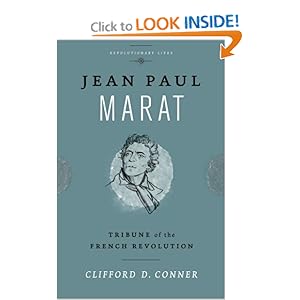
Jean-Paul Marat: Tribune of the Revolution by Clifford D. Connor (Pluto Press)
No figure in the French Revolution—not even Robespierre himself—has been as maligned as Jean-Paul Marat. Enemies of the Revolution (and even some its supporters) have tarred him as a madman, a thief, and a fraud. But now historian Clifford Connor finally resurrects Marat’s role in stoking the fires of a Revolution that would forever alter the European political and social landscape. Marat was a true polymath of the Enlightenment: a doctor, a scientist (Ben Franklin attended one of his lectures on electricity) and inventor, a philosopher, a political theorist and perhaps the fieriest polemicist of the Revolutionary period. In Connor’s grippingly written biography, Marat is revealed as an undaunted champion of poor, the disenfranchised and the enslaved.
Counterpunch for more