
by ANDREA DESSI
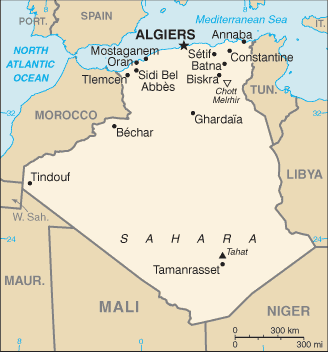 MAP/University of Texas Libraries

Celebrations for Algeria’s 50 years of independence began on July 5 and are due to continue in various forms throughout the rest of 2012. Among ordinary Algerian’s, many of which do not recall their country’s bloody eight-year independence struggle against France, feelings are mixed as there is a perception that the government is leaning on Algeria’s past in order to overshadow the many unresolved challenges of the present. As the only country in North Africa to have largely been spared the type of sustained mass protests that engulfed much of the region since early 2011, Algeria is increasingly being described as something of an ‘exception’ across the Arab world.
The current image of Algeria as an ‘island of stability’ in a region experiencing profound and tumultuous changes cannot however distract from the reality that Algeria still suffers from many of those same features of unsustainability that have largely been credited with sparking popular protest in neighbouring states. The thesis of a so-called ‘Algerian exception’ must therefore be approached with caution, as high levels of unemployment, pervasive corruption, rising public spending and a growing popular disillusionment with the political process cannot represent a sustainable path for the future.
Many had hoped 2012 to be a turning point for Algeria; a time to reflect on the country’s past and future and to begin addressing the many unresolved issues that have plagued state-society relations since Algeria’s first multi-party vote was overturned by a military coup in 1992. Following this stamping out of Algeria’s brief flirtation with democratic reform (1988-92), the country descended into chaos and instability as the military disbanded parliament, suspended the constitution and banned Algeria’s major Islamist party, the Islamic Salvation Front (FIS), which was poised to win a majority in the country’s first elected parliament. A decade of civil war ensured, causing the deaths of over 200,000 people and rampant destruction to Algeria’s infrastructure and national moral. Islamist militias sprung up across the country, whose indiscriminate attacks on civilians – now a familiar scene associated with post-Saddam Iraq or Afghanistan – caused widespread carnage and led to violent reprisals by the army and intelligence services which set up regional security forces to patrol Algeria’s vast territory. Today, both sides stand widely accused of war crimes and while a series of blanket pardons were issued by president Abdelaziz Bouteflika in 2005 and 2006, the scars of Algeria’s ‘lost decade’ of civil war are still very much present in the collective memories of Algeria’s young population.
As the largest country in Africa, Algeria’s population reached 37 million in 2012, and out of this number 70 percent is under the age of 30 while 40 percent is under 15 years of age. These statistics are especially worrying given that unofficial figures for youth unemployment are estimated to be over 30 percent – against an official figure of 21 percent. This can help to explain the prevailing popular apathy with regards to Algeria’s official independence festivities, given that a majority of the population did not live through Algeria’s independence war and are instead more worried about the daily socio-economic hardships affecting them and their families.
President Bouteflika, first elected in 1999 with the clear backing of the military, still no doubt enjoys some level of popular support given his achievements in restoring security to the country, revamping Algeria’s economy and beginning a slow demilitarization of Algeria’s political system, but the government cannot ignore the widespread popular grievances that continue to fester below Algeria’s current image of stability.
ReSet Doc for more