
by RACHMAD HIDAYAT
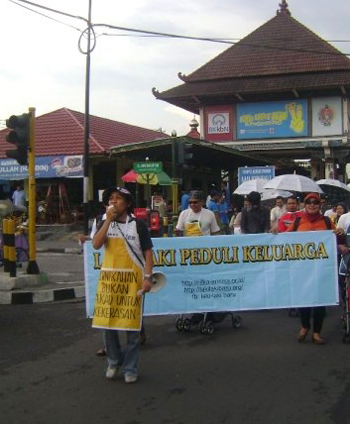 Men care about families PHOTO/Rachmad Hidayat
Activists work to change men’s interpretations of Islam that justify their superiority at home
Indonesia’s high rate of domestic violence against women has led to the establishment of services and networks to provide support for female victims. But very few steps have been taken to resolve the problem from the perspective of abusive husbands. Where efforts have been made, such as those of a team of men working in the Men’s Program of Rifka Annisa, an NGO based in Yogyakarta, they have encountered strong resistance in the face of popular beliefs about men’s superiority in the family, many of which use Islam as a justification for violence in the home.
Rifka Annisa (which means ‘the woman’s friend’ in Arabic) works mainly with women victims, but has recently opened a program aimed at male clients, Muslim and non-Muslim, who are perpetrators of domestic violence. The program provides them with counselling services intended to lead to behavioural changes. Although clients all bring their own specific histories, the counsellors are nevertheless highly aware that Muslim clients tend to deny, minimise and excuse their violence, frequently blaming the victims, and also defend their superiority over their wives using Islamic doctrines which they believe favour them as men. Although not all Indonesian Islamic authority figures support this interpretation, the team has realised that such claims reflect an ideal of manhood that is accepted by many Muslim men, and which too often leads to incidents of domestic violence.
Manhood among Muslim Javanese
Not many abusive men come to Rifka Annisa for counselling. But in serving those who do, Rifka’s male counsellors are confronted with repeated claims about male authority in the family. In spite of the fact that perpetrators show clear signs of a lack of self confidence, insecurity and crisis of identity, they nevertheless believe that Islam gives them the right and authority to lead and educate their wives.
In order to better understand this problem, a researcher affiliated with the Rifka Annisa team carried out a project about ideals of manhood prevalent in Javanese communities located in Pasiran and Lemahduwur. Many of the participants were respected figures, and some were holders of roles in village government. All of them perceive marriage and family as central to their identities as men, as members of society and, above all, as Muslims.
Men in both villages contended that having a family is the main path to personal maturity. They see it as essential for the pursuit of a happy life and extension of the historical lineages of their families. Apart from that, in Islam marriage is considered to be a form of worship (ibadah). At the same time, however, their conception of the family allows them to play a role in which their dominance is socially and religiously acceptable. For these reasons, the men in both communities claim that to be a real man, one must be the leader of one’s family. It was hard for them to reflect upon themselves without referring to their positions as heads of families.
Inside Indonesia for more