
This edition of Inside Indonesia examines the role of money, religion and much else in this year’s elections
By Edward Aspinall
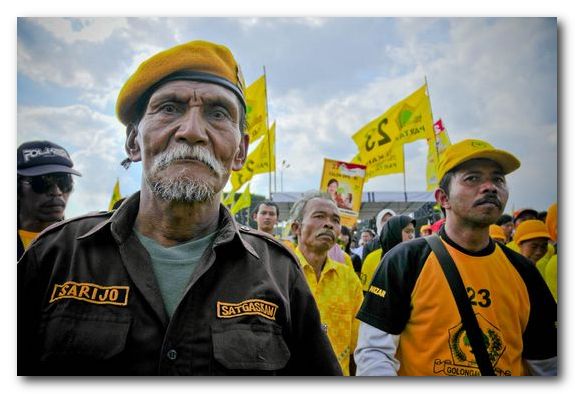
Sarijo, a member of the Golkar party at a campaign event in Yogyakarta. From Tepus, Gunung Kidul, he is a security guard for the party. His job was to take care of the delegation of Golkar supporters from Gunung Kidul who were in town to show their colours for their party.
Danu Primanto Ten years ago, Indonesia held its first democratic elections in the post-Suharto period. The lead article in Inside Indonesia’s pre-election special in 1999 noted that many in the Indonesian press were warning that ‘the coming elections have the potential for national disaster’. But on the day of the polls, the nation heaved a sigh of relief, and outsiders applauded. The elections were generally peaceful, their results were respected, and they ushered in a period of democratic government that has survived, albeit with ups and downs and plenty of shortcomings, until this day.
Ten years on, the atmosphere could hardly be more different. Open elections have become part of Indonesia’s democratic furniture. In April, voters around the country went to the polls to elect thousands of members of legislative assemblies at the national, provincial and district levels. Later this week, citizens will take part in the first of two possible rounds of voting for a president and vice-president. Few people expected either dramatic change or chaos during this year’s elections. In fact, many citizens have lost their initial enthusiasm for voting, but they also take it for granted that this is the way that governments rise and fall.
True to the dampened expectations, the legislative elections last April did not usher in dramatic changes. Some parties – notably President Susilo Bambang Yudhoyono’s Partai Demokrat – did better than in the past, and some did worse. But there were no spectacular breakthroughs or overturnings of established patterns. In the presidential election, the incumbent Yudhoyono is such a strong favourite that some people speculate that he may win in next week’s first round of voting (a second round will only be held if he fails to win an absolute majority and at least twenty per cent in half of the provinces).
But underneath the routine, this year’s elections are still a fascinating moment in Indonesia’s national life. In Indonesia, as in other countries, elections not only determine who controls the government. They can also reveal the social and cultural currents that animate society. Perhaps even more importantly, elections also show much about deeper patterns of power and inequality, about who dominates society and how they do so, and about whose voices are not heard. Elections cement and reflect power even more than they determine it.
Inside Indonesia for more