
by MANUEL CORRALES
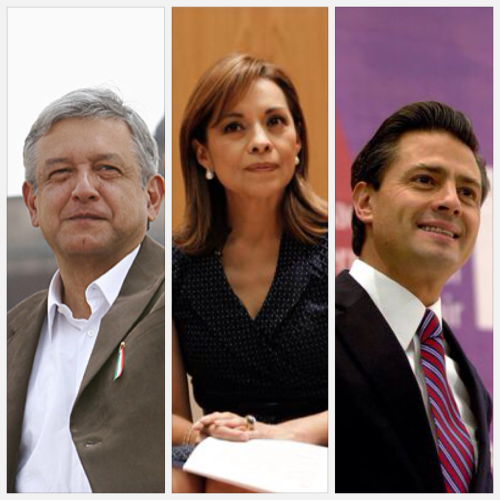 The three major party candidates (shown above from left to right) are: Andrés Manuel López Obrador of the Democratic Revolutionary Party, the PRD; Josefina Vázquez Mota of the National Action Party, the PAN; and Enrique Peña Nieto of the Institutional Revolutionary Party, the PRI. PHOTO/Think Mexican
Distracted by the admittedly discussion-worthy Cuba issue at the Sixth Summit of the Americas last month in Cartagena, the nations of the Western Hemisphere paid little mind to the prospect of reforming hemispheric drug policy. Latin American nations displayed unalloyed unity, indicating a deeply felt disdain for Washington’s normal agenda in the region. Several Latin American countries have demonstrated a desire to approach drug policy in a sharply different manner from the heavy-handed direction traditionally favored by U.S. policymakers. This prevailing tilt toward decriminalization became apparent as several Latin American countries proposed alternatives to the current strategy being used in the drug war.[1] Colombia, Guatemala, and Mexico have all proposed alternatives, each having recognized that militarized efforts against drug trafficking have proven ineffective.
This shift in ideology regarding the drug war is seismic, and may be a significant factor that influences coming elections throughout the hemisphere. For instance, with Mexico’s presidential elections approaching in July, it will be up to that nation’s voters to decide between three major candidates: Enrique Peña Nieto of the Institutional Revolutionary Party (PRI), Josefina Vázquez Mota of the National Action Party (PAN), and Andrés Manuel López Obrador of the Party of the Democratic Revolution (PRD). Each of these candidates proposes somewhat different solutions to the drug battle, and it falls to voters to evaluate these candidates on this crucial issue.
First, Josefina Vázquez Mota has campaigned under the mantle she will have to wear if she is to follow in the footsteps of fellow Panista Felipe Calderón. She is expected to continue using the nation’s military to combat cartel activity, a strategy employed in Mexico for the last few years. Alternatively, Enrique Peña Nieto of the PRI, which is favored to win the election, almost certainly plans to discontinue the use of the nation’s armed forces, in favor of strengthening the federal police force instead. Likewise, the PRD’s candidate, Andrés Manuel López Obrador, also plans to demilitarize the war, but differs from Peña Nieto in proposing the use of “alternate” methods. For all their fanfare, these approaches seem unlikely to produce a sensible outcome, and this article will critique the three security policies proposed by the candidates.
Since President Felipe Calderón assumed the Mexican presidency in 2006 by a narrow margin, he has proceeded to militarize anti-drug efforts in order to combat the profoundly sinister drug trade organizations. This ongoing “war” against the cartels, which has become notorious for its brutality, undermined the rule of law in Mexico and quickly dispensed with the observance of civil liberties. Consequently, Josefina Vázquez Mota has distanced herself from the current PAN administration. The military has committed many human rights abuses, such as torture, rape, and extrajudicial killings. The number of human rights complaints against the military at the National Human Rights Commission (CNDH) dramatically increased from 182 in 2006 to 1,230 in 2008, of which only 37 have resulted in a sentence.
Mexico’s military has acted with impunity, consistently violating the rule of law. To make matters worse, this heavy use of the military against cartels has allowed it to become engaged in Mexican politics, a very dangerous trend. Evidence of this shift can be found in the number of active-duty military commanders holding civilian leadership positions, which nearly doubled between 2000 and 2008 from 4,504 to 8,274. This expanded role of the military in Mexican politics, coupled with the increased politicization of the military itself, has disgraced the Mexican state’s “war” efforts and left about 50,000 dead in the wake of rampant violence. Although the use of military force continues to generate devastating negative effects, the PAN’s candidate, Ms. Vázquez Mota, has emphasized the desire to not stray from, but rather revitalize, Calderón’s strategy of militarization and collaboration with deployed U.S. security forces.
Council on Hemispheric Affairs for more