
by FRED ROSEN
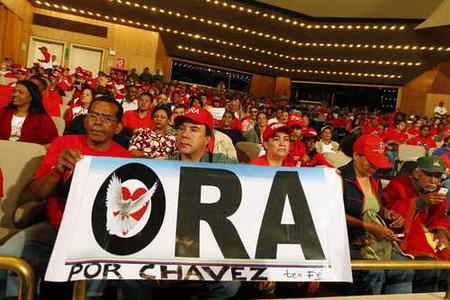 Sympathizers pray for Hugo Chávez’s health. PHOTO/Reuters
President Felipe Calderón wishes Hugo Chávez a full and speedy recovery from cancer surgery, pays homage to Chávez’s hero Simón Bolívar, flirts with Chávez’s Bolivarian movement, and welcomes the CIA, DEA and other U.S. intelligence agencies into Mexico. Is the president guilty of a fraudulent double discourse, or is he maintaining a skillful balancing act?
When Hugo Chávez announced that he was going to Havana this week for treatment of a newly discovered intestinal tumor, the Mexican government sent him and “the people of Venezuela” a message wishing him a full and speedy recovery. The message, publicized by the office of Secretary of Foreign Relations Patricia Espinosa, expressed solidarity “with the people and government of the sister Republic of Venezuela.” The government of Mexico, read the quasi-diplomatic note, “manifests its desire that the operation is successful and that the Venezuelan leader fully recovers.”
Chávez later told the press that he had received expressions of solidarity, in writing and by telephone, from fellow presidents Ortega of Nicaragua, Mujica of Uruguay, Morales of Bolivia, Fernández of Argentina, and a letter from Felipe Calderón who, said Chávez, expressed “his solidarity with the people and government” of Venezuela.
Has the conservative government of Felipe Calderón joined the march toward 21st century Socialism? Hardly! But the Bolivarian movement of Hugo Chávez is more complicated than that, and there is a dimension of bolivarianismo with which conservatives like Calderón have identified: regional sovereignty and freedom from U.S. hegemony. Anti-imperialism has long been associated with the Latin American left, but the question of sovereignty resonates equally with many Latin American conservatives. While Calderón’s expression of “solidarity” with the Venezuelan government brings this paradox to the fore, it is not new.
This past December 2, for example, at the Teresa Carreño Theater in Caracas, Calderón opened the founding “presidential summit” of the Community of Latin American and Caribbean States (CELAC) with phrases that the radical Venezuelan president has long championed.
“Bolívar’s idea is still in force and is common to all Latin American and Caribbean peoples,” the conservative Mexican told the assembled heads of state and government. “I am convinced: This is the hour and this is the decade of Latin America, and we have to step up the pace toward integration.” It was in Calderón’s Mexico that the idea was generated at a preparatory meeting two years ago: an integrated community of 33 countries, all the sovereign states of the Americas except the United States and Canada.