
by ROBERT SMITH
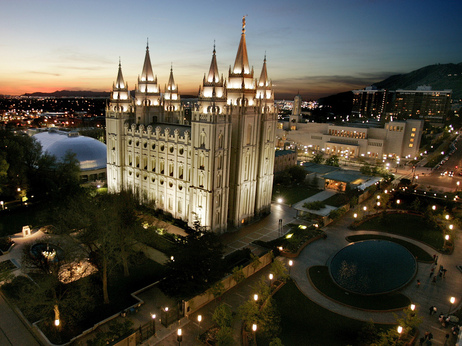 The money Mormons tithe goes to The Church of Jesus Christ of Latter-day Saints headquarters in Salt Lake City, Utah, and then is distributed to congregations around the world. PHOTO/Douglas C. Pizac/AP
Many religious traditions stress the importance of charity. But Mormons are remarkable for the amount and the precision with which they give to their church.
The Church of Jesus Christ of Latter-day Saints teaches that each Mormon in good standing should tithe 10 percent of his or her income. The money goes right to church headquarters in Salt Lake City and then is distributed back to congregations around the world.
“That’s written in stone, and preached from the pulpit,” says Gordon Dahl, an economist at the University of California, San Diego, who is Mormon.
…
“Suppose your parents gave you $500 for Christmas,” he told them. “Would you pay tithing on that money?”
That was a resounding yes among Mormons. Gifts of cash are definitely considered income.
What about a gift of a sofa worth $500? Not so much. Few Mormons said they would tithe on that.
…
David Shapiro, a financial adviser in Littleton, Colo., says there is often a difference of opinion on these issues within Mormonism. In fact, Shapiro and his wife had different tithing styles when he got married.
He tithed on his gross, pretax income. His wife tithed on her net income — she took out taxes first, then tithed on the rest.
“Her logic was [that the] money I pay to the government isn’t money in my pocket,” Shapiro says. “So I shouldn’t have to pay tithing on that”
Shapiro eventually convinced his wife to pay on the larger amount.
NPR for more
(Thanks to reader)