
by ISRAEL SHAMIR
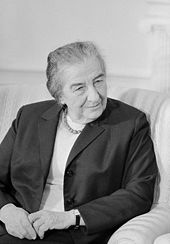
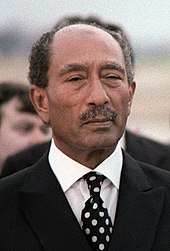 Golda Meir (left) and Anwar Sadat (right) PHOTOS/Wikipedia
 On October 31, 1973, Egyptian foreign minister Ismail Fahmi (left) meets with Richard Nixon (middle) and Henry Kissinger (right), about a week after the end of fighting in the Yom Kippur War. PHOTO/Wikipedia
Here in Moscow I recently received a dark-blue folder dated 1975. It contains one of the most well-buried secrets of Middle Eastern and of US diplomacy. The secret file, written by the Soviet Ambassador in Cairo, Vladimir M. Vinogradov, apparently a draft for a memorandum addressed to the Soviet politbureau, describes the 1973 October War as a collusive enterprise between US, Egyptian and Israeli leaders, orchestrated by Henry Kissinger. If you are an Egyptian reader this revelation is likely to upset you. I, an Israeli who fought the Egyptians in the 1973 war, was equally upset and distressed, – yet still excited by the discovery. For an American it is likely to come as a shock.
According to the Vinogradov memo (to be published by us in full in the Russian weekly Expert next Monday), Anwar al-Sadat, holder of the titles of President, Prime Minister, ASU Chairman, Chief Commander, Supreme Military Ruler, entered into conspiracy with the Israelis, betrayed his ally Syria, condemned the Syrian army to destruction and Damascus to bombardment, allowed General Sharon’s tanks to cross without hindrance to the western bank of the Suez Canal, and actually planned a defeat of the Egyptian troops in the October War. Egyptian soldiers and officers bravely and successfully fought the Israeli enemy – too successfully for Sadat’s liking as he began the war in order to allow for the US comeback to the Middle East.
He was not the only conspirator: according to Vinogradov, the grandmotherly Golda Meir knowingly sacrificed two thousand of Israel’s best fighters – she possibly thought fewer would be killed — in order to give Sadat his moment of glory and to let the US secure its positions in the Middle East. The memo allows for a completely new interpretation of the Camp David Treaty, as one achieved by deceit and treachery.
Vladimir Vinogradov was a prominent and brilliant Soviet diplomat; he served as ambassador to Tokyo in the 1960s, to Cairo from 1970 to 1974, co-chairman of the Geneva Peace Conference, ambassador to Teheran during the Islamic revolution, the USSR Deputy Minister of Foreign Affairs and the Minister of Foreign Affairs of the Russian Federation. He was a gifted painter and a prolific writer; his archive has hundreds of pages of unique observations and notes covering international affairs, but the place of honor goes to his Cairo diaries, and among others, descriptions of his hundreds of meetings with Sadat and the full sequence of the war as he observed it unfold at Sadat’s hq as the big decisions were made. When published, these notes will allow to re-evaluate the post-Nasser period of Egyptian history.
Vinogradov arrived to Cairo for Nasser’s funeral and remained there as the Ambassador. He recorded the creeping coup of Sadat, least bright of Nasser’s men, who became Egypt’s president by chance, as he was the vice-president at Nasser’s death. Soon he dismissed, purged and imprisoned practically all important Egyptian politicians, the comrades-in-arms of Gamal Abd el Nasser, and dismantled the edifice of Nasser’s socialism. Vinogradov was an astute observer; not a conspiracy cuckoo. Far from being headstrong and doctrinaire, he was a friend of Arabs and a consistent supporter and promoter of a lasting and just peace between the Arabs and Israel, a peace that would meet Palestinian needs and ensure Jewish prosperity.
The pearl of his archive is the file called The Middle Eastern Games. It contains some 20 typewritten pages edited by hand in blue ink, apparently a draft for a memo to the Politburo and to the government, dated January 1975, soon after his return from Cairo. The file contains the deadly secret of the collusion he observed. It is written in lively and highly readable Russian, not in the bureaucratese we’d expect. Two pages are added to the file in May 1975; they describe Vinogradov’s visit to Amman and his informal talks with Abu Zeid Rifai, the Prime Minister, and his exchange of views with the Soviet Ambassador in Damascus. Vinogradov did not voice his opinions until 1998, and even then he did not speak as openly as in this draft. Actually, when the suggestion of collusion was presented to him by the Jordanian prime minister, being a prudent diplomat, he refused to discuss it.
Counterpunch for more