
by MALISE RUTHVEN
Shi’ism: A Religion of Protest, by Hamid Dabashi, Belknap Press/Harvard University Press, 413 pp., $29.95
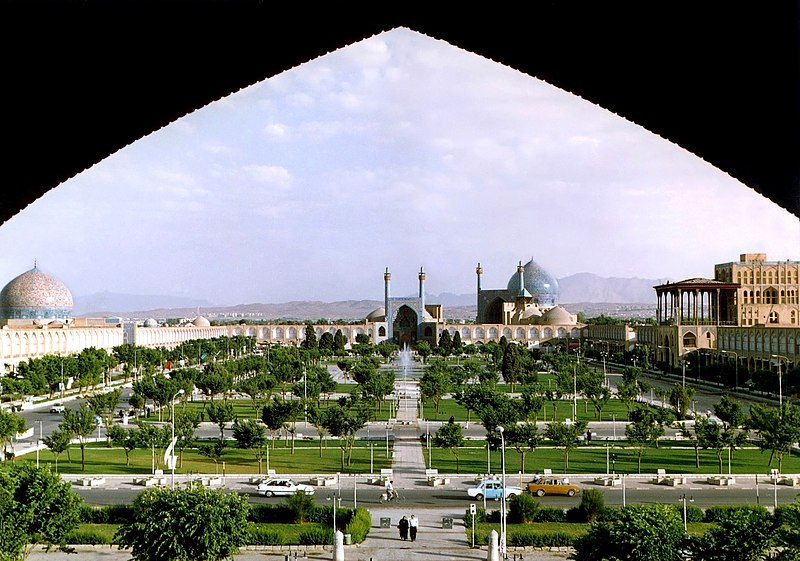 Naqshe Jahan Square (World Square), the biggest historic square in the world. Isfahan, Iran. SOURCE/Wikipedia
In 2004, anticipating the victory of the Shiite parties in the Iraqi parliamentary elections, King Abdullah of Jordan warned of a “Shiite crescent” stretching from Iran into Iraq, Syria, and Lebanon that would be dominated by Iran with its large majority of Shias and Shiite clerical leadership. The idea was picked up by the Saudi foreign minister, who described the US intervention in Iraq as a “handover of Iraq to Iran” since the US was supporting mainly Shiite groups there after overthrowing Saddam Hussein’s Sunni regime. President Hosni Mubarak of Egypt claimed that Shias residing in Arab countries were more loyal to Iran than to their own governments. In an Op-Ed published in The Washington Post in November 2006, Nawaf Obaid, national security adviser to King Abdullah of Saudi Arabia, reflected on the urgent need to support Iraq’s Sunni minority, which had lost power after centuries of ruling over a Shiite majority comprising more than 65 percent of the Iraqi population.
Shiaphobia is nothing new for Saudi Arabia. The kingdom’s legitimacy derives from the Wahhabi sect of Islam, a Sunni Muslim group that attacked Shiite shrines in Iraq in the nineteenth century, and today systematically discriminates against Shias. We know from WikiLeaks that the US government regards the Saudi monarchy as a “critical financial support base” for al-Qaeda, the Taliban, Lashkar-e-Taiba, and other terrorist groups. As well as attacking American and Indian targets, all these are violently anti-Shiite. We also know that the Saudi king venomously urged his US allies to cut off the “head of the snake” by attacking Shiite Iran.
…
The Shias, by contrast, institutionalized the Prophet’s charisma by investing their imams with special sources of esoteric knowledge to which they, through their religious leaders, had exclusive access. Hence Shiism, arguably, presents a more unified approach to Islam than Sunnism, though one that (like Protestantism) is opposed to the mainstream. During Islam’s formative era most of the holy and sinless Shiite imams in the line of Muhammad were deemed to have been martyrs or victims of the usurping Sunni caliphs. After the twelfth imam in the direct line of Muhammad finally “disappeared” in 940, Shiite authority came to be exercised by a formidable clerical establishment—comparable to the Catholic priesthood. These religious specialists were assumed to be in possession of the esoteric knowledge and interpretive skills necessary for the community’s guidance. The parallels with Christianity are striking. For the people called Ithnasharis, or Twelvers (who comprise the majority of the Shia), the disappeared or “Hidden Imam” is a messianic figure who will return (like the resurrected Jesus) to bring peace and justice to a world torn by strife.
…
A larger criticism of the book is that Dabashi fails to address Shiism as comprehensively as his project demands. For example, while he celebrates the Ismaili variant of Shiism in the work of Nasir Khusraw, he is silent on the survival of this tradition for nearly a millennium in the Pamir Mountains of Central Asia (now Tajikistan), followed by seven decades of Communist rule. He is also silent on the remarkable spread of Ismailism in South Asia (mainly Sindh, Gujarat, and Mumbai).
With its unique language and literature, for which the Khoja Ismailis of India invented a special language and script, and its genius for translating Hindu concepts and symbols into the Islamic religious vernacular, Ismailism may be seen as a significant inheritor of the Safavid version of Shiism that Dabashi admires. An impressive model of an enlightenment tendency within the Islamic fold, Ismailis are engaging creatively with contemporary architectural practice, commerce, public health, women’s rights, social empowerment, and a range of contemporary concerns, not just in the developing world but in Europe and North America.
I suspect that Dabashi neglects this quiet Islamic revolution because it does not fit his theme of a tragic bifurcation between artistic creativity and juridical scholasticism that afflicted Iranian Shiism in the post-Safavid era. As a Shiite minority living in the diaspora but with a strong centralized leadership, the Ismailis have preserved the integrity of their tradition while advancing public engagement with the countries in which they reside. They have achieved this by running with the flow of political power—with the British in India, East Africa, and Canada, with the Portuguese in southern Africa, with the Soviets in Central Asia, and—until the current crisis—with their former Alawi rivals in Syria. Dabashi’s somewhat cliché-ridden, anti-imperialist model is based essentially on the Iranian historical experience. It would have to be modified considerably if he were able to accommodate the Ismaili story of social and educational advance, business success, and significant cultural achievements.
The New York Review of Books for more
(Thanks to Robin Khundkar. His note: “I am sold on this. Just ordered my copy from Amazon.”