
Controversial work paves way for scientists to breed primates that are born with the genetic faults responsible for human conditions such as Parkinson’s and motor neurone disease.
By Ian Sample, science correspondent
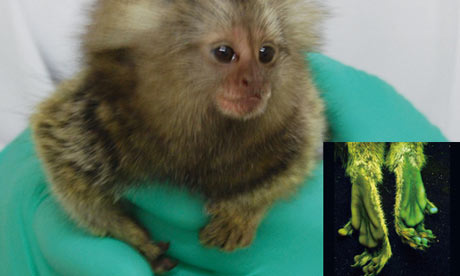
The skin on the soles of the GM marmosets glows green under ultraviolet light. Some of the monkeys passed on the trait to their offspring. Photograph: Nature
Genetically modified monkeys that glow in ultraviolet light and pass the trait on to their young have been created by scientists in Japan in controversial research that “raises the stakes” over animals rights.
The work paves the way for scientists to breed large populations of primates with genetic faults responsible for incurable human conditions, but could also spark an ethical backlash for introducing harmful genes into the primate population.
Researchers hailed the feat as a major step towards understanding the development of inherited diseases, such as Parkinson’s and motor neurone disease, from the cradle to the grave. But the work is likely to dismay animal rights groups as it could lead to a rise in the number of primates used in research labs.
The work also raises the possibility of genetically modifying humans, although such work is outlawed in most countries, including Britain.
Guardian for more