
SEED
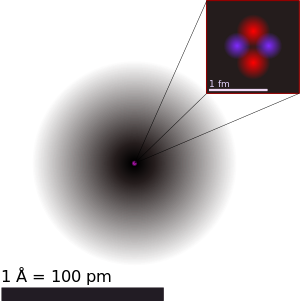
An illustration of the helium atom, depicting the nucleus (pink) and the electron cloud distribution (black). The nucleus (upper right) in helium-4 is in reality spherically symmetric and closely resembles the electron cloud, although for more complicated nuclei this is not always the case. The black bar is one angstrom (10-10 m or 100 pm). Image/Wikipedia
In his famous Lectures on Physics, Richard Feynman presented this interesting speculation:
“If, in some cataclysm, all of scientific knowledge were to be destroyed, and only one sentence passed on to the next generations of creatures, what statement would contain the most information in the fewest words? I believe it is the atomic hypothesis (or the atomic fact, or whatever you wish to call it) that all things are made of atoms—little particles that move around in perpetual motion, attracting each other when they are a little distance apart, but repelling upon being squeezed into one another. In that one sentence, you will see, there is an enormous amount of information about the world, if just a little imagination and thinking are applied.”
Fascinated by Feynman’s question, Seed put a similar one to a number of leading thinkers: “Imagine—much as Feynman asked his audience—that in a mission to change everyone’s thinking about the world, you can take only one lesson from your field as a guide. In a single statement, what would it be?” Here are their answers:
Seed for more