
by BILAL QURESHI
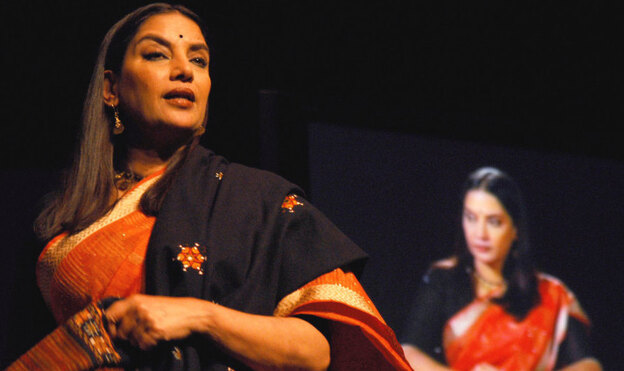 Identity Crisis: Shabana Azmi stars in playwright Girish Karnad’s Kennedy Center production of Broken Images, about a Hindu short-story writer who wonders if she has betrayed her language and identity by writing an English best-seller. PHOTO/Kennedy Center
In a typical Bollywood dance number, a beauty queen might be seen singing in the rain as she awaits her lover’s return. The leading lady is known for her beauty, her dance skills and her ability to deliver a convincing lip sync.
But Shabana Azmi is not your typical Indian movie star.
Yes, she’s beautiful and she’ll do the mainstream dance numbers — but during her 40 years in cinema, Azmi has also portrayed women fighting for a place in Indian society.
“From rural to urban to middle class to across region[s], she in many ways encapsulates the portrayals of women in Indian cinema,” says fellow Indian actress Nandita Das.
So while Azmi can play the Bollywood part, the actress, activist and sometime politician is better known for using the attention those roles attract to spotlight her more socially conscious projects.
Art As ‘Instrument For Social Change’
Shabana Azmi is the daughter of acclaimed Indian poet Kaifi Azmi — an active member of India’s Communist Party — and was raised in a secular Muslim family.
“I grew up in a family that believed that art should be used as an instrument for social change,” Azmi says.
…
Playwright Girish Karnad says despite Azmi’s fame, she’s not exactly someone you’d characterize as glamorous.
“She’s not someone who could have been an Elizabeth Taylor of Indian cinema,” Karnad says. “If you look at her, she looks like an ordinary woman. It’s only when she acts that she begins to glow.”
And that glow has been known to cause quite a stir.
In 1996, Azmi starred in the film Fire alongside actress Nandita Das. It was the first Indian film to openly explore a lesbian relationship, and it was met with protests, death threats and the destruction of Indian cinemas. The Hindu right declared it wicked and an attack on Indian family values.
Five years later — in the aftermath of the Sept. 11 attacks — the actress debated Muslim cleric Syed Ahmed Bukhari, then the head of India’s largest mosque, on live TV about the role of India’s Muslims in the war on terrorism.
“He dismissed me by saying, ‘We don’t have to listen to dancing girls,’ ” Azmi recalls. “I don’t think I could have paid him to make a remark like that — that … boomeranged on his career so badly. Because even amongst his supporters, they were shocked that he should use words like that.”
NPR for more
(Thanks to reader)