
by JASON BURKE
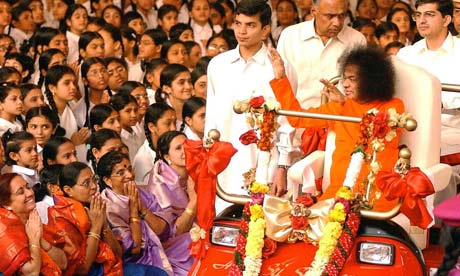 Sai Baba had an estimated six million followers, but critics said his ‘miracles’ were simple magic tricks. PHOTO/AP
The death of Sri Sathya Sai Baba at the age of 85 from heart and breathing problems has prompted scenes of mass grief across India – where his distinctive frizzy hair, trademark saffron robes, controversial miracles and simple message of ecumenical spiritualism had made him a new-age icon.
But though revered by millions around the world as a living god, he was a controversial figure, criticised by some as a fraud protected by political influence. His later years were dogged by allegations of sexual abuse.
The government of the southern Indian state of Andhra Pradesh, where Sai Baba was born, declared four days of mourning. Hundreds of police were deployed in his hometown of Puttaparthi, to maintain order among the thousands of devotees who had gathered over recent days.
In the city of Bangalore, followers walked through the streets carrying portraits of the dead spiritual leader and chanting “Baba is not with us physically. But he remains with us forever.”
In Delhi, worshippers gathered to pray at temples across the city. Many refused to accept that the guru was dead.
“Sai has not gone anywhere. Wait 48 hours. He will be back,” Vandana Bhalla, a 38-year-old housewife in the Indian capital’s middle-class Ashok Vihar neighbourhood told the Guardian.
Among Sai Baba’s estimated six million followers are hundreds of top Indian politicians, industrialists, tycoons, Bollywood stars and sportsmen such as cricketer Sachin Tendulkar. Overseas, they include Goldie Hawn and Isaac Tigrett, the founder of Hard Rock café. Sarah Ferguson has visited one of his ashrams.
Since Sai Baba founded his first permanent meditation centre more than 60 years ago, a vast construction programme funded by donations has converted the remote village where he was born into a thriving small city with dozens of temples, its own 220-bed specialised hospital offering free treatment, a university and an airport where charter planes bringing devotees from around the world arrive every day.
Guardian for more
(Thanks to Salim Amersi)