
by EDWIN CARTLIDGE
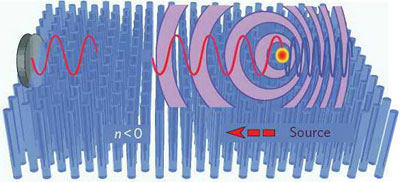 How the inverse Doppler effect works
The Doppler shift of sound or light waves from a moving source is familiar to physicists and non-physicists alike. Now, researchers in China and Australia have seen the more exotic inverse Doppler effect in light passing through a material made from tiny silicon rods. They say the result could enhance the use of the Doppler effect in all sorts of applications, from astronomy to medicine.
In the conventional Doppler effect, the frequency of waves that are emitted by, or bounce off, a moving object increases when the object is moving towards an observer and decreases when the object is moving away. This is because in the former case the waves become compressed as they travel towards the observer – and in the latter case the waves spread out.
In 1968 Soviet physicist Victor Veselago predicted that electromagnetic waves travelling through materials with a negative permittivity and a negative permeability would do the opposite. The frequency should drop for a source moving towards an observer and increase for a source moving away. This is because the magnitude of the Doppler effect is proportional to the refractive index of the medium through which the waves propagate. Whereas the refractive index of air and all other natural media is greater than (or equal to) one, the index of the artificial materials considered by Veselago was negative.
Physics World for more