
by PATRICK KINGSLEY
Scientists hope this year will finally reveal the ‘God particle’
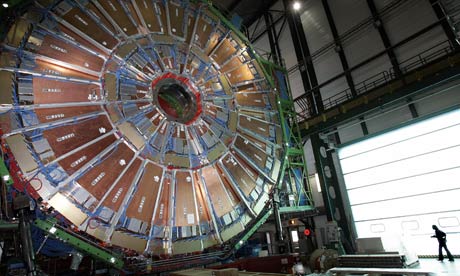 The Large Hadron Collider . . . out of action for half of its two-year history. Fabrice Coffrini/AFP/Getty Images
Britney Spears, Amy Winehouse, Foo Fighters: there are some big comebacks planned for 2011. But surely none will be as literally universe- defining as the third coming of the Large Hadron Collider (LHC), which revved back into gear on Sunday.
Scientists hope that the collider, out of action since early December for its annual winter maintenance, will this year finally reveal the so-called “God particle”, a discovery on which hinges humanity’s very understanding of physics. The particle – known as the Higgs boson – is so small that scientists have never found it; in fact, they are not even sure it exists.
The £5.6bn LHC was set up primarily to prove that it does – and if it is successful, the discovery will confirm long-held theories about the Big Bang, and how the universe was formed. If it is not, most of our physics textbooks will have to be rewritten. For Professor Nicholas Hadley, one of the scientists at CERN, the centre in Switzerland that houses the 17-mile circular collider, the boson’s non-existence might “actually be more intriguing than finding it”.
The Guardian for more