
by BEN GOLDACRE
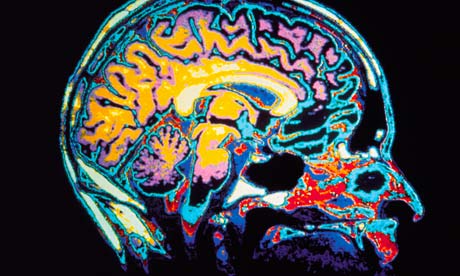 “‘It’s a slightly strange world when a scan of blood flow in the brain is taken as vindication of a subjective mental state.'” PHOTO/Howard Sochurek/Corbis
When the BBC tells you, in a headline, that libido problems are in the brain and not in the mind, you might find yourself wondering what the difference between the two is supposed to be, and whether a science article can really be assuming – in 2010 – that its readers buy into a strange Cartesian dualism in which the self is contained by a funny little spirit entity in constant and elaborate pneumatic connection with the corporeal realm. But first let’s consider the experiment they’re reporting on.
As far as we know (because this experiment has not yet been published, only presented at a conference), some researchers took seven women with a “normal” sex drive, and 19 women diagnosed with “hypoactive sexual desire disorder”. Participants watched a series of erotic films in a scanner while an MRI machine took images of blood flow in their brains: the women with a normal sex drive had an increased flow of blood to some parts of their brain associated with emotion, while those with low libido did not.
Dr Michael Diamond, one of the researchers, tells the Mail: “Being able to identify physiological changes, to me provides significant evidence that it’s a true disorder as opposed to a societal construct”. In the Metro, he goes further: “Researcher Dr Michael Diamond said the findings offer ‘significant evidence’ that persistent low sex drive – known as hypoactive sexual desire disorder (HSDD) – is a genuine physiological disorder and not made up.”
This strikes me as an unusual world view. All mental states have physical correlates, if you believe that the physical activity of the brain is what underlies our sensations, beliefs and experiences. So while different mental states will be associated with different physical states, that doesn’t tell you which caused which.
Guardian for more