
by B. R. GOWANI
Humble being
Modi has cultivated a persona of a humble being who was selling tea in a railway compartment from where he rose to the top post. In May 2015 interview, the Time magazine asked him as to “what influences him?” According to Time, before replying, he “chokes and tears up:”
“This touches my deepest core. I was born in a very poor family. I used to sell tea in a railway coach as a child. My mother used to wash utensils and do lowly household work in the houses of others to earn a livelihood. I have seen poverty very closely. I have lived in poverty. As a child, my entire childhood was steeped in poverty. For me, poverty, in a way, was the first inspiration of my life … I decided that I would not live for myself but would live for others.”
The fact is, Dhruv Rathee, a social media activist and YouTuber, points out in his video, that Modi was from a middle class who wore suits and such clothes .
On democracy, Modi told Time magazine, the US and India should work together to strengthen “democratic values all over” the world. Answering whether he would want autocratic power like Chinese leader, he said “democracy” “is in our DNA,” and he would prefer “democratic values” over “wealth, power, prosperity and fame.” He further said his administration “will not tolerate or accept any discrimination based on caste, creed and religion.” His and his government’s philosophy is “Sabka Sath, Sabka Vikas“, which essentially means, “Together with all, progress for all”.
Modi is a master bullshitter. He further added:
“Religion and faith are very personal matters. So far as the government is concerned, there is only one holy book, which is the Constitution of India.”
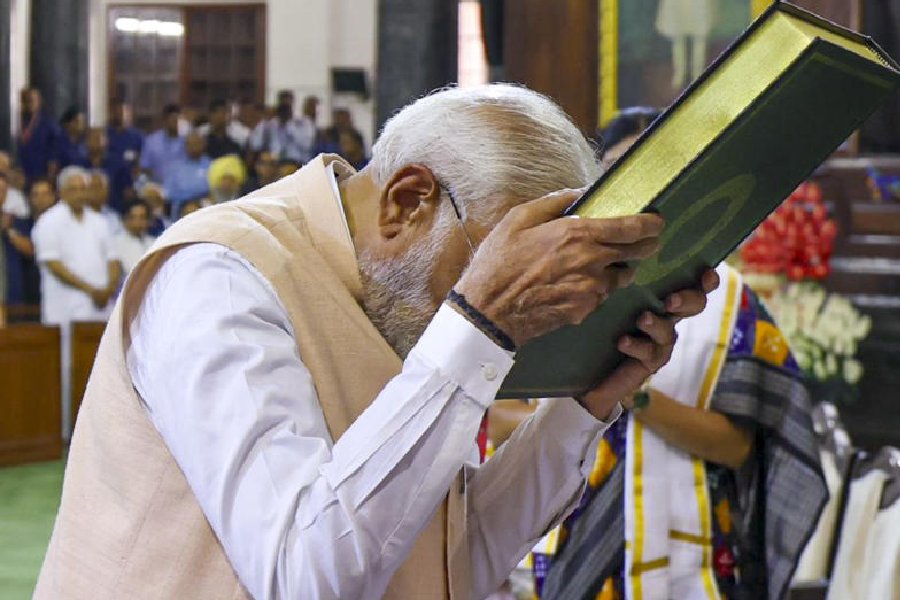
Nine years later, Modi’s party was planning to change that “holy book”‘s secular nature and turn India into a Hindu theocracy by winning over 73% seats. The opposition charged that Modi’s election slogan of “ab ki baar, 400 paar,” that is, in 2024 election Modi’s party wants to win over 400 seats out of total 543 seats, in order to have enough power to change the constitution. In June 2024, Modi visited Samvidhan Sadan (Old Parliament House) and paid respect to the Indian constitution placate opposition’s fear. Anyway, Modi’s party didn’t perform well in the election; with only 240 seats it had to rely on allies to form a government.
Modi’s party BJP didn’t get enough seats to change the constitution but its agenda to make India a “Hindu Rashtra” or Hindu Nation is being implemented through other means.
Unlike Trump, who uses his oral member all the time, Modi knows when to use it and when not to, who to hug and who to avoid, from whom to accept and from whom to refuse.
Modi always hugs foreign leaders, even if they’re reluctant, such as Trump, but refused to accept a cap (worn by many Indian Muslims) from a Muslim leader in India.
Minorities
Modi who belongs to RSS (Rashtriya Swayamsevak Sangh), a communalist paramilitary group, became Chief Minister of Gujarat in October 2001. In less than five months, he strengthened his position by presiding over a pogrom in which more than 2,000 people, mostly Muslims, were killed. For Modi, there was no looking back. The next stop from chief minister-ship was the premiership. In May 2014, he became India’s Prime Minister. Now most Muslims, Christians, and other minorities who had some rights has been turned into second or third class citizens, or non-citizens nationwide.
A Muslim student activist Afreen Fatima describes the plight of Muslims in these words in July 2022:
“Ever wondered what is it like to be a Muslim in the undeclared Hindu state that is India? To be constantly humiliated, demeaned, and brutalized? To have your soul destroyed by the state? And sometimes, your home, too?
“From our faith and history to our eating habits and clothes, the Hindu supremacists ruling India today have spared nothing in their campaign against our community. During the eight years of Narendra Modi’s government, they have taken a sledgehammer to our country’s secular foundations by routinely finding ever newer ways of targeting us. Last month they brought a bulldozer to my home.”
In May of that year, on live TV, a BJP national spokeswoman Nupur Sharma spoke disparagingly of Islamic Prophet Muhammad. There were protests in many Indian cities. Fatima’s father was illegally arrested, without any warrant, her mother and sister were picked up in the middle of the night and spent more than 35 hours at police station. None of them were involved in the protests, Fatima informs Al Jazeera TV in an interview. Their house in Prayagraj (erstwhile Allahabad), Uttar Pradesh, was demolished in what is known in India as “bulldozer justice.” (Uttar Pradesh is India’s most populous state and its Chief Minister is Yogi Adityanath, a roguish politician.)
Javed Mohammad, Fatima’s father, was released after 21 months.
No action was taken against Nupur Sharma until Iran and Arab Gulf monarchies protested. BJP now had to take some action; they just suspended her from the party.
Many other means are used to harass, malign, and humiliate Muslims. Just one example: Muslim women’s vocal opposition to Modi’s anti-Muslim policies saw his followers create an app “Sulli Deals” where Muslim women were auctioned off.
According to India Hate Lab, 2025 saw 13% increase in hate speech events compared to 2024 — more than 88% of them targeted Muslims. (See the full report here.)
Muslims in Gujarat
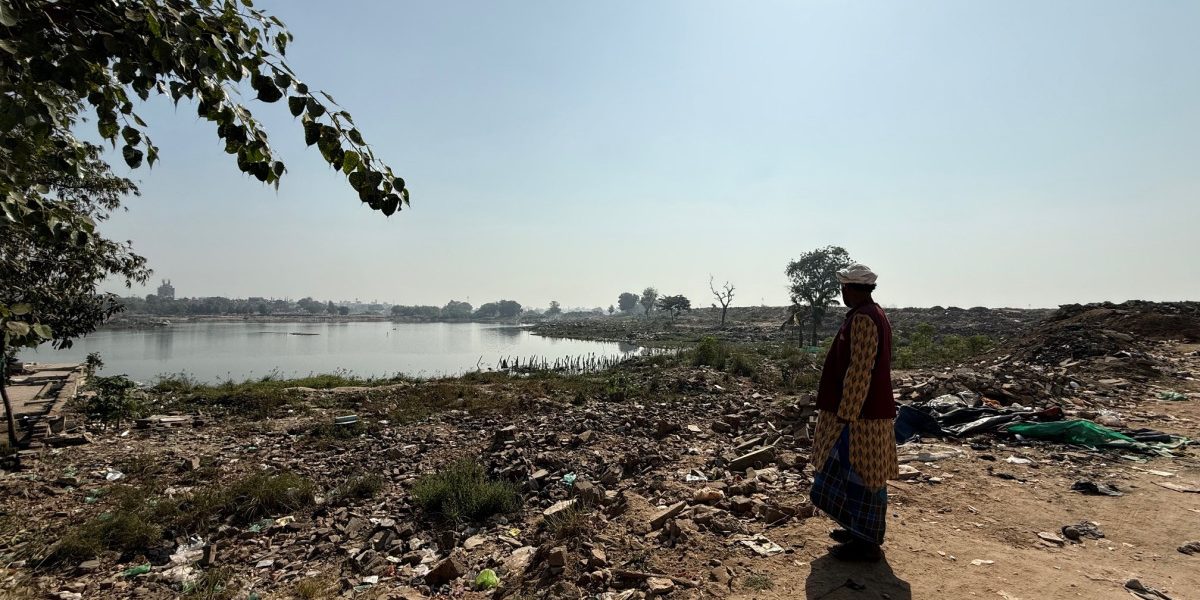
Last year in April and May, a “mega demolition drive” was undertaken by the Gujarat government against what they called illegal Bangladeshi settlements in Ahmedabad’s Chandola Lake area.
At least 12,000 houses were razed, including that of Mumtaz who lamented:
“Everything that I bought with my hard-earned money, and the home I raised my children in, doesn’t exist anymore.”
South Asia has a joint family system. Besides, these houses belonged to very poor people. At the minimum, if you count five persons per house, 60,000 people were turned homeless by the communalist government. What was people’s fault? Their Muslimness.
One of the victims Sarkari Bano said:
“After our homes were stolen from us, landlords would quote us three times the rent, knowing our vulnerability.”
She further added:
“Humein 20 saal peeche kardia hai, yateem, bewa, gareeb sabse chhatt chheen li”
“They have pushed us 20 years back. They’ve robbed roofs from widows, orphans and the poor).”
Prior to demolition in one of the areas, Bengali Vas, 457 men were accused of being from Bangladesh who had entered India illegally. They were paraded for 4 kilometers.
It’s nine months since Saiyed Minhajuddin lost his house. He has to keep passports and ration card in his scooter because there is no safe place in the room he and his wife are renting.
“You know they called me ‘Bangladeshi’, dragged my wife away, calling her a Bangladeshi too. Our passports saved us.”
Several cities in Gujarat have seen houses and shops belonging to Muslims and their mosques and shrines being destroyed.
Muslim shrines are one place which Hindus, Sikhs, Christians, and Muslims visit for the fulfillment of their wishes and intermingle with people of other faith. But when the government demolishes them, a dual purpose is served: a Muslim shrine is gone and so are the interfaith-mingling.
The other factor, besides communalism, is capitalism. A social activist Kaleem Siddiqui, who devoted his time and efforts to help the people who lost their homes in Chandola, pointed out the link between the AMC (Ahmadabad Municipal Corporation) and the builder lobbies:
“A communal narrative was created to kick people out of their homes, using allegations like Bangladeshi, drug peddling etc. [and] Chandola was emptied.”
B. R. Gowani can be reached at brgowani@hotmail.com