
by B. R. GOWANI
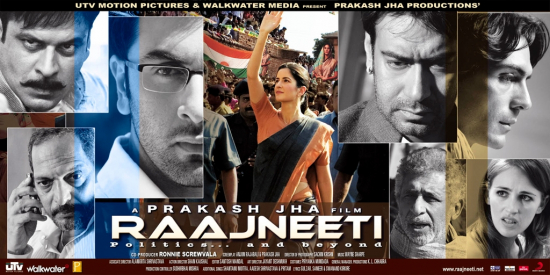 POSTER/Pro Kerala
The recently released film Raajneeti by Prakash Jha is based loosely on the epic Mahabharata (1) with a touch of the Gandhi dynasty with an aura of the Godfather thrown in to indulge the veiwer. According to tradition, the sage Vyasa is considered the writer of the epic. A central aspect is the power struggle between two sets of cousins, the Kauravas (100 brothers) and Pandavas (5 brothers) which ends on the battlefield of Kurukshetra. The Pandavas were the winners. They had Lord Krishna as the guiding force behind their victory – achieved, of course, with great loss of lives and heavy devastation.
Rajneeti has two Pandava brothers Yudhisthira (played by Arjun Rampal) and Arjun (Ranbir Kapoor) and one Kaurava brother, Duryodhan (Manoj Bajpai). Krishna is Nana Patekar, who is omniscient and omnipresent. His character also reminds one of M. K. Gandhi (2). The Pandava brothers had Draupadi as a common wife, which on screen is played by Katrina Kaif, though here, not as a common wife.
Kapoor is in India to attend his uncle’s (Nationalist Party leader) birthday who suffers a stroke during the celebrations. As the heir, Bajpai demands the party leadership, but the sick guy selects his younger brother, and thus begins the power struggle. Ajay Devgan, the Dalit leader was denied a party ticket to fight the election and Bajpai woos the disgruntled Devgan to his side. When the new party leader is murdered, the cousins part ways, prompting Rampal and Kapoor to form a new party named People’s Power Party. But where will the funds come from? Kaif’s father is a rich businessman.
Kaif, who loves Kapoor, proposes marriage but the offer is rejected because he has a girlfriend Sarah Thompson in the US. But for money, Kapoor agrees to marry Kaif—who later on comes to know that she is just being used as a pawn. Her father has a condition: he would marry his daughter to the brother who is running for the Chief Minister-ship. So now Kapoor convinces Rampal to marry Kaif and tells him: “She’ll learn to love you.”
(Benazir Bhutto may have heard the same thing from her mother who arranged her marriage to Zardari. She not only learned to love him, but also produced three children; and left Zardari as her parting gift to Pakistan.)
Next, gripping medley of violence leaves deaths and drama. The continuing enmity and violence claims Rampal and Thompson’s lives. Kapoor along with Nana Patekar sets up a trap for Bajpai, who gets severely wounded in a gunfight. Devgan asks for a ceasefire and throws away his weapon. Patekar asks Kapoor to finish them off but he reasoned that they’re unarmed. Patekar reminds him: “Remember! In politics, the respect is accorded to victory. And your victory is incomplete till the time he is alive.” This was the time for Kapoor to take an independent stand, but like Mahabharat’s Arjun, he listens and shoots Devgan, who looks at his half youngest brother. Patekar knows this fact but Kapoor does not.
In the Bhagavad-Gita (The Song of God), on the battlefield, Arjun shows his hesitancy: “I shall not fight.” Krishna coaxed:
“Either killed you will attain heaven,
or conquering you will enjoy the earth.
Therefore stand up, Kaunteya [Son of Kunti], resolved to the battle.”
The new party leader is Rampal’s widow Kaif. (You can’t avoid thinking of Sonia Gandhi. In the film, the word “widow” has been changed to “daughter” when one of the villagers, played by Jha himself, opines that Kaif will get most of the votes.) She gets elected on a sympathy vote (3). Kapoor, like Ashoka the Great, (4) regrets the violence that ensued in lieu of his decision to join politics which unleashed the inside demon within him. Kaif, who still loves Kapoor, informs him that she is pregnant. Kapoor promises that he’ll return soon. The impression viewers get is that Draupadi will unite with her Arjun.
Jha himself has unsuccessfully contested two elections and has seen from near how dirty and corrupt the political system is—deadly violence and power at any cost are part of the game.
Minus the weaknesses (listed below), one cannot downplay the film’s plus factors. Except for a few scenes, the screenplay, by Jha and Anjum Rajabali is well written, has enough drama, and the actors have done good work to hold audience’s interest. Cameramen Sachin K. Krishn has succeeded in creating a sense of an epic. Editor Santosh Mandal should have used his scissors more. Over all, the film is watch-able. One wishes Naseeruddin Shah, the leftist leader and Devgan’s father, had a bigger role.
Some of the things Jha should have avoided:
He shouldn’t have had the character of Suraj in the film. Not only such a brilliant actor as Ajay Devgan didn’t get a chance to show his full histrionics, but it also looks ridiculous when his real mother (also of Rampal and Kapoor) begs him to return, and being the eldest (half) brother, to take over the party leadership.
In Mahabharata, before her marriage to Pandu, Kunti (the mother of Pandavas) had a son called Karna by sun. Karna was abandoned and adopted by a couple. In the film, Devgan, when abondoned upon his birth by Patekar, was adopted by a low caste couple. His adoptive father is a driver in his birth mother’s family.
So many old South Asian movies have had similar kinds of scenes that in a political drama of 2010, it is difficult to digest this rubbish: man and woman meet, man leaves (either intentionally or due to circumstances), woman is pregnant, child born out of wedlock, father is unaware, child is abandoned, adopted by a family, child shows up as a grown up man, and is face to face with the real parents.
There should have been a low caste character in the film as a voice of the Dalit people.
Also, the movie has several minutes of excessive violence which could have been depicted in an abbreviated, subtle and abstract way; allowing the artistic talents of the actors to be displayed more and to save time. The Godfather style murder of one of the gay partners was an absolutely unnecessary part to the overall plot. Just the pictures of the two men sleeping together would have been enough to get the senior guy to agree to malign Bajpai. Also, very rarely, politicians themselves go out and fight, it is done by their henchmen. So it is too much when Rampal, Bajpai, and Kapoor are out blowing up cars or shooting their opponents.
Then there is the sex factor. Justifying as “absolutely essential,” Jha was disappointed that a “very aesthetically shot love making scene,” got reduced to half under the censor board knife. One more sex scene in the film in standing position in front of the mirror focusing on Shruti Seth’s facial expressions and her asking for the party ticket should actually belong to an adult movie. And one scene “featuring Arjun Rampal and a theatre actress (name withheld) turned out so explicit that the actress in question has requested the director to keep her name out of the credits.” Jha accepted that it had gone a bit too far. Rampal “feared the love-making sequence would not go down well with his wife and daughters. He even requested a re-shoot.” How far did it go? Did the body parts get too wet? The scene was deleted before submitting the movie to the film censor board. According to Jha, the scene will be in the DVD version.
So much sex and violence are readily available on the internet and elsewhere, so it would have been better to concentrate on the central theme of Rajneeti (Politics) rather than indulging in sex. Besides, most of the South Asians watch films with families. (5). The time saved in violence and sex could have been devoted to a scene or two of parliamentary proceedings, which are never short on drama, to give viewers better understanding of the mess generated in their name in the legislative branch.
If the name of the dissertation of Kapoor’s PhD, “The Sub-textual, Emotional Violence of the 19th century Victorian Poetry,” would instead have been, “Was Machiavelli’s Prince Inclined Towards the Rulers or the Subjects” or “Chanakya’s Relevance to the 21st Century South Asia” (or some other title related to realpolitik,) it would have made more believable his transformation from someone indifferent to politics, to a shrewd political strategist. He entered politics as a result of his father’s murder.
To make it more believable, the murder should have taken place at the airport where the father comes out of the car to say good bye to his son, rather than on the road; because, when the traffic is blocked and the car has come to a standstill, with so many police cars around the first thing a person in charge of security would do is to provide cover to the politician.
All told, it was a gripping movie that could have been better.
B. R. Gowani can be reached at brgowani@hotmail.com
Notes:
(1) The greater Mahabharata than Vyasa’s occurred in 1947 when brothers/cousins could not resolve their differences or tame their arrogance and India was divided into two: India and Pakistan. Aftershock of that division occurred in 1971 when Pakistan was split into Pakistan and Bangladesh. Both separations were quite bloody. More separations cannot be ruled out.
(2) Gandhi’s presence in the Congress Party was similar to Patekar’s, that is, totally in control of all the strings. Dissidents couldn’t survive. Many had that experience, especially Subhas Chandra Bose.
(3) This is common in South Asia: After Prime Minister Indira Gandhi’s murder, her son Rajiv Gandhi got the sympathy vote and became the new premier. After Rajiv’s murder, his widow Sonia Gandhi became the Congress Party leader. Benazir’s death got Zardari in office.
(4) Basically, it is an opportunity for actors to fulfill their fantasies by performing their “job.” For directors, cameramen, and others watching these kinds of scenes may give a boost to their intimate life. Otherwise it serves no purpose. There are many other aspects to the story that have been ignored.
(5) The Mauryan Emperor whose rule extended from Afghanistan to India (Bangladesh and Pakistan included) renounced violence when he initiated war in about 260 BCE against the state of Kalinga which resulted in a great loss of life.