
by ZUBAIR TORWALI
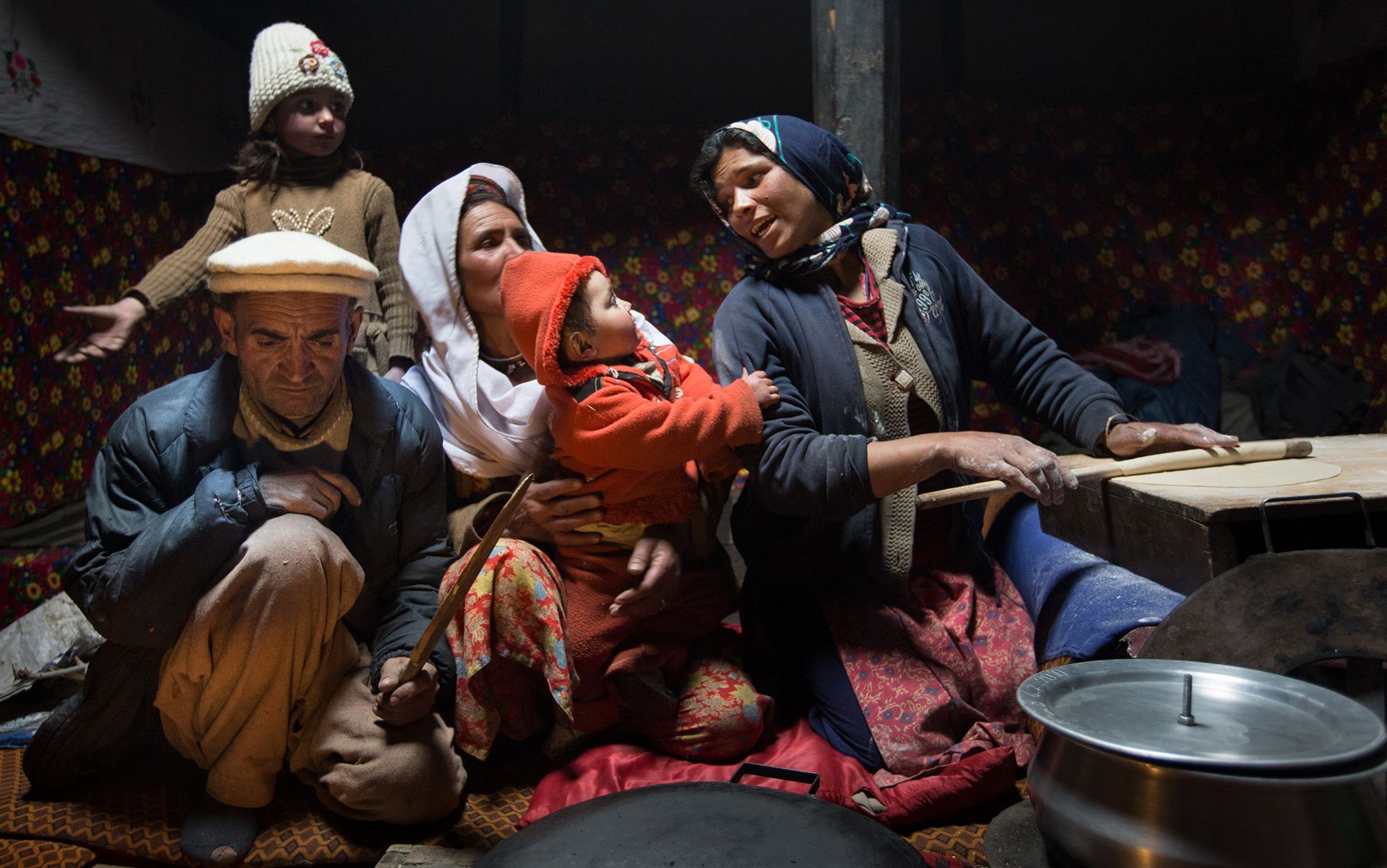
At the crossroads of south and central Asia lies one of the world’s most multilingual places, with songs and poetry to match
Dardistan is one of the most diverse linguistic regions in the world. In the 1930s, the Norwegian linguist Georg Morgenstierne called it one of the most polyglot parts of Asia. More recently, the Italian anthropologist Augusto Cacopardo has called it ‘Peristan’, an area with an ‘enormous diversity of tongues and cultures’. The region has the large Dardic languages such as Kashmiri, Shina and Khowar on the one hand and, on the other, it is home to the Burushaski language, which could not be placed within any language family because of its unique features. The Nuristani, formerly Kafiri, languages are spoken here, too. There are minor languages such as Kalasha, spoken by the Kalash community of hardly 4,000 people who still follow the ancient animistic religion that was once practised across Dardistan.
The name ‘Dardistan’ describes the area comprising the highest mountain ranges of Hindu Kush, Karakoram, western Himalaya and the Pamir mountains, and includes northern Pakistan, parts of Eastern Tibet in China, eastern Afghanistan and the Kashmir valley on both sides of the Pakistan-India border.
Dardistan’s enormous linguistic diversity occurs despite the fact that, culturally, the area is fairly homogeneous. Cacopardo says there is no match for this region in terms of linguistic and cultural diversity, except the Caucasus. Though, of course, minor differences exist, the same religious rituals and religious pantheon prevailed among the polyglot peoples of Dardistan.
The many languages spoken here, though mostly belonging to the Indo-European family, still more narrowly to the Dardic sub-family within the Indo-Aryan group, are so different from each other that the people of one linguistic community have to rely on a third language, Pashto or Urdu, to communicate with members of another community. For instance, the people belonging to the Torwali and Gawri communities of the upper Swat valley in Pakistan need Pashto to converse with each other. This is despite the fact that the Torwali and Gawri languages are ‘sister languages’ and seem to have evolved from one single language a few centuries ago when Swat was taken over by the Yousafzai Pathans in the 16th century.
In 1986, the Summer Institute of Linguistics in collaboration with the National Institute of Folk Heritage, Lok Virsa, and the National Institute of Pakistan Studies at the Quad-e-Azam University in Islamabad, undertook a survey of the languages of northern Pakistan. Published in five volumes, this Sociolinguistic Survey of Northern Pakistan (1992) documented 25 languages. In fact, there are even more – at least 35 – languages in north Pakistan, namely Badeshi, Bateri, Balti, Brokskat, Burushaski, Chilisso, Dameli, Domaaki, Gawar-Bati, Gawri, Gowro, Gujari, Hindko, Kalasha, Kalkoti, Kamviri, Kashmiri, Kativiri, Khowar, Kohistani, Kundal Shahi, Kyrgyz, Madakhlashti, Mankiyali, Ormuri, Pahari, Palula, Pashto, Sarikoli, Shina, Torwali, Ushojo, Yadgha, Wakhi, and Waneci.
In his paper ‘India as a Linguistic Area’ (1956), the linguist M B Emeneau uses the phrase ‘linguistic area’ as a technical term to mean an area that includes languages of more than one family sharing some common traits with one another, but not all the linguistic features are alike among the language families. More recently, the Swedish linguist Henrik Liljegren has spent the past two decades conducting research on the languages of the northwestern fringe of the Indian subcontinent. His comparative study ‘The Hindu Kush–Karakorum and Linguistic Areality’ (2020) offers one definition of ‘linguistic area’ as ‘a geographical area with well-defined and neat boundaries within which all or most of the languages, regardless of phylogenetic identity, share a significant number of unique features that have arisen as the result of contact’.
At the same time, Liljegren suggests that this part of the world is not a ‘linguistic area’ in that conventional meaning. Instead, he argues that the Hindu Kush–Karakorum (HK) – also known as Dardistan – is a ‘linguistic area’ in the sense that it is a ‘convergence zone with a core that shares certain linguistic features’ as a result of a prolonged period of contact with other subareas whose languages do not share all the features of HK yet display some other ‘micro-areal convergence’.
Writing a century earlier, Morgenstierne was correct to claim that the region is among the most linguistically diverse in the world. Presently, about 50 languages are spoken here. Despite the Islamisation ongoing since the 16th century, the region has maintained this linguistic diversity but it is under grave threat. Dardistan is at the crossroads of South Asia and Central Asia. It is mountainous and makes for very hard travelling. Its mountain valleys remained isolated, beyond the reach of the invaders during the Islamisation, political domestication by Asian nation-states or colonisation by Europe. It is perhaps thanks to Dardistan’s mountainous geography that we still find such a rich array of languages from different linguistic phyla here.
Aeon for more