
Birds are falling from the sky in India as a record heatwave dries up water sources
by ALIA SHOAIB

- Dehydrated birds are falling from the sky in India as a record heatwave dries up water sources.
- In India’s Gujarat state dozens of high flying birds such as pigeons or kites are falling from the sky daily.
- This month temperatures were expected to peak at around 122°F near the India and Pakistan border.
Dehydrated birds are falling from the sky in India as a record heatwave dries up water sources, veterinary doctors and animal rescuers said, according to Reuters.
In India’s western Gujarat state, currently averaging temperatures over 110°F, dozens of high flying birds, including pigeons and kites, have been dropping out of the sky every day, Reuters reported.
Vets in an animal hospital in Ahmedabad said they had treated thousands of birds in recent weeks, the outlet said.
“This year has been one of the worst in recent times. We have seen a 10% increase in the number of birds that need rescuing,” Manoj Bhavsar, who works with the trust and has been rescuing birds for over a decade, told Reuters.
Vets have been injecting water into birds’ mouths with syringes and feeding them multivitamin tablets.
Other animals, including cats, have also been suffering from dehydration.
Since March, large parts of India and Pakistan have been suffering from searing temperatures, which the World Meteorological Organization said was India’s hottest March.
This month temperatures were expected to peak at around 122°F near the India and Pakistan border.
The nearly “unsurvivable” heat is increasingly the result of human-caused climate change, according to Yale Climate Connections.
Yahoo News for more
The age of extinction is here — some of us just don’tkKnow it yet
by UMAIR HAQUE
We’re crossing the threshold of survivability — and there’s no going back
“Why do you think people are a little freaked out by what I’m talking about these days?”
I was asking my kid sis. She laughed. “You’re basically telling them it’s the end of the world?”
It was the night of the eclipse. A red moon illuminated the sky. 300,000 years had gone by since our kind walked the earth. And now it would never be the same again.
Let me try and tell you how I’ve come to think of the Event, as I’ve begun to call it. The Cataclysm. Extinction. A different earth.
My friends in the Indian Subcontinent tell me stories, these days, that seem like science fiction. The heatwave there is pushing the boundaries of survivability. My other sister says that in the old, beautiful city of artists and poets, eagles are falling dead from the sky. They are just dropping dead and landing on houses, monuments, shops. They can’t fly anymore.
The streets, she says, are lined with dead things. Dogs. Cats. Cows. Animals of all kinds are just there, dead. They’ve perished in the killing heat. They can’t survive.
People, too, try to flee. They run indoors, spend all day in canals and rivers and lakes, and those who can’t, too, line the streets, passed out, pushed to the edge. They’re poor countries. We won’t know how many this heatwave has killed for some time to come. Many won’t even be counted.
Think about all that for a moment. Really stop and think about it. Stop the automatic motions of everyday life you go through and think about it.
You see, my Western friends read stories like this, and then they go back to obsessing over the Kardashians or Wonder Woman or Johnny Depp or Batman. They don’t understand yet. Because this is beyond the limits of what homo sapiens can really comprehend, the Event. That world is coming for them, too.
The analogy is often used to describe “climate change” of frogs in a boiling pot. It’s useful, but only to a certain degree. When the pot boils, they’re taken out and eaten. We were in a boiling pot, and now we’re at the stage where we’re about to get taken out and eaten. This is when things start to get really, really bad — really, really fast.
The way that I’ve come to think of the Event — a species that’s been around for 300,000 years now having altered the climate in ways that haven’t happened for millions of years, triggering an Extinction Event — is this.
Imagine a black hole. Humanity’s lined up before it. Everyone has to march through. Some are at the front of the line. They reach the other side first. Some are at the back of the line. They’re still laughing and joking and pretending, maybe. Nobody much hears from those who’ve gone through, because, well, it’s a black hole. But on the other side, nothing is ever to be the same again.
This is where we are now. We are at the threshold of the Cataclysm. Some of us are now crossing over to the other side, of a different planet, one that’s going to become unlivable. This isn’t “going to happen” or “might happen,” it is actually happening now.
Medium for more
India and Pakistan’s brutal heat wave poised to resurge
by JEFF MASTERS

2022 will likely be one of the coolest years Earth will experience in the foreseeable future; much more intense heat waves are in India and Pakistan’s future.
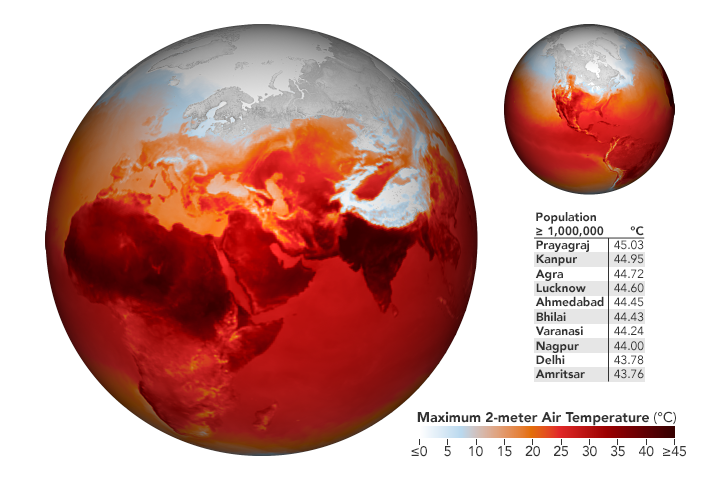
A brutal, record-intensity heat wave that has engulfed much of India and Pakistan since March eased somewhat this week, but is poised to roar back in the coming week with inferno-like temperatures of up to 50 degrees Celsius (122°F). The heat, when combined with high levels of humidity – especially near the coast and along the Indus River Valley – will produce dangerously high levels of heat stress that will approach or exceed the limit of survivability for people outdoors for an extended period.
The latest forecasts from the GFS and European models predict an unusually strong region of high pressure intensifying over southern Asia in the coming week, bringing increasing heat that will peak on May 11-12, with highs near 50 degrees Celsius (122°F) near the India/Pakistan border. May is typically the region’s hottest month, and significant relief from the heat wave may not occur until the cooling rains of the Southwest Monsoon arrive in June. But tropical cyclones are also common in May in the northern Indian Ocean, and a landfalling storm could potentially bring relief from the heat wave.
Hottest March in record in India
According to the World Meteorological Organization, India recorded its hottest March on record, with an average maximum temperature of 33.1 degrees Celsius, or 1.86 degrees above the long-term average. Pakistan recorded its warmest March for at least the past 60 years. April was record-hot over northwestern India, and was the fourth-hottest April for all of India. The heat peaked on May 1, when Nawabshah, Pakistan, hit 49.5 degrees Celsius (120.2°F) – the hottest temperature recorded on Earth so far in 2022.
According to an excellent analysis by James Peacock of metswift.com, the current La Niña event in the eastern Pacific contributed to the March and April heat, by reducing the pre-monsoonal rains that typically fall. These dry conditions have led to abnormally high heat and wildfire conditions. In addition, Earth’s warming climate has brought conditions more favorable for more intense and longer-lasting heat waves. In northwestern India, the number of days with temperatures reaching at least 40 degrees Celsius (104°F) increased from 25 per year in the 1970s to 45 per year in the 2010s; the duration of the worst heat waves has approximately doubled.
The extreme heat in April which impacted Pakistan & India was part of a huge region of anomalous warmth which reached from Equatorial Africa all the way to the Arctic. pic.twitter.com/JssILtjPGt— Scott Duncan (@ScottDuncanWX) May 4, 2022
Because of the heat wave, India’s wheat crop is expected to be 4% lower than the 2021 harvest, breaking a string of five consecutive record harvests. Even with the heat wave, India’s wheat exports could beat last year’s shipments, helping replace the lack of wheat exports from Ukraine and Russia this year. However, some traders project that export restrictions may occur in India because of the heat wave.
‘Unsurvivable’ heat occurred during the heat wave
While the heat index – which measures heat stress due to high temperatures combined with high humidity – is often used to quantify dangerous heat, a more precise measure of heat stress is the wet-bulb temperature, which can be measured by putting a wet cloth around the bulb of a thermometer and then blowing air across the cloth. The wet-bulb temperature increases with increasing temperature and humidity and is a measure of “mugginess.”
Since human skin temperature averages close to 35 degrees Celsius (95°F), wet-bulb temperatures above that critical value prevent all people from dispelling internal heat, leading to fatal consequences within six hours, even for healthy people in well-ventilated conditions. The U.S. National Weather Service defines the “Danger” threshold for wet-bulb at 24.6 degrees Celsius (76.3°F), and “Extreme Danger” at 29.1 degrees Celsius (84.4°F), assuming a 45% relative humidity.
Yale Climate Connections for more