The new sexual radicalism

by PETER DRUCKER

What are the social origins of queer? Does this current have a vision — whether implicit or explicit — of sexual liberation, and if so, what is it? What is its relationship to such emancipatory projects as feminism, antiracism, global justice and socialism?

I come to these questions as a socialist, whose own socialist activism and LGBT activism have been linked for 30 years. The year I came out as a gay man, 1978, was also the year I became active on the socialist left — more specifically, the socialist-feminist left. The two things were closely linked in my mind and in my life, and still are. So the questions I bring to queer activism are very much the questions of a socialist and feminist gay man.

International Viewpoint for more
Bhutan to ban tobacco sale again

THE HINDU

Bhutan, the Himalayan kingdom that takes pride in living by a pristine set of values, began its second attempt to ban the sale of tobacco and tobacco products this month by enacting legislation that makes it illegal to buy or sell cigarettes in the country.

The Hindu for more

(Submitted by Pritam Rohila)

Love among the ruins

by AYAZ AMIR

There is this newspaper story in front of me, which everyone must have read, about the rickshaw driver in Lahore driven by poverty and debt to take his own life and that of his two young daughters. A photograph of the family in what must have been good times shows them all reasonably happy. But then something must have happened for darkness to take over and for this tragedy to have unfolded.

Even as Jews were being transported to death camps across Europe, Furtwangler was conducting the Berlin Philharmonic. There are downloads on YouTube showing him conducting the Ninth Symphony (Beethoven’s) with the Nazi elite in attendance, listening to the music with rapt attention, giant swastika drapes hanging from the walls. Music among the ruins. Bombs falling all around, death on the march, but concert halls, at least some of them, still open.

The News for more

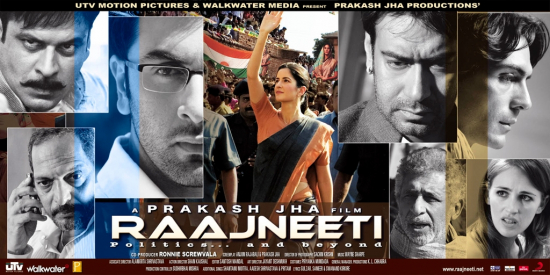
Rajneeti: Riveting, but marred by mistakes

by B. R. GOWANI

POSTER/Pro Kerala

The recently released film Raajneeti by Prakash Jha is based loosely on the epic Mahabharata (1) with a touch of the Gandhi dynasty with an aura of the Godfather thrown in to indulge the veiwer. According to tradition, the sage Vyasa is considered the writer of the epic. A central aspect is the power struggle between two sets of cousins, the Kauravas (100 brothers) and Pandavas (5 brothers) which ends on the battlefield of Kurukshetra. The Pandavas were the winners. They had Lord Krishna as the guiding force behind their victory – achieved, of course, with great loss of lives and heavy devastation.

Rajneeti has two Pandava brothers Yudhisthira (played by Arjun Rampal) and Arjun (Ranbir Kapoor) and one Kaurava brother, Duryodhan (Manoj Bajpai). Krishna is Nana Patekar, who is omniscient and omnipresent. His character also reminds one of M. K. Gandhi (2). The Pandava brothers had Draupadi as a common wife, which on screen is played by Katrina Kaif, though here, not as a common wife.
Continue reading “Rajneeti: Riveting, but marred by mistakes”

How South Africa has cracked down on the poor and the shack dwellers’ movement ahead of the World Cup

RAJ PATEL talks to Democracy Now

RAJ PATEL: OK, so the website is Abahlali—A-B-A-H-L-A-L-I.org. And the organization is called the Abahlali baseMjondolo, which is Zulu for “people who live in shacks.” Now, the reason this is an interesting organization is because when we’re seeing all the joy around the World Cup, it’s important to remember, of course, that the World Cup is not an unalloyed good. Not everyone in South Africa is benefiting from the World Cup. And in fact, you know, FIFA, the organization that organizes the World Cup, the Federation of—sorry, the International Federation of Football Associations, is an incredibly powerful organization that in many ways has sort of commandeered the willing South African government to be able to rearrange the country to make it more football- and corporation-friendly.

Democracy Now for more

Iran’s Green Movement: One year later

by JUAN COLE

Iran’s Green Movement is one year old this Sunday, the anniversary of its first massive demonstrations in the streets of Tehran. Greeted with great hope in much of the world, a year later it’s weaker, the country is more repressive, and its hardliners are in a far stronger position — and some of their success can be credited to Israeli Prime Minister Benjamin Netanyahu and sanctions hawks in the Obama administration.

Tom Dispatch for more

Size matters — when it comes to DNA

BIOLOGY NEWS NET

“Telomeres consist of repeating pieces of DNA that vary in length between individuals. Important research over a number of years has shown that these structures shrink in length over an individual’s lifetime and that this may contribute to several diseases.

Telomere shortening can be reversed in two specific ways:

* a protein termed telomerase can directly add new DNA to the end of telomeres.

Biology News Net for more