The limits of anti-racism

by ADOLPH REED JR.

Antiracism is a favorite concept on the American left these days. Of course, all good sorts want to be against racism, but what does the word mean exactly?

The contemporary discourse of “antiracism” is focused much more on taxonomy than politics. It emphasizes the name by which we should call some strains of inequality—whether they should be broadly recognized as evidence of “racism”— over specifying the mechanisms that produce them or even the steps that can be taken to combat them. And, no, neither “overcoming racism” nor “rejecting whiteness” qualifies as such a step any more than does waiting for the “revolution” or urging God’s heavenly intervention. If organizing a rally against racism seems at present to be a more substantive political act than attending a prayer vigil for world peace, that’s only because contemporary antiracist This view, however, is mistaken. The postwar activism that reached its crescendo in the South as the “civil rights movement” wasn’t a movement against a generic “racism;” it was specifically and explicitly directed toward full citizenship rights for black Americans and against the system of racial segregation that defined a specific regime of explicitly racial subordination in the South. The 1940s March on Washington Movement was also directed against specific targets, like employment discrimination in defense production. Black Power era and post-Black Power era struggles similarly focused on combating specific inequalities and pursuing specific goals like the effective exercise of voting rights and specific programs of redistribution.

Clarity lost

Whether or not one considers those goals correct or appropriate, they were clear and strategic in a way that “antiracism” simply is not. Sure, those earlier struggles relied on a discourse of racial justice, but their targets were concrete and strategic. It is only in a period of political demobilization that the historical specificities of those struggles have become smoothed out of sight in a romantic idealism that homogenizes them into timeless abstractions like “the black liberation movement”—an entity that, like Brigadoon, sporadically appears and returns impelled by its own logic.

Ironically, as the basis for a politics, antiracism seems to reflect, several generations downstream, the victory of the postwar psychologists in depoliticizing the critique of racial injustice by shifting its focus from the social structures that generate and reproduce racial inequality to an ultimately individual, and ahistorical, domain of “prejudice” or “intolerance.” (No doubt this shift was partly aided by political imperatives associated with the Cold War and domestic anticommunism.) Beryl Satter’s recent book on the racialized political economy of “contract buying” in Chicago in the 1950s and 1960s, Family Properties: Race, Real Estate, and the Exploitation of Black Urban America, is a good illustration of how these processes worked; Robert Self’s book on Oakland since the 1930s, American Babylon, is another. Both make abundantly clear the role of the real estate industry in creating and recreating housing segregation and ghettoization.

Tasty bunny

All too often, “racism” is the subject of sentences that imply intentional activity or is characterized as an autonomous “force.” In this kind of formulation, “racism,” a conceptual abstraction, is imagined as a material entity. Abstractions can be useful, but they shouldn’t be given independent life.

Left business Observer for more

Big brother focuses on stability in Burma

by BRIAN MCCARTAN

Bangkok, Thailand (Mizzima) – Chinese vice-president Xi Jinping’s visit to Burma over the weekend reaffirmed ties and resulted in the granting of exclusive rights to build and operate a controversial oil pipeline. The Chinese leader was also given assurances that stability would be maintained on the border. However, relations between Beijing and Naypyidaw have not always been so cordial over the past year.

The visit to Burma was part of a four nation tour that also included Cambodia, South Korea and Japan. The significance of Xi’s role in the weekend visit was seen by analysts as diplomatically introducing the probably future Chinese president to Burma’s leaders. It may also have been a show of support for the generals after several months of strained relations between the two countries.

Xi Jinping is widely believed to be the frontrunner to succeed current president Hu Jintao in 2012. Xi is currently the highest ranking member of the Secretariat of the Communist Party of China and ranked sixth in the Politburo’s Standing Committee. Although Xi was not selected as vice-chairman of the important Central Military Commission in September, he is still believed to be in a strong position.

The most significant outcome of the meeting was Xi’s overseeing the signing of an agreement granting exclusive rights to the China National Petroleum Corporation (CNPC) to build and operate a crude oil pipeline. The 2,000 kilometer pipeline will extend from Burma’s western coast across much of the length of the country to China’s southwest Yunnan province and on to Chongqing. The pipeline operation will be run by CNPC-controlled South-East Asia Crude Oil Pipeline Ltd. which also received tax concessions and customs clearance rights to bring in construction materials as part of the deal.

Construction of the pipeline began in November and when completed is expected to carry an initial 12 million tons of crude oil a year. A crude oil port on the island of Kyaukpyu in Burma’s western Arakan State has been under construction by CNPC since in October. The port and the oil pipeline are part of an effort by China to avoid having to send tankers through the easily blocked Malacca Straits. In addition, a gas pipeline is planned to be built by CNPC to carry natural gas from the offshore Shwe gas field. The gas pipeline will pump 12 billion cubic units of gas per year to China when it comes online in 2012.

Burmese officials gave assurances to Xi that the junta would maintain security along the 771 kilometers of the pipeline that run through Burma. This is a contentious issue among human rights organizations which allege that the military’s efforts to secure the area will result in large-scale human rights abuses. Groups like environmental and human rights watchdog Earth Rights International say similar operations in the 1990’s to secure the route of the Yadana gas pipeline to Thailand caused widespread human rights violations.

Burma has become an increasing important source of natural resources for China, especially oil and gas. Beijing also sees Burma as essential to plans to develop its landlocked southwestern Yunnan province. To this end, China is actively promoting the construction of road networks and port facilities to make the transportation of goods through Burma for export.

Mizzima

Please sign the following Petition for Civil Rights for Palestinian Refugees in Lebanon

To:  The Cabinet and Parliament of Lebanon

Secondary only to ending the siege of Gaza and achieving Statehood, the enactment of the basic civil right to work and to own a home for the hundreds of thousands of Palestinian Refugees living in squalor in Lebanon is perhaps the most critical and immediately achievable goal of the Palestinian resistance and the ideals enshrined in the 1948 Universal Declaration of Human Rights.

Friends of Palestine and supporters of basic civil rights, wherever they live, can help this happen without violence or martyrs by signing and distributing the Online Petition and by twinning with a Palestinian Refugee in Lebanon.”
The Palestine Civil Rights Campaign-Lebanon and the Sabra Shatila Foundation Beirut, Lebanon-Washington DC

“We the undersigned from many countries, mindful of the urgent need for equal human rights for our Palestinian Refugee sisters and brothers in Lebanon in their Civil, Political, Social and Economic dimensions, herewith signify our solidarity with Lebanon as this great country nobly corrects six decades of injustices by enacting civil rights legislation for her guests from Palestine.
Affixing my name to this petition expresses my wish to personally “twin” in solidarity with one of Lebanon’s Palestinian refugees as they and their Lebanese hosts continue to work and prepare for their Return.

Sincerely,

The Undersigned

Click here to sign

(Submitted by Ingrid B. Mork)

Mars or Bust

by ERIC BENSON AND JUSTIN NOBEL

Launch at Cape Canaveral on July 24, 1950. © NASA.

While the aerospace community waits for February when President Obama will announce the 2011 budget, effectively setting NASA’s direction for the near future, aerospace engineer Robert Zubrin agitates for a manned mission to Mars.

On a Saturday last August just outside the nation’s capital, Dr. Robert Zubrin saw his ambitions come crashing back to Earth—or, more accurately, back to the moon. Chris McKay, a NASA astrobiologist, had just delivered a speech to the Mars Society in which he proposed a human space exploration program based around a permanent lunar base. A trip to Mars, he said, should be delayed for several decades as humanity learns to live on our closest celestial body. “I grew up with Star Trek—the original series,” McKay said, “and the slogan was ‘to boldly go.’ Going is easy… we need to boldly stay.”

As soon as McKay finished, a dozen livid conference-goers—most wearing “Mars or Bust” pins—stormed the two audience microphones at the front of the hall. First in line was Zubrin, the Mars Society’s founder and president.

“The reason we didn’t stay on the moon is because there was nothing worth staying for!” howled Zubrin, whose unkempt comb-over, baggy eyelids, and impatient bark give the impression that he rarely gets more than three hours of sleep. “The prospect for agriculture on Mars is vastly superior. After we learn to live on Mars, we can use that as practice for living on the moon!”

“It’s about colonies,” cried a squat, shaggy man, “followed by the terraform mission.”

“I think one of the biggest flaws we have is to look at Mars and think there is no deadline,” said a mustached dandy in a felt beret. “There is a deadline. We have to do this before our environment goes belly up.”

“Why don’t we leave the moon to the Japs?” proposed a debonair European.

A few hours later, Zubrin ducked out of an eight-person panel on Space Art to hold an impromptu crisis-management meeting in the aftermath of McKay’s presentation.

“If Kennedy in ’61 had said we need to be on the moon by 2000, we never would have made it,” he said in an emphatic whisper to two followers, pitching his eyebrows at sharp angles for dramatic effect. Zubrin has intense, deep-set eyes that narrow into slits when he smiles (rarely) or gets excited (constantly). “On the moon, you find out if the Aristoteles crater is this old or that old, big fucking deal. The real question is, ‘Are we alone in the universe?’”

Guernica for more

Honduras: Why Do Garifuna Community Radios Burn?

by ORGANIZACION FRATERNAL NEGRA HONDURENA

Translated by Ramor Ryan

Honduran Black Fraternal Organization Denounces Attack Against their Radio Station

In the early morning hours of Wednesday January 6, the Garifuna community radio Faluma Bimetu (“Sweet Coconut”) based in Triunfo de la Cruz was burnt down by unknown armed individuals who proceeded to loot the station’s radio equipment. This is not the first time the radio has been attacked and its equipment stolen.

In 2002 unknown people stole the transmitter and other key tools for radio transmission. The Garifuna people have been exposed to a slow process of assimilation into the dominant culture through the mass media – monopolies that are in the hands of figures who are well known throughout the country as manipulators of information.

Lacking control of our own Garifuna media has led to an acceleration of loss of our culture, a process that has become increasingly painful. Most of the communities with access to television are confronted by a permanent alienation through consumerism, acculturation, alienation (soccer, fashion, soap operas, cartoons and violence) and media terrorism. We have also seen a decline in the use of our own indigenous language, which has become, lamentably, a second language.

Transmission of Radio Faluma Bimetu began in 1997, promoted by the Land Defense Committee of Triunfo de la Cruz (CODETT), in order to strengthen Garifuna culture and defend the ancestral territory of the community.

Triunfo de la Cruz, like other Tela Bay Garifuna communities, has become a conflict zone since the intervention of businessmen, politicians and foreign investors attempting to seize community land for the construction of mega-tourism projects.

This systematic usurpation at the hands of outsiders has led the community – conducted by CODETT and the Community Board — to file a petition with the Inter-American Commission on Human Rights
(IACHR), who accepted the case on 14th March 2006, registered under No. 125-48. For the powerful ruling elite of Honduras, the staunch defense taken by the community of Triunfo de la Cruz of their ancestral territory, is a serious challenge to their economic interests.

Honduras is renowned for the high level of poverty for the majority of its inhabitants ruled by a minority that holds the country under a feudal regime. The use of mass media by the local feudal lords has been an effective tool for control and manipulation.

As in the rest of Latin America, the media monopolies have served to replicate the distortion of information and thus perpetuate domination. The community radios of the Garifuna have been growing strong over the past decade, setting a precedent among our people. And the primary goal is the protection of our culture – which is closely linked to Mother Earth.

Up to the present moment, we have installed four community radios and in the not too distant future we envision extending the network throughout the entire Garifuna nation. The overarching goal: to strengthen and enrichen our culture, to defend our ancestral territory and at the same time, to build early warning systems to deal with climate change, earthquakes, and diseases.

The attack against Radio Faluma Bimetu can be simply reduced to the fact that it enrages the power elite that we, the Garifuna, have been in a process of cultural resistance that has lasted 212 years. And, specifically, that we have broken chains by actively participating in the resistance against the destruction of democracy in our country, a crime (the June 28th Coup) committed by the Honduran oligarchy last year – with the support of the troglodyte right wing of the United States.

Covering Activism and Politics in Latin America for more

RIGHTS: Expulsions From EU Rise Sharply

by DAVID CRONIN

BRUSSELS, Jan 22, 2010 (IPS) – The number of asylum-seekers and other migrants expelled from the European Union in joint operations between its governments has grown three times in as many years, IPS has learned.

At least 1,570 individuals were removed from the EU’s territory in 31 flights coordinated by the bloc’s external borders agency Frontex between Jan. 1 and Dec. 15 last year. This represented a tripling in joint expulsions – involving authorities from two or more EU states – since 2007. Some 428 migrants were flown out in such operations that year, with the figure rising to over 800 in 2008.

The data – unpublished until now – indicates that Frontex has rapidly stepped up the pace of its activities in the four-and-a-half years since it was founded. And the involvement of the Warsaw-based agency in expelling people who have been denied permission to remain in the EU looks set to increase further.

When the EU’s presidents and prime ministers met in Brussels in late October, they approved a plan to expand the work of Frontex. The European Commission, the EU’s executive arm, has been asked to come forward with proposals early this year to beef up the agency’s powers. The plan foresees that the agency will finance a greater number of chartered flights for expulsions and cooperate more closely with countries from which migrants trying to enter Europe originate.

Organisations working with asylum-seekers are perturbed that Frontex is acquiring greater resources and responsibility without being required to demonstrate that fundamental human rights are safeguarded during its activities.

A recent report by Human Rights Watch drew attention to how Frontex has helped the Italian authorities expel migrants to Libya, without giving them an opportunity to apply for asylum.

In June last year, Frontex coordinated Operation Nautilus, in which a boat carrying an estimated 75 migrants was intercepted off the Italian coast. Using a German Puma helicopter, the operation was the first of its kind in which Frontex succeeded in forcing migrants from the central Mediterranean Sea back to Libya.

Titled ‘Pushed Back, Pushed Around’, the Human Rights Watch report stated that Frontex was unable to give guarantees that Libya had allowed the migrants to apply for asylum. All individuals are entitled to seek asylum from persecution in a country other than their own under the United Nations’ 61- year-old Universal Declaration on Human Rights. Bill Frelick, a campaigner on asylum issues with Human Rights Watch, said he was concerned that Frontex is being given a bigger role in expulsions and that its future operations will needed to be carefully scrutinised.

Bjarte Vandvik, director of the European Council for Refugees and Exile, a group defending the rights of asylum-seekers, said that whenever an individual is removed from the EU, the principle of “non-refoulement” must be respected. A key tenet of international refugee law, non-refoulement means that nobody should be sent to a country where he or she will be at risk of persecution.

Inter Press Service for more

Obama: The Manifest Destiny continues

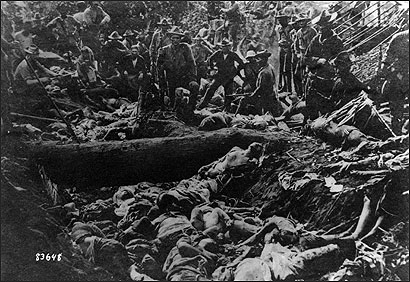
On March 7, 1906, US troops under the command of Major General Leonard Wood massacred as many as 1,000 Filipino Muslims, known as Moros, who were taking refuge at Bud Dajo, a volcanic crater on the island of Jolo in the southern Philippines. Above, US soldiers pose for the camera in the aftermath of the massacre. (Photo from The National Archive)

An Iraqi under US custody at the infamous Abu Gharaib. Photo/Wired

Is the United States after Muslims?

Anyone looking at the above pictures cannot resist reaching that conclusion that the US is hell bent on humiliating, killing, and destroying Muslims. Some will see the US war in Afghanistan, Iraq, and northwest areas of Pakistan as an extension of the Christian Crusades or Holy Wars.
But that is not the case. The US is basically an imperial power and so it after any government or country which refuses to part with its resources. Horrific pictures of US covert and overt wars against Vietnam, Nicaragua, Panama, and dozens of other countries would confirm that assertion. Some religious nuts like George Bush or other right wingers use religious terminology but fundamentally it is the corporations who call the shots. Thus the US does not discriminate between Muslims or Christians, or between Africans or Latin Americans or Asians when it goes to war. Like religious fanatics, they strongly believe that they have some God given right to impose their interpretation of democracy on the entire world.

Manifest Destiny

Every imperial power, which colonizes directly or indirectly, has to produce some reasoning to justify its stealing of another country’s natural and/or other resources, and grabbing of territories. Various arguments were put forth by the leaders and writers in the United States to defend its territorial aggression and/or annexation of other countries. Then in 1839, journalist John O’ Sullivan came up with the idea of manifest destiny. Six years later, in an article entitled Annexation, he justified annexing the Mexican state:

“Texas is now ours. … the sweep of our eagle’s wing already includes within its circuit the wide extent of her fair and fertile land. She is no longer to us a mere geographical space–a certain combination of coast, plain, mountain, valley, forest and stream. She is no longer to us a mere country on the map. She comes within the dear and sacred designation of Our Country …”

He then invoked the divinity:

“[It is] our manifest destiny to overspread the continent allotted by Providence for the free development of our yearly multiplying millions.”

The phrase is not in fashion for some time now, the spirit, however, inhabits the corridors of power in the US. And Obama’s foreign policy echoes the continuation when he put forth his doctrine:

“As President, I will pursue a tough, smart and principled national security strategy — one that recognizes that we have interests not just in Baghdad, but in Kandahar and Karachi, in Tokyo and London, in Beijing and Berlin.” “I will focus this strategy on five goals essential to making America safer: ending the war in Iraq responsibly; finishing the fight against al Qaeda and the Taliban; securing all nuclear weapons and materials from terrorists and rogue states; achieving true energy security; and rebuilding our alliances to meet the challenges of the 21st century.”

Stated goals are usually unachievable and are meant to calm down or fool various segments of society. It is the unstated goals which are to be pursued and are mostly carried on successfully.

How can Obama end the war against Iraq responsibly when the US is building a huge 104 acres embassy cum base in Baghdad?

Taliban have been around since the 1980s and have tasted power in Afghanistan between 1994 and 2001, whereas Al-Qaeda is around since the late 1980s. They do not have a majority support but have sympathy from a substantial minority and have access to money and weapons and are well entrenched in both Afghanistan and Pakistan. So it seems it is beyond obama’s power to finish them.

As far as the nuclear weapons are concerned, the “terrorists” are not in possession of any of them. About “rogue states”, Iran does not have nuclear weapons and Pakistan which does have is an ally.

For true energy security, the first step needed to be taken is to say good bye to the Middle East. And that is not possible because Middle East is the second home to the United States.

This is not the Twentieth Century; the world has changed. China, India, Russia, Brazil, the European Union are the other powers with their own agendas and interests and are not going to toe the US line. And so the alliance would not be easy to build.

Obama lost a historical opportunity by not concentrating on ending the wars and creating a secure homeland for the Palestinians.

What Obama should have done?

Obama should have disowned what he had said during the campaign and should have instead halted the drone attacks on Pakistan and concentrated on an exit strategy from Afghanistan. This could have earned him support and sympathy from Afghans and Pakistanis in particular and the world in general.

The right wing in the US and his critics would have been upset and would have labeled his campaign statements as political rhetoric. That would have been fine rather than what has happened. He has gotten himself do deep in the war on terror mess that none of his spin masters would be able to save him.

It is no exaggeration to state that one year ago, President Barack Hussein Obama was seen as the greatest hope for a substantial number of people in the United States and for a majority of people worldwide. These people hoped that it will be a different and a better world. Alas! Such is not the case. The only difference his election made was to disappear George Bush. If the world is not any worse than it was during his predecessor’s reign, it is not any better either.

He has not done much on the home front. But that will not hurt him much, and will be taken care of by his PR section and the sympathetic section in the dominant media. It is the foreign front which is going to drag him and his Nobel Peace Prize down the drain of history.
Long before Obama assumed the US presidency, the Al-Qaeda and Taliban bombings and atrocities had become known the world over. Anyone familiar with their philosophy knew well that their ultimate goal is to gain power. (They are equally fanatics as the US establishment and would go to any extent.)

On the other hand, the Taliban/Al-Qaeda axis could only gain power through ruthless tactics because their philosophy has no attraction for most of the Pakistanis—who are more close to South Asia than to West Asia. This would have created repulsion among the people in the region and would have prompted early response from the people and the government and would thus have put a dent in their support.

Andrew J. Bacevich’s observation about the Moros and the Afghans and Iraqis demands our attention:

“Above all, however, the results of the campaign to pacify the Moros suggest that pacifying Afghans or Iraqis or others in the Muslim world today will require extraordinary persistence. The Moros never did submit. A full century after Leonard Wood confidently predicted that ‘one clean-cut lesson’ would bring the Moros to heel, their resistance to outside rule continues: The present-day Moro Islamic Liberation Front, classified by the Bush administration as an Al Qaeda affiliate, carries on the fight for Moro independence.

“For advocates of today’s ‘long war,’ eager to confer on Muslims everywhere the blessings of freedom and democracy, while reserving the honor of the US military, the sheer doggedness of Moro resistance ought to give pause.”

Positive Outcome

One positive thing that has come out of Obama’s winning the presidency is that the colored people, excepting the die-hards, who had supported him with a feeling of color affinity, would come out of the fantasy land that a colored person belonging to the higher echelon of society would implement programs beneficial to them.

B. R. Gowani can be reached at brgowani@hotmail.com

In the United States, but apart from it

by CHRIS MCGREAL

The US president has pledged to improve the lives of the country’s one million Native Americans. But he faces an enormous challenge. Chris McGreal reports from Pine Ridge Indian reservation

Indian country begins where the prairie of Custer county gives way to the formidable rock spires marking out South Dakota’s Badlands. The road runs straight until the indistinguishable clapboard homesteads fade from view and the path climbs into a landscape sharpened by an eternity of wind and water.

The first marker that this may be a part of the United States, but is also apart from it, comes as the road descends to the plains of the Pine Ridge Indian Reservation. Here an abandoned mobile home, daubed with the name of a Sioux rebel who led the tribe’s last armed showdown with the US authorities nearly 40 years ago, stands as a monument to defiance and despair.

The reservation’s own station struggles through on the radio: the tribe’s president, Theresa Two Bulls, is on air lamenting the death of a schoolboy, Joshua Kills Enemy, who hanged himself the day before. His funeral will be the second of the week, coming days after a 14-year-old girl took her own life in the same way. They are not the first.

Two Bulls wonders how it can be that the Oglala Sioux tribe’s children are killing themselves. “We must hug our children, we must tell them we love them. A lot of these youth don’t get a hug a day. They’re never told that they’re loved. We need to start being parents and grandparents to them,” she says.

Two days later, Two Bulls declared a “suicide state of emergency” in response to the deaths and a spate of attempts by others to kill themselves, such as Delia Big Boy, who was 15 when she put a rope around her neck. “It had a lot to do with my parents and alcohol abuse and what they say to you. The things they say make you think they don’t love you,” says the high school student, now 17.

“I hear the same thing from my friends. There’s hopelessness on the reservation. There’s no sense of belonging, of a future. There’s alcoholism. The parents drink. A lot of the children drink.”

Two Bulls sees the children’s deaths as a symptom of a wider crisis that has gripped generations of Oglala Sioux. More than 100 people, mostly adults, attempted suicide or took their own lives on Pine Ridge Reservation last year.

“This is about how defeated our people feel,” Two Bulls tells me later. “People across the US don’t realise we could be identified as the Third World, our living conditions. People think we’re living high off the hog on welfare and casinos. I’ve asked them — US congressional people, US secretaries of these departments who deal with us — to come out to our reservation, see first-hand how we live, why we live that way. Find out why our children are killing themselves. Learn who we are.”

Mail & Guardian for more

Zia Mohiuddin reads Manto’s Toba Teg Singh (part 1 & 2)

Zia Mohiuddin reads Saadat Hasan Manto’s immortal classic Toba Tek Singh, a short story based on the absurdity of partitioning India and creating a new country of Pakistan in the name of religion. Both countries have gone to wars and have tried their best to make traveling between two countries as difficult as possible. Even after over six decades, the rulers in both countries do not want the wounds of 1947 to heal. The peoples’ suffering still continues and Pakistan is hanging in uncertainty. Click here to read an English translation. Ed.

(Submitted by reader)