World People’s Resistance Movement (Britain) Launches New Website!

Submitted by a reader in UK:

To visit our website Click on: www.wprmbritain.org

World People’s Resistance Movement (Britain) has launched a new website to promote and unite people’s struggle against the British ruling class and the imperialist system in general. This political website supports all anti-imperialist and revolutionary forces and individuals, regardless of their ideology, and informs the people about their statements, articles, leaflets and practical activities. All visitors to the site will have the opportunity to leave comments and join a lively public debate.

WPRM ( Britain ) is a democratic organisation, which supports resistance to imperialism and the revolutionary struggles (e.g. Nepal, India, Bhutan, Peru, Philippines etc.) of the peoples of the world. Its existence is a response to a world where imperialism is on the rampage, bringing nation after nation to ruin, from Afghanistan and Iraq to Somalia and Palestine .

WPRM ( Britain ) supports the right of oppressed nations to self-determination, which includes defending themselves when the imperialist ruling class and their client states wage wars of aggression against them. The oppressed peoples of the world (workers, peasants, women, national minorities, etc.) have the right to rebel against oppression and its root cause – the imperialist system.

In Britain , we need to unite with all those who always support the people’s struggle against the imperialist ruling class. We believe that active participation of the British people in the global struggle against imperialism will pave the way for their liberation.

Join us to develop and promote the website to serve the people.

World People’s Reistance Movement (Britain)
BM Box 7970 , London.
WC1N 3XX
E-mail: wprm_britain@yahoo.co.uk
Website: www.wprmbritain.org
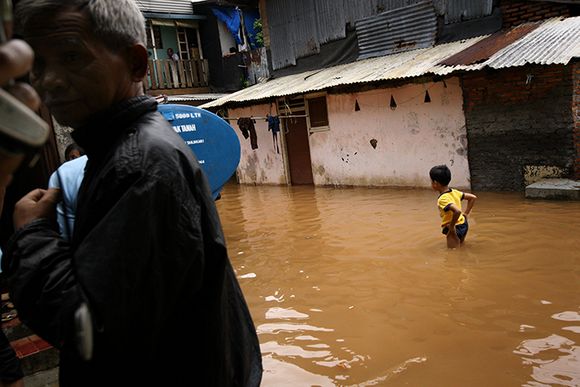
Private sector participation in Jakarta’s water supply has left many citizens high and dry

Access to clean water is difficult. With seasonal flooding, both the Ciliwung river and groundwater from the many hand-pumps become increasingly contaminated.
Henri Ismail

In Cipinang Muara, East Jakarta, there lies a cemetery complex known as ‘Kuburan Cina’. It is not, unfortunately, solely a resting place for the deceased. It is also home to over 80 families living in a slum inside the complex where water is a precious commodity. The people here earn their income from selling goods in a nearby flea market, making just Rp20,000 (US$2.60) a day. Buying clean water from private vendors is clearly not an option for them. Likewise, piped water is too expensive, and the city’s private water operators do not offer their services to what they consider illegitimate houses. In the past, the slum residents obtained water for cooking, drinking and sanitary purposes by collecting rainwater from the roofs of the buildings in their neighbourhood. Two years ago they collaborated to install four shallow wells. Given the quality of water they use however, water borne diseases such as diarrhoea and typhoid are not uncommon.

The story from Kuburan Cina is a stark reminder of the water service predicament in Jakarta and particularly its impact on the city’s urban poor. When a new system of Private Sector Participation, or PSP as it is sometimes known, opened up the city’s water supply sector to private companies in February 1998, it was hoped that Jakarta would finally be relieved of its clean water shortage woes. However, eight years later a UNDP report found that over 75 per cent of Jakartans – most of whom are of the poorer segment of the population – were still without improved access to clean water, relying instead on multiple sources, including rivers, lakes and private vendors.

Jakarta is in dire need of a functioning water supply system that can allow the city’s burgeoning population to stop relying on contaminated underground water

In the same year, however, Jakarta’s environmental body reported that approximately 85 per cent of the shallow underground water in the city had been contaminated by faecal coli bacterium resulting from human waste, causing those who consume it to be infected by water borne diseases. In light of these statistics, there is little doubt that Jakarta is in dire need of a functioning water supply system that can allow the city’s bourgeoning population to stop relying on the contaminated underground water. Unfortunately, to date the participation of private companies in the distribution and maintenance of Jakarta’s water supply seems to have done more harm than good.

Inside Indonesia for more

INDIA: Farm Suicides Turn Children Into Farmers

By Jaideep Hardikar


Digambar Rathod with his mother, Sunita, elder sister Roshni (in yellow), and younger siblings Saroj and Mahesh (right foreground). His father committed suicide on Jan. 1.
Credit:Jaideep Hardikar/IPS

YAVATMAL, India, Jun 10 (IPS) – Eleven-year-old Digambar Rathod looks older than his age. Shy and uncertain, he stares disconcertedly at the garlanded photograph of his father Jaideep, a 42-year-old cotton farmer who committed suicide on Jan. 1, 2009 in Tiwsala village, in eastern Maharashtra state’s suicide-torn Yavatmal district.

As the new head of the household, the boy-turned-farmer has adult responsibilities like the repayment of a bank loan of 190,000 rupees (roughly 3,960 dollars) that was the cause of his father’s death.

Digambar has dropped out of school, says his mother, Sunita, grief-stricken and burdened by the terrible tragedy the family has suffered. His older sister Roshni too has left school to take over the household work. The two younger children, a boy and a girl, are too young to work, says Roshni.

But everyone knows that it won’t be long before all four Rathod children join the ranks of Vidarbha’s baccha-kisans (child farmers). Here in six districts including Yavatmal, Wardha and Akola, thousands of cotton farmers have taken their lives due to mounting debts and a dramatic decline in farm incomes over the past decade or so, and their children have stepped into their shoes.

According to the National Crime Record Bureau (NCRB), 40,000 of the 184,000 farmers’ suicides reported in India between 1995 and 2007 were from Maharashtra. Over 25,000 of the deaths in the state were registered after 2002.

Ganesh Diliprao Kale in Ralegaon village, Yavatmal, was barely 13 when he became the eldest male in both his own and his two uncles’ families. Over a span of five years, between 2003 and 2008, his father’s brothers and father were driven by debt to suicide.

“Ganesh cultivated our farm last season with little support from relatives,” says his mother Shalini. Her school-going daughter, Ashwini, 11, assists them on the weekends. She’s already taken over much of her mother’s work in the house.

A few miles away, in Khadakdoh village, in south Yavatmal, Kavita Kudmethe and her two daughters, around 13 years of age, scrape a living as farm workers. Her husband killed himself in 2007, and his parents threw Kavita and her daughters out of the house.

Daughter as ‘Burden’

In November 2005, a 17-year-old schoolgirl from an impoverished farm household in Aasra village, Maharashtra state, committed suicide.

“If I don’t my farmer father will (take his life),” Neeta Pudalikrao Bhopat wrote in her dying note. “My family can’t make 1,000 rupees (roughly 20 dollars) a month. I have two younger sisters. My parents can’t bear the burden of our marriages when we don’t have enough to eat. So, I am ending my life.”

The inability to meet dowry demands is one of the many factors driving poor farmers to suicide, a study commissioned by Government of Maharashtra found in 2005.

IPS news for more

Teachers File Racial Discrimination Suit Against Obama Administration’s School “Turnaround” Plan

by BAR managing editor Bruce A. Dixon

“The fired teachers are disproportionately African American, and the newly hired teachers are not.”

In May, Secretary of Education Arne Duncan declared the Obama administration’s intent to close and “turn around” 5,000 “underperforming” public schools in poorer neighborhoods across the country. Duncan’s last job was CEO of Chicago’s public schools where he shut down dozens of neighborhood schools, practically all in lower income areas, and dismissed thousands of committed and experienced teachers, the vast majority of them African American women.

When the Chicago Teachers Union made no effort to reach out to parents, students or their communities, refused to organize teachers to oppose the wave of school shutdowns and privatizations, teachers organized what they call CORE, the Coalition of Rank & File Educators. CORE has now filed suit against the Chicago Board of Education, charging that the mass dismissal of hundreds of mostly black veteran teachers and their replacement with uncertified and generally underqualified white teachers is racially discriminatory.

“We looked at the number of teachers who lost their jobs in these ‘school turnarounds,’” CORE research director Carol Caref told BAR, “and we looked at the number of African American teachers who were employed in those same schools or in the charter schools which replaced them and there was a huge discrepancy which couldn’t be accounted for by chance. The fired teachers are disproportionately African American, and the newly hired teachers are not.”

“Even if it’s inadvertently discriminatory, it’s still discriminatory because the majority of the teachers wiped out in these turnarounds are African American,” offered Chicago teacher Wanda Evans. The fired veteran teachers, CORE also maintains, are being replaced by a much younger, much whiter and much less experienced corps of instructors graduated from a handful of accelerated programs funded by Boeing, the Bill and Melinda Gates, Bradley, Walton Family, Rockerfeller and other foundations, and favored by City Hall and the Commercial Club. “The new teachers are paid half or less what experienced teachers with advanced degrees were making.”

“The fired veteran teachers are being replaced by a much younger, much whiter and much less experienced corps of instructors.”

They are forced to work longer hours. They are reluctant to stand up for themselves or their students and tend to be fearful of participating in union and other activities. A high percentage of them burn out or are not asked to stick around after their first year,” according to Jackson Potter, another CORE teacher.

Black Agenda Report for more

Docu exposes disturbing truth about U.S. food supply

(2009-06-16) (Reuters) –

By Kirk Honeycutt

LOS ANGELES (Hollywood Reporter) – In 1906, Upton Sinclair published his muckraking novel “The Jungle,” which exposed corruption, unsanitary conditions and horrifying labor practices in the U.S. meatpacking business. The book caused a sensation that brought about a huge public outcry and considerable reform. More than a century later, “Food, Inc.,” a documentary from director-producer Robert Kenner and investigative journalist Eric Schlosser (“Fast Food Nation”), might be “The Jungle” for the 21st century. Things, it seems, have gotten worse in our food supply.

No question, watching this film is a tough go. Horror films cause less seat-squirming. The challenge faced by Magnolia Pictures is how to bring in the unconverted, meaning those who pooh-pooh the notion that what they eat could possibly be unsafe. Making the film available across several platforms should deliver not only greater returns but a better-educated public that can vote for greater food safety by the way they shop for food.

Several films, including “Food Fight” and “Fast Food Nation,” have explored many of these themes. But none engenders the sense of urgency — and anger — that “Food, Inc.” does. The main villain is agribusiness, a multicorporation behemoth that controls virtually everything you eat.

The film, like Sinclair’s novel, is an unapologetic exercise in advocacy journalism. However, lest anyone accuse the filmmakers of unfairness, representatives of the corporations that control our food supply were offered time to explain their approach to food safety. Everyone proved camera shy. Worse, the corporations pressured farmers not to give interviews or allow cameras inside food factories. Conditions are that bad.

But one chicken farmer did cooperate. And hidden cameras got inside a “factory farm.” Don’t schedule dinner after seeing this film.

Guided by Schlosser — who appears on camera, as does fellow food journalist Michael Pollan (“The Omnivore’s Dilemma”) — the film explores how food has changed more in a half-century “than in the previous 10,000 years.” Despite the farm images that appear on packaged foods, a handful of corporations, not farmers, control our food supply. Governmental regulatory agencies charged with overseeing food safety essentially are toothless because most of the administrators are former — or future — food company executives.

Here is what results: Cattle are fed corn rather than grass because it’s cheaper. This has produced new strains of E. coli virus that have stricken thousands and killed hundreds. The processing of animals — an often cruel process for animals and humans alike — admits far too many contaminants into the meat supply.

Government policy favors subsidies for the “wrong calories” in our diet. This has led to epidemics in obesity and diabetes. Because of these policies, the cost of many foods is actually down — but at the hidden cost of increased medical expenses. Don’t flatter yourself if you don’t eat fast food: The “system” reaches into everything you eat.

NPR for more

Godi recounts days in jail

Lulu Jemimah (Monitor)

Barely two weeks out on bail, Arua Municipality MP Akbar Godi, changes cars – at least four times a day. Living an apparent shady life, he takes refuge in hotels, different residences and has converted his car into a mobile lodge – at least by his accounts for safety reasons. Everywhere he moves, he has become a recognisable face, suffering the torture of loss of privacy like a celebrity.
Daily Monitor’s Lulu Jemimah caught up with the MP, who is facing charges of murdering his wife Rehema Caesar, for an interview on Tuesday. Below is the first instalment of a two-part series of the legislator’s riveting account of life at Upper Luzira Maximum Security Prison. The second part will run in tomorrow’s edition.

Godi’s tale
I am a Muslim but back in Arua I attend both the Catholic and Protestant churches. In prison, people hold intensive prayers like there is no tomorrow and you are living your last day. There is so much that goes on inside those walls and I guess the hope and faith is what keeps the inmates sane.

I have followed these sodomy stories in churches and I wonder why it got so much coverage yet sodomy, sometimes voluntary but usually coerced and poverty-induced in prisons, goes unmentioned. I don’t know the causes of it outside but in prison I did.

Monitor for more

Taking the heat off

Biomimetic-engineering design can replace spaghetti tangle of nanotubes in thermal material.

Denise Brehm, (MIT) Civil and Environmental Engineering

Nanoelectromechanical systems (NEMS) devices have the potential to revolutionize the world of sensors: motion, chemical, temperature, etc. But taking electromechanical devices from the micro scale down to the nano requires finding a means to dissipate the heat output of this tiny gadgetry.

In a paper that recently appeared in the journal Nano Letters, Professor Markus Buehler and postdoctoral associate Zhiping Xu of MIT’s Department of Civil and Environmental Engineering say the solution is to build these devices using a thermal material that naturally dissipates heat from the device’s center through a hierarchical branched network of carbon nanotubes. The template for this thermal material’s design is a living cell, specifically, the hierarchical protein networks that allow a cell’s nucleus to communicate with the cell’s outermost regions.

“The structure now used when designing materials with carbon nanotubes resembles spaghetti,” said Buehler, who studies protein-based materials at the nano and atomistic scales with the goal of using biomimetic-engineering principles to design human-made materials. “We show that a precise arrangement of carbon nanotubes similar to those found in the cytoskeleton of cells will create a thermal material that effectively dissipates heat, which could prevent a NEMS device from failing or melting.”

NEMS devices are characterized by extremely small, high-density heat sources that can’t be cooled by traditional means. Even the microelectromechanical systems (MEMS) devices used in automobiles and electronics are hard to cool, because conventional thermal management strategies such as fans, fluids, pastes and wiring often don’t work at these small scales; heat buildup in MEMS frequently leads to catastrophic device failure, which limits the reliability of larger systems.
MIT news for more

Vela Bambhentsele1: Intimacies and Complexities in Researching Within Black Lesbian Groups in Johannesburg

Zethu Matebeni

Introduction
Gay and lesbian people have been on the social, legal and political agenda for some time. Post-apartheid South Africa has boldly included gay and lesbian rights in the transition to democracy. Most recently, same-sex marriages have been legalised even though widely challenged. While there is much talk about gay and lesbian rights, for many lesbian women these rights are merely paper rights as women struggle to cope and live with the challenges of a society with rampant inequalities. Furthermore, gay and lesbian people continue to face resistance from a society entrenched with patriarchy and notions of homosexuality as “unAfrican”.

Since the 1930s, sex and sexuality in South Africa, although to varying
degrees and largely focusing on men’s experiences, have been widely
speculated on and have been an important register of social hierarchy and
change (Delius and Glaser, 2002). Under apartheid, public and political
scrutiny of sex and sexuality was intensified through legislature, policing and censorship, as argued by Posel (2004). Also in the last two decades, sexuality has gained momentum in the public sphere due to the HIV and AIDS epidemic which has forced public discussions on sex and sexuality. The 1996 Constitution and the Bill of Rights have also placed sexual practices, identity, and freedom of expression as protected rights accessible to all citizens.

Despite some of these advances, critical work on lesbians or women’s samesex relationships has been minimal in the scholarship in South Africa.

Feminist Africa for more