Beyond Politics: People for Sale in Hungry World

By Ramzy Baroud

One might be tempted to dismiss the recent findings of the US State Department on human trafficking as largely political. But do not be too hasty.

Criticism of the State Department’s report on trafficked persons, issued on 16 June, should be rife. The language describing US allies’ efforts to combat the problem seems undeserved, especially when one examines the nearly 320- page report and observes the minuscule efforts of these governments. Also, it was hardly surprising to find that Cuba, North Korea, Iran and Syria — Washington’s foremost foes — languish in the report’s Tier 3 category, i.e. countries where the problem is most grave and least combated. Offenders in Tier 3 are subject to US sanctions, while governments of countries in Tier 1 are perceived as vigilant in fighting human trafficking.

One could also question the US government’s own moral legitimacy; classifying the world into watch lists, congratulating some and reprimanding and sanctioning others, while the US itself has thus far (and for nine consecutive reports starting 2000) been immune to self-criticism.

Undoubtedly, the political hubris and self- righteous underpinnings of the report are disturbing, but that hardly represents an end to the argument. The fact remains that the report’s rating of over 170 countries is thorough and largely consistent with facts as observed, reported by the media and examined in other comprehensive reports on the same issue. Indeed, the UN’s own Global Report on Trafficking in Persons, launched by the United Nations Office on Drugs and Crime (UNODC) in February 2009, affirms much of the State Departments’ findings regarding patterns of abuse reported around the world, most notably in Africa, the Middle East and the Asia-Pacific region.

The report examined governmental responses to the exploitation of people, including children, for the purposes of forced labour, sex and stolen organs. At least 12.3 million adults and children are used to sustain the thriving business of modern-day slavery, though the real number is probably much higher given that human traffickers have little interest in divulging exact data.

The global financial crisis has fuelled the demand for cheap labour, making the exploitation of the most vulnerable people part and parcel of the economic recovery plans of many companies, and even countries. Under these circumstances, there should be little doubt that the UN’s once promising campaign to eradicate much of the world’s hunger by 2015 is already a pipedream.

One of the testimonies cited in the State Department’s report was that of Mohamed Selim Khan, who “woke up in a strange house and felt an excruciating pain in his abdomen. Unsure of where he was, Khan asked a man wearing a surgical mask what had happened. ‘We have taken your kidney,’ the stranger said. ‘If you tell anyone, we’ll kill you.'”

Khan’s experience epitomizes the nightmare of millions of people around the world, as they struggle to provide for hungry families. Their plight is no secret. It can be seen on the streets of many cities around the world, from Europe to Asia and Central America to the Gulf, where worn out, haggard looking men in dirty uniforms are working long hours for little pay, trapped between pressing needs at home and the merciless demands of their “recruitment agencies”.

But cheap or forced labor is not the only form of human trafficking. According to the UN’s Global Report on Trafficking in Persons, based on data collected in 155 countries, “the most common form of human trafficking [79 per cent] is sexual exploitation”.

IRIN News, affiliated with the UN Office for the Coordination of Humanitarian Affairs, reported on 18 June that “women from the former Soviet Union and China are still being trafficked across the border with Egypt into Israel for forced prostitution by organized criminal groups”. Israel has been identified as a “prime destination for trafficking by both the State Department and the UN Office on Drugs and Crime”. One Israeli gang alone, according to the report, has trafficked over 2,000 women into Israel and Cyprus in the last six years.

One has to wonder the wisdom of international conferences and global efforts aimed at cracking down on Gazans smuggling food and medicine across the same Egyptian border to survive the Israeli siege when almost no efforts have been dedicated to ending the stark exploitation and abuse of thousands of women enriching Israel’s sex industry.

Dare I say that while human trafficking is itself an apolitical issue, recognizing and combating, or failing to combat, the problem is very much political. Think of the banking crisis, which fuelled a global recession, and the way astronomical amounts of money have been dedicated to solving it, trillions of dollars in global bailouts ultimately rewarding those who caused the crisis in the first place. Compare these efforts to the pathetic attempts at halting the disgraceful commercialization of humans, their organs, their sexuality, their very humanity.

The problem is now compounded. UN food officials declared on 19 June that hunger around the world has passed the unprecedented threshold of one billion, that is one in six people. The alarming increase of 100 million hungry children, women and men from last year’s estimates is blamed on the economic recession. While international institutions are efficient at recognizing such problems, proposed solutions often lack sincerity, or any sense of urgency.

“A hungry world is a dangerous world,” said Josette Sheeran of the World Food Programme. “Without food, people have only three options: they riot, they emigrate or they die.” They also become products in markets ready to exploit those whose very survival is at stake.

When Julia, from the Balkans, was eight years old, she was taken along with her sisters to a neighboring country, where she was sold to beg. She was beaten every time she failed to return with her fixed quota of money. Once she became a teenager she was forced into prostitution. After escaping she was placed in a government orphanage from which she also escaped, returning to the streets. According to the State Department report, eventually “Julia was arrested on narcotics charges”.

Can this injustice be any more obvious?

– Ramzy Baroud (www.ramzybaroud.net) is an author and editor of PalestineChronicle.com. His work has been published in many newspapers, journals and anthologies around the world. His latest book is, “The Second Palestinian Intifada: A Chronicle of a People’s Struggle” (Pluto Press, London), and his forthcoming book is, “My Father Was a Freedom Fighter: Gaza’s Untold Story” (Pluto Press, London)
If you like this article, please consider making a contribution to the Palestine Chronicle.
Palestine Chronicle for more
The New York Times and Stolen Elections

Hyping Iran, Ignoring Mexico

By JOHN ROSS

Mexico City.
A stolen election by an entrenched regime? Opposition charges that more votes were cast than ballots distributed to the polling places? That independent electoral observers were barred from witnessing the vote count? Demands for a recount to which election officials respond by offering to recount just 10% of the vote? A regime-controlled media that exalts the incumbent’s victory and demonizes the loser? The use of alternative media by the opposition to get their side of the story out? Massive street protests by millions of peaceful demonstrators waving homemade signs and wearing bracelets displaying the color of their movement? At least 20 protestors gunned down by authorities and paramilitaries? Worldwide moral indignation stirred up by the international media?

Iran 2009? Yes!

Mexico 2006? Yes and no.

All aspects of the above scenario describe the Great Mexican Electoral Flimflam three years ago this July 2nd – save for the conundrum of worldwide moral indignation. Virtually ignored by the international media, the stealing of the Mexican presidential election by the right-wing oligarchy stirred little indignation anywhere outside of Mexico.

A comparison of coverage extended to both instances of electoral fraud by the New York Times, the “paper of record”, is instructive.

NYT coverage of the upheaval in Iran has been overwhelming. During the first nine days of the electoral crisis, the Times ran at least one front-page story daily – from Election Day Friday, June 12th through Saturday, June 20th, the Iranian electoral sham occupied the right-hand column (the lead story) in the international edition on eight out of nine days. The Times also ran a second Iran story on the front page in six out of the nine editions reviewed – on four of those days, the stories were accompanied by a four and sometimes five column color photo, mostly of multitudes supporting the challenger Mir-Hossein Mousavi, a former prime minister who made his mark in history back in the 1980s by receiving a Christian bible and a key-shaped cake from the emissaries of Ronald Reagan in exchange for funding the Nicaraguan Contras.

As the week wore on, many stories focused on street protests and violence inflicted by paramilitaries that reportedly left a score of demonstrators dead. In addition to the front-page stories, jumps ran inside over one or more pages daily, accompanied by additional photos.

The Times sent four by-lined reporters into Teheran for the festivities – Robert Worth, Michael Slackman, Neil MacFarquhar, and the Iranian Nazna Pathi, plus Eric Schmidt reporting from Washington. Bill Keller, the New York Times executive editor, flew to the Iranian capital to pen a daily journal. All of the Times’ reporters in Teheran were housed in five-star hotels in the upscale north of the city where Mousavi has a substantial upper middle class base.

Meanwhile back in New York, the Times editorial board ran a pair of editorials during the first week of the upheaval decrying repression of peaceful protest and the purported vote fraud. At least seven op-ed screeds vilified incumbent president Mahmoud Ahmadinejad whose condemnations of Israel the Times assiduously combats, and celebrated the presumed victor Mousavi, albeit with varying degrees of caution.
Counter punch for more

Australian singer Sia (Kate Isobelle Furler) sings Healing is difficult


From her Healing Is Difficult CD, the title track. Here are some lyrics:

Healing is difficult
Often results in psychosomatic
I admit to enjoying drugs
They get rid of tension, boredom and static
Hate those adverse side effects
Forcing the people who love me to scatter
Excuse me for being such a hypocrit
The way I see it really doesn’t matter

Why do you cock your head to the side when you look at me
Why are my skills in bed more important than sanity

Why do you cock your head to the side when you look at me
Why are my skills in bed more important than sanity

To tell you the truth
I can’t believe I love you so much
So much in fact that I don’t know whether to weep or wind my watch
I have a sick sense of humour
It amazes me how many points it scores
I’m addicted to vice
My best friends are pushers, my boyfriends are whores

Why do you cock your head to the side when you look at me
Why are my skills in bed more important than sanity

Why do you cock your head to the side when you look at me
Why are my skills in bed more important than sanity

Simple to see why I breathe
No one bothers me completely

Simple to see why I breathe
No one bothers me completely

Why do you cock your head to the side when you look at me
Why are my skills in bed more important than sanity

Why do you cock your head to the side when you look at me
Why are my skills in bed more important than sanity

Waking up next to you
Your morning breath reminds me of Lucy
The flies in the frontroom
Buzz round my head and try to seduce me
If I contract illness
The last thing I want is to pass it to others
Fucking leaves guilt pangs
When I start forgetting the names of my lovers

Why do you cock your head to the side when you look at me
Why are my skills in bed more important than sanity

Why do you cock your head to the side when you look at me
Why are my skills in bed more important than sanity…
(Submitted by Sogul Azad)

Burka speech should not be mistaken for Islam baiting

Published: June 24 2009 18:45

It was a strange throwback to the halcyon days of the early 2000s, before the economic crisis, when European politicians had little more to worry about than what Muslims wear. Nicolas Sarkozy, France’s president, speaking on Monday amidst the very pre-crisis opulence of Louis XIV’s palace of Versailles, attacked an item of clothing that few French people ever see: the burka. “It’s a sign of abasement,” he told parliamentarians. “The burka is not welcome on the territory of the French republic.”

It all sounds like a rerun of Europe’s rhetorical wars of religion that followed September 11 2001. But in fact we are in a new era. It’s true that Mr Sarkozy’s speech signalled a break with French Muslim organisations. However, in this new era, European toughness with Muslims has limits. Mr Sarkozy accepts Islam’s presence in Europe. Few mainstream European politicians still regard the religion as an “enemy within”. The “burka speech”, made in a calmer climate, chiefly intends to draw the boundaries of a European Islam.
FT for more
(Submitted by reader)

China argues to replace US dollar

Friday, 26 June 2009

China’s central bank has reiterated its call for a new reserve currency to replace the US dollar.

The report from the People’s Bank of China (PBOC) said a “super-sovereign” currency should take its place.

Central bank chief Zhou Xiaochuan has loudly led calls for the dollar to be replaced during the financial crisis.

The bank report called for more regulation of the countries that issue currencies that underpin the global financial system.

“An international monetary system dominated by a single sovereign currency has intensified the concentration of risk and the spread of the crisis,” the Chinese central bank said.

The dollar fell after the report was released. The US currency dropped 1% against the euro to $1.4088, and declined 0.8% versus the British pound to $1.6848.

SDRs
Mr Zhou caused a stir earlier this year when he said the dollar could eventually be replaced as the world’s main reserve currency by the Special Drawing Right (SDR), which was created as a unit of account by the IMF in 1969.

BBC for more

Zar Gul

Lahore Film and Literary Club presents screening of film: “Zar Gul “
Written and directed by Salman Peerzada

Reflecting a difficult period of transition in Pakistan’s history Zar Gul’s story is set against the backdrop of Pakistani politics, which lie at the heart of the conflict in so many human stories. The film describes the endemic political turmoil and injustice created by the corrupt, autocratic and vicious politics of the feudal system.

Writer-director Salmaan Peerzada’s Zar Gul took five years from raising the finance to final print. It is the first independent British/Pakistani co-production, shot on location in Pakistan, post-produced in England.

Salman Peerzada will be joining us for discussion after the film

Date: Saturday 27th June 2009
Venue: South Asian Media Centre, 177-A ,Shadman2
Time: 6:30 pm

For information contact: 0300-4591184
Ms Sarah Tareen
Coordinator

South Asian Documentary Festival
Lahore Film and Literary Club
177-A,Shadman-2,Lahore

South Asian Media Centre.
(92-42) 7555621-8

Lonely in the Crowd


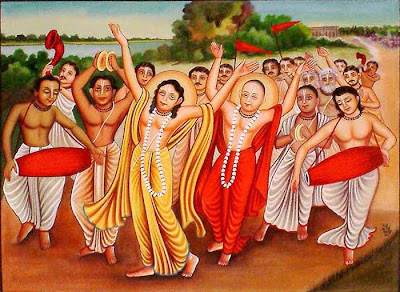
(A Pattachitra painting of Sri Chaitanya Dev)

The Bhakti movement in Indian literature focused on singular devotion, mystical love for God, and had a particular focus on a personal relationship with the Divine. Given their belief in the centrality of personal devotion, poet-saints were highly critical of ritual observances as maintained and fostered by the Brahmin priesthood. Though the Bhakti movement had its genesis in southern India in the 6th century AD, it didn’t gain momentum until the 12th century in the central western regions of India. It then moved northward, coming to an end roughly in the 17th century.

But strangely enough, if we compare the gender basis participation ratio of saint-poets, we find the inclusion of women in this movement was tempered. It is also true that there is little evidence to support any type of revolt against the patriarchal norms of the time. Women bhaktas (disciples) were simply staying largely within the patriarchal ideology that upheld the chaste and dutiful wife as ideal. These women transferred the object of their devotion and their duties as the “lovers” or “wives” to their Divine Lover or Husband. Nonetheless, that their poetry became an integral aspect of the Bhakti movement at large is highly significant and inspirational for many who look to these extraordinary women as ideal examples of lives intoxicated by love for the Divine.

Andal Thiruppavai (a 10th century Tamil poetess), Akka Mahadevi (a 12th century Kannad poetess), Janabai (a 13th century Marathi poetess), Meera Bai of 16th century in Hindi and Madhavi Dasi in that century in Oriya literature were some poetesses who wrote exquisite poetry that has been passed on through bards and singers throughout India. But strangely enough, they had to face the challenge from the patriarchal society, whereas no male poets of their time had to encounter such bitter experiences. These female poets were often blamed by their husbands for acting opposite to marital practices while no evidence was found that the wives of the male poet-saints raised voices against the divine love affairs of their husbands.

Complete Blog
here

(Submitted by Sarojini Sahoo)

Carvings From Cherokee Script’s Dawn


LETTERS Characters in a Kentucky cave that may be the earliest examples of the script

By JOHN NOBLE WILFORD
(NY Times)

The illiterate Cherokee known as Sequoyah watched in awe as white settlers made marks on paper, convinced that these “talking leaves” were the source of white power and success. This inspired the consuming ambition of his life: to create a Cherokee written language.

Born around 1770 near present-day Knoxville, Tenn., he was given the name George Gist (or Guess) by his father, an English fur trader, and his mother, a daughter of a prominent Cherokee family. But it was as Sequoyah that around 1809 he started devising a writing system for the spoken Cherokee language.

Ten years later, despite the ridicule of friends who thought him crazed, he completed the script, in which each of the 85 characters represented a distinct sound in the spoken tongue, and combinations of these syllables spelled words. Within a few years, most Cherokees had adopted this syllabary, and Sequoyah became a folk hero as the inventor of the first Native American script in North America.

It may be, as is often noted, that his achievement is the only known instance of an individual’s single-handedly creating an entirely new system of writing.
NY Times for more

Evolution faster when it’s warmer

By Victoria Gill
Science reporter, BBC News

The results could help explain why the warm tropics are so species-rich

Climate could have a direct effect on the speed of “molecular evolution” in mammals, according to a study.

Researchers have found that, among pairs of mammals of the same species, the DNA of those living in warmer climates changes at a faster rate.

These mutations – where one letter of the DNA code is substituted for another – are a first step in evolution.

The study, reported in Proceedings of the Royal Society B, could help explain why the tropics are so species-rich.

DNA can mutate and change imperceptibly every time a cell divides and makes a copy of itself.

But when one of these mutations causes a change that is advantageous for the animal – for example, rendering it resistant to a particular disease – it is often “selected for”, or passed down to the next few generations of that same species.

Such changes, which create differences within a population but do not give rise to new species, are known as “microevolution”.

BBC for more